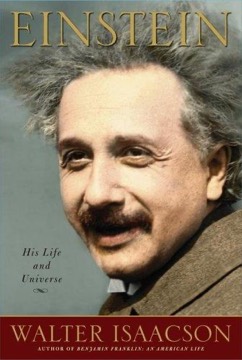
Einstein: His Life and Universe
Walter Isaacson's biography written with access to newly released personal papers — the physics explained for general readers, set against a life of exile, celebrity, political commitment and considerable personal failure.
- First published
- 2007
- Publisher
- Simon & Schuster
- Pages
- 704
- Shelf
- History
- Level
- Core
- ISBN-13
- 9788441540378
Record checked against
Catalogue note
- Reads as
- ReflectiveChanges how you see rather than what you do.
- Level
- Core / BuildingAssumes general familiarity with the subject.
- Approach
- Theoretical
- Written for
- Readers of history, Readers with some grounding
Saved in this browser only — no account, nothing sent anywhere. My library
Read this if
- You want a life told honestly, at full length.
- You want to know how the universe is put together.
- You want a book that changes how you see things rather than what you do tomorrow.
- You know roughly how the subject works and want the fuller account.
The archive
Isaacson wrote with access to Einstein's personal correspondence released shortly before, including letters about his first marriage and his children.
The material sharpened the portrait considerably. The saintly public figure is replaced by a man who was warm at a distance and frequently cold to the people closest to him, and the book does not soften this.
The released letters replaced the saintly public figure with a man warm at a distance and cold up close.
Devmark’s reading — not a quotation from the book
The rebellious student
His account of Einstein's school difficulties, his resistance to authority and rote instruction, and his failure to obtain an academic post after graduating.
Isaacson's argument is that the non-conformity was not incidental but methodological: a willingness to question assumptions that established physicists had stopped noticing is precisely what the 1905 work required.
The patent office and 1905
His treatment of the year in which Einstein, working as a patent examiner, published papers on the photoelectric effect, Brownian motion, special relativity and mass-energy equivalence.
The circumstances matter to Isaacson's argument. The work was done outside the academy, in spare hours, by someone with no supervisor and no institutional position to protect, which is part of why the questions could be asked at all.
The physics, explained
Isaacson works through special relativity via the relativity of simultaneity, and general relativity via the equivalence principle and the thought experiment of the accelerating lift.
The exposition is competent and accessible. Physicists have noted it is also conventional — Isaacson is relaying standard explanations well rather than offering new insight into the work.
The eclipse and celebrity
His account of the 1919 expedition confirming the deflection of starlight, and of the immediate global fame that followed — a scientist becoming a public figure on a scale without precedent.
His treatment of what the celebrity cost, and of how Einstein used it for political purposes, is one of the more interesting threads in the second half.
Mileva and the children
The most uncomfortable material. His first wife Mileva Marić was a physics student, their daughter born before marriage disappears from the record, and the conditions Einstein set for continuing the marriage — delivered in writing, as a list of duties — are reproduced in full.
The question of Marić's scientific contribution is contested; the evidence does not establish collaboration on the 1905 papers, and Isaacson reviews it without resolving more than the evidence allows.
Quantum mechanics and the long dissent
His account of Einstein's opposition to the Copenhagen interpretation, the debates with Bohr, and the EPR paper.
Isaacson is fair to both sides: Einstein was wrong about quantum mechanics being incomplete in the way he thought, and the EPR paper identified entanglement, which became one of the most important subjects in modern physics. Being wrong productively is its own kind of contribution.
He was wrong about quantum mechanics, and the paper making the case identified entanglement. Both are true.
Devmark’s reading — not a quotation from the book
Politics and the letter
His pacifism, his Zionism and his refusal of the Israeli presidency, his flight from Germany, and the letter to Roosevelt warning that Germany might build an atomic weapon.
Isaacson handles the letter carefully. Einstein signed rather than drafted it, played no part in the Manhattan Project, and later described the signature as his one great mistake.
The later years
His decades at Princeton pursuing a unified field theory while the field moved elsewhere, and his growing isolation from mainstream physics.
Isaacson treats this without condescension: the programme failed, the instinct behind it — that the forces should be unified — remains the goal of theoretical physics, and he was pursuing it half a century early.
As a book
It is long, readable and well balanced between the life and the work, which is the hardest thing to get right in a scientific biography.
Its limitations are that the physics is standard exposition and the analysis of the historical context is thinner than the personal narrative. For the science alone there are better sources; for the person, this is the standard account.
What to take away
- 01The non-conformity was the methodQuestioning assumptions established physicists had stopped noticing is what the 1905 work required.
- 02Outside the academy, in spare hoursNo supervisor and no position to protect is part of why those questions could be asked.
- 03Wrong productivelyHis dissent from quantum mechanics was mistaken and the paper making it identified entanglement.
- 04Warm at a distanceThe released letters show a man generous to humanity and frequently cold to the people nearest him.
- 05The unification instinct outlived the programmeHis late work failed and the goal behind it is still what theoretical physics is pursuing.