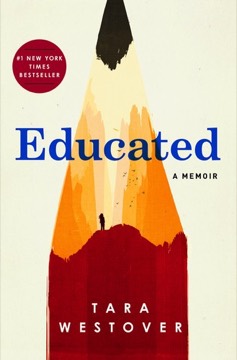
Educated
A Memoir
Tara Westover's memoir of growing up in a survivalist family in rural Idaho, kept from school and from hospitals, and of what it cost to arrive at a university at seventeen having never sat in a classroom.
- First published
- 2018
- Publisher
- Random House Publishing Group|isbn=978-0-399-59051-1|page=1
- Pages
- 388
- Shelf
- History
- Level
- Entry
- ISBN-13
- 9781443452472
Record checked against
Catalogue note
- Reads as
- ReflectiveChanges how you see rather than what you do.
- Level
- Accessible / FoundationalNo prior reading assumed.
- Approach
- Theoretical
- Written for
- Readers of history, Newcomers to the subject
Saved in this browser only — no account, nothing sent anywhere. My library
Read this if
- You want a life told honestly, at full length.
- You want to learn things that stay learned.
- You want a book that changes how you see things rather than what you do tomorrow.
- You are starting from scratch here and want a way in that assumes no prior reading.
What the book is
A memoir, and unusually careful about being one. Westover was the youngest of seven children in a family whose father distrusted the government, public education and medicine. She had no birth certificate for years, no schooling, and worked in her father's scrapyard.
The book follows her from that childhood to a doctorate at Cambridge. It is not a triumph narrative, and the parts that make it valuable are the ones that refuse to resolve.
Not a book about escaping a place. A book about what it costs to acquire the ability to disagree with your family.
Devmark’s reading — not a quotation from the book
What education means here
The title is doing more work than it appears to. Westover's subject is not schooling but the acquisition of a capacity — the ability to hold an interpretation of reality that differs from the one you were raised inside.
The book's most striking scenes are not academic achievements but moments of vocabulary: encountering a word or a fact that reorganises everything already known. Learning what the Holocaust was, at nineteen, in a lecture hall, is not presented as a gap being filled but as a floor giving way.
Memory, and the footnotes
The most intellectually serious thing about the book is how it handles the unreliability of its own material. Westover footnotes disagreements between her account and her siblings', notes where her own memory has changed, and marks passages she cannot verify.
This is rare in memoir and it strengthens the book considerably. She is a trained historian writing about events she cannot document, and she treats that as a methodological problem rather than a licence.
Physical danger, told plainly
A recurring feature of the childhood is severe injury — scrapyard accidents, burns, car crashes, head trauma — treated at home on principle rather than in hospital.
Westover narrates these without heightening, which makes them harder to read rather than easier. The effect is to show how a family's shared framework can absorb almost any evidence: each survival is taken as confirmation the framework was right.
Gaslighting, named precisely
The book contains one of the clearest lay accounts of what it is to have your perception of events systematically denied by people you love and depend on.
The mechanism Westover shows is not a single lie but the slow erosion of confidence in your own memory, to the point where documentation becomes necessary to believe yourself. Her journals, kept throughout, become the book's evidence and its subject at once.
The cost of leaving
The book's refusal of the easy shape is its main achievement. Education does not deliver a clean escape; it produces a person who no longer fits anywhere, and it costs her most of her family.
She is explicit that this is a loss rather than a price worth paying in some settled accounting. There is no scene in which the family understands, and the ending resolves almost nothing — which is the honest version.
There is no scene where they understand. The book's integrity is in declining to supply one.
Devmark’s reading — not a quotation from the book
What it avoids
Westover consistently declines several available moves. She does not present her family as simply ignorant; her father's intelligence and her mother's competence are both clear. She does not present formal education as straightforwardly good, and several academic figures in the book are useless or worse.
She also declines to diagnose. Her father's behaviour is described in detail and she raises the possibility of mental illness while refusing to assert it, which is both ethically careful and more disturbing than a diagnosis would be.
The disputed account
Members of Westover's family have publicly disputed parts of the book. This is worth knowing, and it does not have a clean resolution available to a reader.
What can be said is that the book anticipates the dispute, marks its own uncertainties, and does not claim the authority of documented history. A reader should hold it as one person's carefully qualified account of a contested past, which is what it presents itself as.
Where it is criticised
Some readers find the later sections less compelling than the childhood, as the narrative moves from a specific and strange world into a more recognisable academic one.
There is also a fair question about the book's reception: it has been read as a story about the redemptive power of higher education, which is close to the opposite of what it argues, and Westover has pushed back on that reading in interviews.
Why it matters
It is the clearest account available of what it is to change your mind about something foundational, and what that operation costs in relationships rather than in comfort.
Its most transferable idea is that the hard part of learning is not acquiring information but acquiring the standing to doubt — and that this is something a person can be denied without anyone ever forbidding a book.
What to take away
- 01Education is the capacity to disagreeNot information. The standing to hold a reading of reality different from the one you were raised inside.
- 02Frameworks absorb their own counter-evidenceEach survived accident was taken as proof the approach was right, which is how belief systems stay sealed.
- 03Footnote your own memoryWestover marks where her account and her siblings' diverge, which strengthens the book rather than weakening it.
- 04Changing your mind costs relationshipsThe price is not intellectual discomfort; it is people, and the book refuses to pretend otherwise.
- 05There is no reconciliation sceneIts integrity lies in declining to supply the resolution the shape of the story seems to promise.