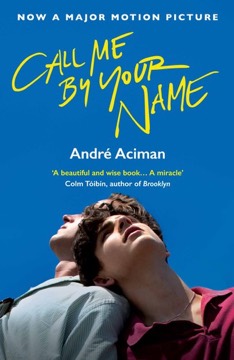
Call Me by Your Name
André Aciman's novel about six weeks in an Italian summer in the 1980s, when a seventeen-year-old falls for the twenty-four-year-old academic staying with his family.
- First published
- 2007
- Publisher
- Atlantic Books
- Pages
- 256
- Shelf
- Love
- Level
- Core
- ISBN-13
- 9781786499998
Record checked against
Catalogue note
- Reads as
- ReflectiveChanges how you see rather than what you do.
- Level
- Core / BuildingAssumes general familiarity with the subject.
- Approach
- Theoretical
- Written for
- Anyone thinking about how people attach, Readers with some grounding
Saved in this browser only — no account, nothing sent anywhere. My library
Read this if
- You read for the writing as much as for the argument.
- You want evidence about why people behave as they do, not folklore.
- You want to learn things that stay learned.
- You want a book that changes how you see things rather than what you do tomorrow.
- You know roughly how the subject works and want the fuller account.
The premise
Elio's father, a professor, hosts a doctoral student each summer at their house on the Italian Riviera. This year it is Oliver, American, confident, and in Elio's account almost unbearable.
The novel is the six weeks, and then a coda spanning twenty years.
Aciman wrote it in a few months after decades of teaching Proust, and that lineage shows in the method: a narrator reconstructing a short period at enormous length, from the far side of it.
Six weeks, narrated obsessively, and then twenty years compressed into a coda.
Devmark’s reading — not a quotation from the book
The narration
Aciman writes from inside adolescent obsession with unusual honesty: the compulsive reinterpretation of small gestures, the alternation between certainty and humiliation, the physical specificity most novels decline.
The prose is dense, digressive and interior. Very little happens externally; almost everything happens in Elio's reading of what happened.
Almost nothing occurs. Everything occurs in his interpretation of it.
Devmark’s reading — not a quotation from the book
The title
The exchange of names is the novel's central gesture and its idea: not possession but substitution, each person calling the other by their own name.
Aciman has said the book is about the fear of speaking and the cost of the delay, which is what the coda is for.
The coda, and the father
The final section, which most adaptations shorten, is where the novel makes its argument about regret and about lives arranged to avoid risk.
Elio's father's speech — that grief and joy are the price of having felt something, and that most people spend their lives economising — is the book's most quoted passage and is earned by everything preceding it.
Six weeks
The compression is doing the work. Almost the whole novel takes place inside a single Italian summer with a fixed end date that both parties know from the first page, and every scene is coloured by the deadline. Aciman is writing about anticipation and about the awareness of running out of time rather than about a relationship with a future.
They both know the date he leaves. Every page is written under that.
Devmark’s reading — not a quotation from the book
Elio's interiority
The narration is almost entirely internal: the obsessive rereading of gestures, conversations rehearsed in advance and then abandoned, humiliation imagined in detail before it can occur, and the constant recalculation of whether a look across a table meant anything at all. Aciman renders adolescent infatuation with a fidelity that a great many readers find uncomfortably accurate rather than romantic, which is the intended effect.
Desire and disgust
The novel is unusually frank about the physical, including moments of revulsion, shame and the body's ordinary indignity, and it refuses to keep desire tasteful. The much-discussed peach scene belongs to this pattern: the point is not shock but the collapse of any distance between wanting and embarrassment.
The house
The setting is specific and deliberately enclosed: a scholarly family, a villa in northern Italy, long meals, translation work done in the mornings, a swimming spot, a piano, and houseguests who arrive and leave. The family's annual ritual of hosting a visiting academic for six weeks supplies both the premise of the novel and its built-in, non-negotiable impermanence.
The ages
Elio is seventeen and Oliver twenty-four, in a country where that is legal, and the novel does not present it as transgressive on those grounds. Readers have argued about the gap since publication and more loudly since the film; the book is aware of the imbalance in experience without treating it as the subject.
Time afterwards
The last section jumps forward across twenty years in a few dozen pages, and it changes what the novel is about: not a summer but a life organised around one. The father's speech late in the book — permission offered rather than withheld — is the passage most readers carry away.
What to take away
- 01Six weeks and twenty yearsThe coda is where the novel makes its case.
- 02Adolescent obsession, honestlyCompulsive reinterpretation rendered without embarrassment.
- 03The name exchangeSubstitution rather than possession; the title's idea.
- 04The father's speechThe book's argument about economising on feeling.
- 05Interior, not eventfulThe action is in the narrator's reading of small things.