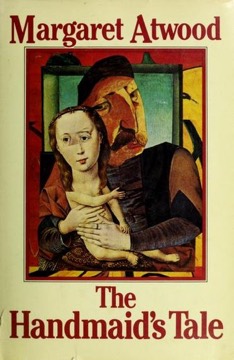
The Handmaid's Tale
Margaret Atwood's 1985 novel about Gilead, a theocratic regime built on the ruins of the United States, narrated by a woman assigned to bear children for a commander's household. Atwood's rule for writing it was that nothing in it would be invented.
- First published
- 1985
- Publisher
- Jonathan Cape
- Pages
- 352
- Shelf
- Fiction
- Level
- Core
- ISBN-13
- 9781984899668
Record checked against
Catalogue note
- Reads as
- ReflectiveChanges how you see rather than what you do.
- Level
- Core / BuildingAssumes general familiarity with the subject.
- Approach
- Theoretical
- Written for
- Readers of literature, Readers with some grounding
Saved in this browser only — no account, nothing sent anywhere. My library
Read this if
- You want a thought experiment you can live inside for a while.
- You want to think about how gender shapes a life, including your own.
- You want a book that changes how you see things rather than what you do tomorrow.
- You know roughly how the subject works and want the fuller account.
The premise
Environmental collapse has made most of the population infertile. A religious movement seizes the United States government and reorganises society around reproduction. Women lose their money, their jobs and their names. The narrator, called Offred, is a Handmaid: property of the household she is assigned to, valued only for a possible pregnancy.
She tells the story in fragments, in the present tense, with flashbacks to the months when the change happened and almost nobody stopped it.
The frightening part is not the regime. It is the ordinariness of the weeks in which it arrived.
Devmark’s reading — not a quotation from the book
How it is built
Offred's narration is deliberately unreliable about detail and explicit about why: she is reconstructing, she is tired, she is not sure. Atwood closes the book with an academic conference held long afterwards, studying the narrative as a historical artefact — a frame that both confirms Gilead ended and shows scholars being condescending about a woman's testimony.
The prose is short-breathed and sensory. Offred's world has been reduced to a room, a walk and a shopping errand, and the writing enacts that constriction.
Themes
Atwood's stated constraint was that every practice in Gilead had a historical precedent somewhere. The novel is therefore an argument that this is a recombination of things already done rather than a fantasy.
Its central insight is about complicity: Gilead runs on women policing women, and on the ordinary people who found the transition survivable.
Atwood called it speculative rather than science fiction, because nothing in it had to be invented.
Devmark’s reading — not a quotation from the book
Nothing invented
Atwood's stated constraint was that she would include no practice that had not already happened somewhere: enforced reproduction, public execution, book bans, the confiscation of women's bank accounts, children reassigned to politically approved families. She kept a file of clippings while writing. The novel's authority comes from that rule, and it is the answer to readers who find the regime implausible.
She refused to include anything that had not already been done somewhere by somebody.
Devmark’s reading — not a quotation from the book
How Gilead arrived
The takeover is described as sudden but procedurally ordinary: a suspended constitution after an attack blamed on extremists, then an electronic freeze on accounts held by women, then dismissal from employment. Offred remembers being surprised at how quickly it went through and how little anyone did, which is the book's most frequently cited passage for a reason.
Complicity among women
Gilead is enforced substantially by women: the Aunts who train and punish the Handmaids, and the Wives who supervise them in their own households. Atwood is specific that a system oppressing a category does not require solidarity within it, and that a small delegation of authority is enough to secure cooperation.
The language
The regime rewrites vocabulary as policy — patronymic names that mark ownership, greetings that must be answered in fixed formulae, scriptural phrasing used for every transaction. Offred's private wordplay and her memory of a Scrabble set become genuine resistance, because a controlled language is the mechanism rather than the decoration.
The Historical Notes
The novel ends with the transcript of an academic conference held long afterwards, in which a male scholar discusses Offred's recovered recording with detachment and a few jokes, declining to judge Gilead on cultural relativist grounds. It reframes everything before it and it is the sharpest thing in the book.
Where it has been criticised
The most substantial critique is that Gilead's practices — reproductive control, family separation, forced labour — were the lived experience of enslaved Black women in America, and that the novel transposes them onto white women while its Gilead has expelled Black citizens offstage. It is a serious objection and it does not require dismissing the book.
The afterlife
It has been a film, an opera, a long-running television series that continued far past the novel, and a protest costume used on legislature steps in several countries. Atwood published a sequel more than thirty years later. The novel's current meaning is inseparable from that reception, which is worth separating from the 1985 text while reading it.
What to take away
- 01Nothing inventedAtwood's rule was that every element had a historical precedent.
- 02The gradual takeoverThe flashbacks to the weeks of change are the most disturbing part of the book.
- 03Testimony under doubtThe closing frame shows historians treating a survivor's account as a curiosity.
- 04Women policing womenThe regime's enforcement layer is female, which is how it holds.
- 05Reduced world, reduced sentencesThe prose narrows as Offred's permitted world narrows.