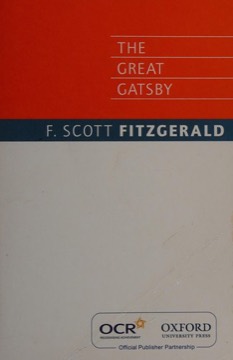
The Great Gatsby
F. Scott Fitzgerald's short novel of a man who assembles a fortune and a persona in order to recover a past that cannot be recovered — narrated by a neighbour who is both participant and judge.
- First published
- 1925
- Publisher
- Charles Scribner's Sons
- Pages
- 185
- Shelf
- Fiction
- Level
- Core
- ISBN-13
- 9798591068387
Record checked against
Two sources agreed on 1925; a third reported differently (openlibrary 1920, wikidata 1925, wikipedia 1925).
Catalogue note
- Reads as
- ReflectiveChanges how you see rather than what you do.
- Level
- Core / BuildingAssumes general familiarity with the subject.
- Approach
- Theoretical
- Written for
- Readers of literature, Readers with some grounding
Saved in this browser only — no account, nothing sent anywhere. My library
Read this if
- You read for the writing as much as for the argument.
- You want a book that changes how you see things rather than what you do tomorrow.
- You know roughly how the subject works and want the fuller account.
The narrator's position
Nick Carraway rents a small house next to Gatsby's mansion, is cousin to Daisy and an old acquaintance of Tom, and is therefore positioned between every party in the story.
He opens by claiming to reserve judgement and spends the novel judging. That contradiction is deliberate and it is the first thing to notice: the book's moral verdicts are his, and he is not a neutral instrument.
He opens by claiming to reserve judgement and then judges everyone. The verdicts are his, not the novel's.
Devmark’s reading — not a quotation from the book
The shape
It is very short — the length of a long novella — and almost nothing is wasted. The plot is simple: a man wants a woman he lost, arranges his life to reach her, reaches her briefly, and is destroyed by the consequences.
Fitzgerald's compression is the book's technical achievement. A social world, four major characters and an argument about America are all delivered in under two hundred pages.
Gatsby's construction
The revelation of who he was and how he became who he is arrives late and is delivered in pieces: the name change, the mentor, the war, the bootleg money, the years of deliberate self-invention.
The novel's interest is not in whether the fortune is criminal — it is — but in the fact that the entire apparatus exists for one purpose, and that the purpose is a woman he knew for a few weeks five years earlier.
Daisy
The most argued-over character. Whether she is a real person the novel declines to examine, or whether her thinness is the point — that Gatsby has constructed an idea and attached her name to it — divides readers.
Her line about hoping her daughter will be a beautiful fool is the closest the book comes to giving her an interior position, and it indicates a clearer view of her own situation than her behaviour otherwise suggests.
Tom and the violence underneath
Tom Buchanan's racial theorising, his casual infidelity, his physical brutality toward Myrtle, and his willingness to let another man take the consequences of what Daisy did.
He is the novel's statement about inherited money: careless, protected, and returning to safety while others absorb the damage. Nick's summary judgement of the Buchanans is the book's clearest moral statement.
The green light and the last page
The light at the end of Daisy's dock, the eyes on the billboard, the valley of ashes between the city and the suburbs — the novel's symbols are placed openly rather than buried.
The final page turns Gatsby's private longing into a general statement about the pull of an imagined past. It is the most quoted ending in American fiction and it is doing something specific: converting an individual failure into a national condition.
The final page converts one man's private failure into a claim about a whole country's relationship to its past.
Devmark’s reading — not a quotation from the book
The class argument
The novel is organised around distinctions its characters can perceive and the reader must learn: old money and new, the two Eggs, the city and the ash heaps between.
Gatsby's failure is social rather than romantic. He acquires the money and cannot acquire the thing money was supposed to buy, because the people who have it by inheritance can identify him instantly as someone who does not.
What is in the text about race and antisemitism
Tom's white-supremacist reading material and his anxieties are presented critically and are clearly attributed to a character the novel condemns.
Wolfsheim's portrayal is a different matter — it draws on antisemitic caricature without the same critical framing, and modern readers and critics have noted it. It should be read as what it is rather than passed over.
Its reception and revival
It sold modestly and Fitzgerald died believing himself a failure. Its standing came later, substantially through wartime distribution to American servicemen and subsequent inclusion in school curricula.
Its current position as a fixture of American education is almost entirely posthumous, which is a pattern it shares with several of the books it is usually listed beside.
Why it holds up
Because the prose is genuinely exceptional at the sentence level and the book is short enough to reread, which most people do.
And because the central mechanism — a person who believes the past can be repeated if enough is arranged around it — is recognisable in a way that does not depend on the period or the country.
What to take away
- 01Nick is not neutralHe claims to reserve judgement in the opening paragraphs and delivers verdicts throughout.
- 02The fortune has one purposeEverything Gatsby built exists to recover a few weeks from five years earlier.
- 03The failure is social, not romanticHe gets the money and cannot get what money was meant to buy, because inheritance can spot him.
- 04The Buchanans retreat into their moneyCareless, protected, and leaving others to absorb the consequences, which is the book's clearest judgement.
- 05Wolfsheim is not framed criticallyUnlike Tom's racial theorising, the caricature there is not held at a distance by the text.