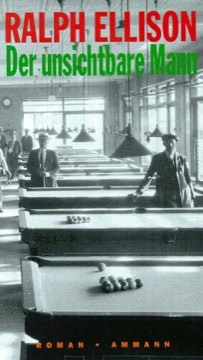
Invisible Man
Ralph Ellison's 1952 novel about an unnamed Black narrator moving from a Southern college to Harlem, discovering at every stage that he is seen only as whatever others need him to be.
- First published
- 1952
- Publisher
- Signet.
- Pages
- 480
- Shelf
- Fiction
- Level
- Deep
- ISBN-13
- 9781436104463
Record checked against
Catalogue note
- Reads as
- ReflectiveChanges how you see rather than what you do.
- Level
- Advanced / AdvancedAssumes you have read around the subject already.
- Approach
- Theoretical
- Written for
- Readers of literature, Specialists and serious readers
Saved in this browser only — no account, nothing sent anywhere. My library
Read this if
- You read for the writing as much as for the argument.
- You want a book that changes how you see things rather than what you do tomorrow.
- You have read around this already and want a book that assumes it.
The premise
The narrator begins underground, in a cellar lit by 1,369 stolen light bulbs, and tells how he got there. The invisibility of the title is social: people look at him and see a projection.
The route runs through a Black college modelled on Tuskegee, a paint factory, and a political organisation called the Brotherhood that recruits him for his voice and discards him when the line changes.
He is not unseen. He is seen as whatever the person looking needs him to be.
Devmark’s reading — not a quotation from the book
How it is written
Ellison moves between naturalism, surrealism and set pieces of near-hallucinatory intensity — the battle royal, the paint factory explosion, the Harlem riot — so the form itself refuses to settle into a single register.
Jazz structure is explicit in his own account: statement, improvisation, return. The novel is built to be read as variations rather than as a plot.
The argument
Ellison wrote against the protest novel as then practised, including Richard Wright's. His position was that reducing Black life to sociology was itself a form of erasure, and the novel insists on interiority, absurdity and comedy alongside the violence.
The Brotherhood sections are a direct critique of the Communist Party's instrumental use of Black members, drawn from Ellison's own experience.
Its standing
It won the National Book Award and has never been out of print. Ellison published no second novel in his lifetime, which is part of the book's mythology.
It is demanding — long, episodic, deliberately unstable in tone — and is usually read twice, because the prologue only makes sense once you have the rest.
What invisibility means
The narrator is not literally unseen; he is looked at and never perceived, because everyone he meets substitutes a category for a person. Ellison states this in the opening pages and then demonstrates it in every episode, with each group — white philanthropists, a Black college, a union, a political organisation — doing the same thing for different reasons.
He is looked at constantly. Nobody has ever once seen him.
Devmark’s reading — not a quotation from the book
The battle royal
The opening set piece, in which Black schoolboys are made to fight blindfolded for the entertainment of white townsmen before one delivers a speech about humility, establishes the book's method: a scene that functions as literal event and as complete allegory without either reading cancelling the other.
The college
The section at the Southern Black college is among the novel's most uncomfortable, because the betrayal comes from within: a president who maintains his institution by managing white patrons and who destroys a student for showing them something true. Ellison's criticism runs in every direction.
The Brotherhood
The political organisation that recruits him for his oratory, gives him a new name and then discards him when the line changes is drawn from Ellison's own period close to the Communist Party. The charge is specific: he is valued as an instrument and never as an analyst of his own community's situation.
Jazz as structure
Ellison was a trained musician and the novel is built on improvisation over changes — episodes as solos, recurring motifs, sudden shifts of register from naturalism to surrealism. The prologue's account of listening to a recording while suspended in light is the book explaining its own form.
One novel
He published no second novel in his lifetime despite decades of work, part of which was lost in a fire and part of which appeared posthumously. The absence is part of the book's standing: a single, enormous, completely achieved novel followed by forty years of an unfinished one.
What to take away
- 01Invisibility as projectionBeing seen as what the viewer requires.
- 02Jazz structureStatement, improvisation and return, by Ellison's own account.
- 03Against the protest novelWritten in opposition to reducing Black life to sociology.
- 04The BrotherhoodA direct critique of instrumental political recruitment.
- 05Read the prologue lastIt resolves only once the rest is behind you.