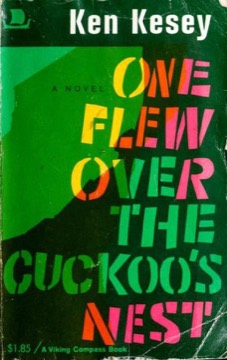
One Flew Over the Cuckoo's Nest
Ken Kesey's 1962 novel about an Oregon psychiatric ward, the head nurse who runs it, and the new patient who decides to contest her authority. Narrated by a patient everyone believes is deaf and mute.
- First published
- 1962
- Publisher
- Penguin Putnam~mass
- Pages
- 311
- Shelf
- Fiction
- Level
- Core
- ISBN-13
- 9782253016076
Record checked against
Catalogue note
- Reads as
- ReflectiveChanges how you see rather than what you do.
- Level
- Core / BuildingAssumes general familiarity with the subject.
- Approach
- Theoretical
- Written for
- Readers of literature, Readers with some grounding
Saved in this browser only — no account, nothing sent anywhere. My library
Read this if
- You read for the writing as much as for the argument.
- You want evidence about why people behave as they do, not folklore.
- You want a book that changes how you see things rather than what you do tomorrow.
- You know roughly how the subject works and want the fuller account.
The premise
Chief Bromden, a large Native American man who has not spoken in years and is assumed to be deaf, narrates. Randle McMurphy arrives having faked insanity to escape a prison work farm and finds a ward organised around Nurse Ratched's absolute and quiet control.
McMurphy begins contesting it, mostly for amusement, and the stakes rise until they are not amusing.
The narrator is the man everyone in the ward has decided cannot hear them.
Devmark’s reading — not a quotation from the book
The narrator
Bromden's perception is unreliable in a specific way: he describes machinery in the walls, fog filling the ward, a Combine that processes people. These are hallucinations and they are also an accurate description of the institution.
Kesey worked night shifts in a veterans' psychiatric hospital and wrote parts of the book under peyote, which produced the narration's doubled quality.
His hallucinations are wrong about the facts and right about the place.
Devmark’s reading — not a quotation from the book
What it argues, and its problem
The novel is a genuine indictment of institutional psychiatry in the era of electroconvulsive therapy without consent and of lobotomy, and it contributed to real reform.
It is also, by wide agreement, misogynist in its construction: the oppressive institution is embodied in a woman whose power is coded as sexual denial, and the liberatory force is aggressive masculinity. That reading is not a modern imposition and should travel with the book.
Its standing
Enormously influential on the anti-psychiatry movement and on American fiction, and frequently challenged in schools.
The 1975 film removed Bromden's narration entirely, which removes the thing that makes the novel unusual. Kesey disliked it and never watched it.
Kesey wrote it in his twenties after volunteering for CIA-funded psychoactive drug trials at the same hospital, a detail that is frequently reported as anecdote and is genuinely relevant to the book's perception of institutions.
The Combine
Chief Bromden perceives society as a vast machine that processes people into compliance, with the ward as one small installation. Kesey delivers this as hallucination — fog machines, hidden wiring, walls that move — and the novel's achievement is that the paranoid account turns out to describe the institution's actual function accurately.
The narrator's delusion is a wildly inaccurate picture of the walls and a very accurate one of the purpose.
Devmark’s reading — not a quotation from the book
A narrator nobody watches
Bromden is assumed to be deaf and mute, so staff speak freely in front of him. It is an elegant solution to a narrative problem: a first-person witness with unrestricted access, whose own unreliability is established on the first page, and whose gradual recovery of speech is the book's actual plot.
Where it came from
Kesey worked night shifts as an orderly in a veterans' hospital psychiatric ward and volunteered for government-funded drug trials involving LSD and similar compounds. The ward routines, the medication rounds and the group sessions are reported from observation, which is why the procedural detail is convincing even where the argument is not.
The therapy on trial
The novel indicts specific mid-century practice: the group session used to extract humiliation, electroconvulsive therapy administered punitively, and lobotomy as a final disposal. These were real and were being contested at the time, which is why the book functioned as polemic rather than only as fiction.
The problem with Nurse Ratched
The book's serious weakness is its treatment of women, who are either castrating authority figures or compliant sexual rewards, and its equation of liberation with the reassertion of masculinity. The critique has been made consistently since the 1970s and it is not a modern imposition — the novel's politics are genuinely tangled.
The film and the narrator
The 1975 adaptation swept the major Academy Awards and removed Bromden's narration entirely, shifting the centre of the story from the Chief to McMurphy and turning a novel about perception into a drama about defiance. Kesey objected to the change, took legal action over his contract, and said he never watched the finished film. Readers arriving from it are missing the single element that makes the novel formally interesting.
What to take away
- 01A narrator presumed deafEveryone speaks freely in front of him, which is how he knows everything.
- 02The CombineHallucinated machinery that accurately describes the institution.
- 03Written from night shiftsKesey worked in a psychiatric hospital while writing.
- 04A real indictmentContributed to reform of consent and psychosurgery practice.
- 05A serious objectionIts gender politics are widely and reasonably criticised.