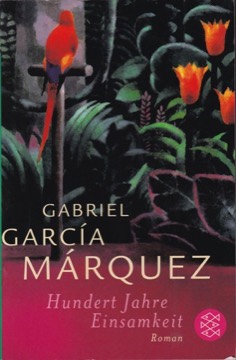
One Hundred Years of Solitude
Gabriel García Márquez's chronicle of seven generations of the Buendía family in the town of Macondo — the defining work of magical realism, in which the extraordinary is narrated in the same register as the mundane.
- First published
- 1967
- Publisher
- Cambridge University Press |location=Cambridge |page=50 |quote=One Hundred Years of Solitude is a family saga, or indeed, if one prefers, a postmodernist parody of a family saga.
- Pages
- 432
- Shelf
- Fiction
- Level
- Deep
- ISBN-13
- 9783462015096
Record checked against
Catalogue note
- Reads as
- ReflectiveChanges how you see rather than what you do.
- Level
- Advanced / AdvancedAssumes you have read around the subject already.
- Approach
- Theoretical
- Written for
- Readers of literature, Specialists and serious readers
Saved in this browser only — no account, nothing sent anywhere. My library
Read this if
- You read for the writing as much as for the argument.
- You want a book that changes how you see things rather than what you do tomorrow.
- You have read around this already and want a book that assumes it.
The register
The novel's defining technique is tonal. Ascensions, plagues of insomnia, rain that lasts years and a trail of blood that navigates a town are reported in exactly the same matter-of-fact voice as meals and marriages.
García Márquez attributed the voice to his grandmother, who told extraordinary stories with a completely straight face. The refusal to mark the marvellous as marvellous is what distinguishes the mode from fantasy.
Nothing is marked as marvellous. That refusal is what separates the mode from fantasy.
Devmark’s reading — not a quotation from the book
Macondo
The town founded by José Arcadio Buendía and Úrsula, initially isolated, then reached by gypsies, then by government, then by a banana company, then abandoned.
Its arc — founding, discovery, exploitation, decay — is a compressed history of Latin America, and the novel's political content is carried almost entirely through what happens to the town rather than through commentary.
The repeating names
The Buendías reuse a small set of names across generations, with characteristics recurring alongside them: the Aurelianos withdrawn and lucid, the José Arcadios impulsive and physical.
This is the most common obstacle for readers and it is deliberate. The family cannot escape its patterns, and the confusion of one generation with another is an effect the novel wants the reader to experience rather than a failure of clarity. Most editions include a family tree, and using it is not cheating.
Solitude
The title's subject and the family's inherited condition. Every Buendía is isolated in some fashion — in obsession, in workshops, in beds, in war, in the reading of manuscripts — and none manages a connection that lasts.
The novel's diagnosis is that the solitude is what perpetuates the cycle: people who cannot reach each other cannot learn from each other, and each generation repeats what it could have been told.
The banana company massacre
The novel's most direct political passage: workers striking, an army response, thousands killed, the bodies removed by train, and an official account stating that nothing happened.
It is based on the 1928 Ciénaga massacre of United Fruit workers in Colombia. The novel's treatment — a single survivor whom nobody believes, and an entire town that accepts the official version — is a statement about historical erasure that the surrounding fantasy makes more rather than less pointed.
One survivor nobody believes and a town that accepts the official denial. The fantasy makes the point sharper.
Devmark’s reading — not a quotation from the book
Time
The novel's structure is circular rather than linear. Events recur, characters sense they are living something already lived, and the narration moves freely across decades within single sentences.
Its famous opening sentence holds three time frames at once — a future moment, a present act of remembering and a distant past — and establishes the temporal method in a single line.
The ending
The final pages, in which the last Buendía deciphers a manuscript that turns out to contain the family's entire history including the moment of his reading it.
The novel closes on itself, and the reader finishes the book at the same moment the character does. It is one of the most discussed endings in twentieth-century fiction.
Where it is difficult
Beyond the names: it has no conventional plot, no protagonist sustained across the book, and a great deal happens to people the reader has only just met.
The treatment of women and of sexuality has also drawn substantial criticism, particularly several passages involving very young characters, and readers should not be surprised by them.
Its reception
It sold in enormous numbers across the Spanish-speaking world immediately and was central to the Latin American Boom, and García Márquez received the Nobel Prize in 1982.
Its influence on world fiction is extensive, and it also produced a large quantity of imitation, which is why magical realism became a marketing category and partly why García Márquez expressed impatience with the term.
How to read it
With the family tree beside you, in reasonably long sittings, and without attempting to hold every character — the blurring is the effect.
Gregory Rabassa's English translation is regarded highly, including by the author, who reportedly considered it an improvement on his original in places.
What to take away
- 01The marvellous is not markedAscensions and rainstorms of years are reported in the same voice as meals, which is the whole technique.
- 02The repeating names are the argumentThe family cannot escape its patterns, and the reader's confusion is an intended effect.
- 03Solitude perpetuates the cyclePeople who cannot reach each other cannot pass on what they learned, so each generation repeats it.
- 04The massacre is historicalBased on the 1928 killing of United Fruit workers, and the official denial is the point.
- 05The book closes on itselfThe last Buendía reads the manuscript describing the moment of his reading it.