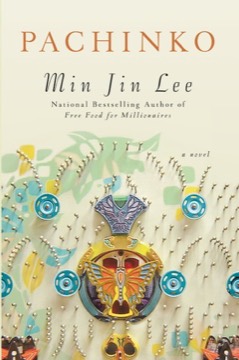
Pachinko
Min Jin Lee's four-generation novel about a Korean family in Japan, beginning in 1910 and running to the late twentieth century. About a minority that has lived in a country for generations and is still, formally, foreign.
- First published
- 2017
- Publisher
- Grand Central Publishing
- Pages
- 512
- Shelf
- Fiction
- Level
- Core
- ISBN-13
- 9781478967439
Record checked against
Catalogue note
- Reads as
- ReflectiveChanges how you see rather than what you do.
- Level
- Core / BuildingAssumes general familiarity with the subject.
- Approach
- Theoretical
- Written for
- Readers of literature, Readers with some grounding
Saved in this browser only — no account, nothing sent anywhere. My library
Read this if
- You read for the writing as much as for the argument.
- You want to know how we got here.
- You want a book that changes how you see things rather than what you do tomorrow.
- You know roughly how the subject works and want the fuller account.
The premise
Sunja is the daughter of a boarding-house keeper in Japanese-occupied Korea. Pregnant by a married man, she accepts a marriage proposal from a sickly minister travelling to Osaka, and emigrates.
What follows is her family in Japan across the century: her sons, their work, their concealment of Korean names, and the pachinko parlours that become one of the few businesses open to Zainichi Koreans.
The novel opens by conceding that history failed this family, and then declining to dwell on it.
Devmark’s reading — not a quotation from the book
How it is built
Lee writes long, plain, close third person that moves between family members across decades. There is no single protagonist after the first section; the book is about a lineage rather than a life.
She spent years interviewing Zainichi Koreans in Japan and rewrote the novel substantially after doing so. The texture — registration papers, fingerprinting, school bullying, which names are used where — is documentary.
Pachinko is legal, profitable, faintly disreputable, and one of the few doors left open. Hence the title.
Devmark’s reading — not a quotation from the book
Themes
The central subject is a discrimination that is bureaucratic rather than dramatic: residency status, family registers, the question of whether to naturalise, and what each generation is willing to give up to be ordinary.
Against that the book is about work and endurance — a family that keeps going without a redemptive arc, because the novel does not believe one was available.
The first sentence
The novel opens by stating flatly that history has failed this family, and then declines to dwell on the grievance for the next five hundred pages. The sentence functions as a licence: having conceded the injustice at the outset, Lee is free to write about work, money, sons and marriages rather than producing a book that argues.
History has failed them. The novel says so once, on the first line, and then gets on with the living.
Devmark’s reading — not a quotation from the book
What Zainichi means
The central fact most readers arrive without is that Koreans who came to Japan under colonial rule, and their Japanese-born descendants, were stripped of citizenship after the war and left as resident foreigners. The discrimination in the book is therefore legal and bureaucratic before it is social, and it is inherited.
Registration and names
The recurring machinery is paperwork: alien registration renewed with fingerprints, family registers, and the Japanese names used at school and the Korean ones used at home. Lee shows a family managing two identities as an administrative routine, and the exhaustion of it accumulates across generations.
Why pachinko
The parlours are legal, lucrative, faintly disreputable, and one of the few industries open to a group locked out of respectable employment. The title is an argument: the family's prosperity is real and permanently marked, and their success is built on the one door that was left unlocked.
A lineage, not a life
After the opening section the protagonist changes every generation, and the novel accepts the cost — characters the reader has invested in recede and die offstage. The form follows the subject: this is a book about what is transmitted through a family rather than about any individual's arc.
What the research changed
Lee worked on the book for decades and rewrote it substantially after moving to Tokyo and interviewing Zainichi Koreans directly. Her account is that the earlier draft was about victimhood and the interviews replaced it with ordinary people with jobs and opinions, which is visible in the finished texture.
No redemptive arc
Nothing in the novel resolves: the legal position does not change, the prejudice does not lift, and the last generation is still negotiating it in a different register. Lee declines the shape a family saga is expected to take, because she does not believe the history supplied one.
What to take away
- 01A lineage, not a lifeThe protagonist changes every generation; the subject is the family.
- 02Bureaucratic prejudiceDiscrimination here is paperwork, registration and names rather than spectacle.
- 03The title's tradePachinko is the business a closed society leaves open, with the stigma attached.
- 04Researched textureLee's interviews with Zainichi Koreans rebuilt the novel.
- 05No redemptive arcEndurance is the shape of the book, because it was the shape available.