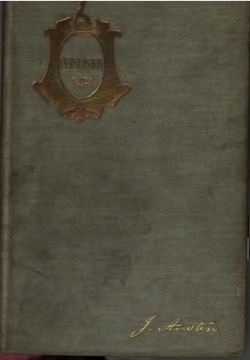
Persuasion
Jane Austen's last completed novel, published after her death in 1817. Anne Elliot, twenty-seven, refused a proposal eight years ago on advice she now doubts, and the man has returned. Austen's quietest and most adult book.
- First published
- 1817
- Publisher
- Xist Publishing
- Pages
- 268
- Shelf
- Love
- Level
- Core
- ISBN-13
- 9780553904567
Record checked against
Catalogue note
- Reads as
- ReflectiveChanges how you see rather than what you do.
- Level
- Core / BuildingAssumes general familiarity with the subject.
- Approach
- Theoretical
- Written for
- Anyone thinking about how people attach, Readers with some grounding
- Ideas
Saved in this browser only — no account, nothing sent anywhere. My library
Read this if
- You want to understand why people attach to each other the way they do.
- You want a book that changes how you see things rather than what you do tomorrow.
- You know roughly how the subject works and want the fuller account.
The premise
Anne Elliot was persuaded at nineteen to refuse Frederick Wentworth, a naval officer with no fortune, by a family friend acting in what she believed were Anne's interests. Wentworth has since made his fortune in the Napoleonic wars. He returns to her circle, successful and evidently still angry.
Anne's family is vain and in financial trouble. She is the middle daughter nobody consults, and the novel spends a great deal of time on how it feels to be present and not attended to.
The book begins after the mistake. Everything in it is about living with a decision you cannot revisit.
Devmark’s reading — not a quotation from the book
How it is different
Austen's earlier heroines learn something and are rewarded. Anne has already learned it, eight years ago, and the novel is about endurance rather than education. There is no comic reversal of her character because there is nothing wrong with it.
The prose carries more interiority and less social comedy than Emma or Pride and Prejudice. Free indirect style, which Austen largely developed, is used here to sit inside a woman who says very little aloud.
This is the Austen novel about regret, written by someone who was dying.
Devmark’s reading — not a quotation from the book
Themes
Persuasion asks whether Anne was wrong to be persuaded, and refuses a tidy answer. The novel takes seriously that prudent advice can be both well-meant and ruinous.
It is also Austen's most pointed book about class in motion. The Royal Navy supplies men who earned their money, set against a baronet who is mortgaging his estate to keep up appearances, and the novel's sympathies are entirely clear.
The last one
It was completed shortly before Austen's death and published posthumously with another novel, and it reads unlike the others: quieter, more interior, with less comic machinery and a heroine already past the age the marriage plot usually addresses. It is the work of someone who no longer needs to demonstrate anything.
Eight years late
The courtship happened before the book begins, and was ended by advice Anne accepted. The novel therefore opens with a relationship already failed and asks whether prudence was wisdom or cowardice — a question Austen leaves genuinely open, and one the earlier novels never risked.
The love story is over before page one. What the novel examines is the eight years afterwards.
Devmark’s reading — not a quotation from the book
Being unheard
Anne spends much of the book being talked over, sent for, relied on and not consulted. Austen renders this from inside with unusual technical skill: the free indirect style lets the reader sit in a consciousness that is fully present and socially invisible, which is the novel's strongest effect.
The navy against the landed
The Elliots are ruinously vain and financially incompetent; the naval officers have money they earned and manners that are plain. Austen, with two brothers in the service, sets merit against inheritance more directly here than anywhere else in her work, and the landed party does not survive the comparison.
The fall at Lyme
The novel's one dramatic incident is an accident on a harbour wall, and it functions as an examination: everyone present is judged by what they do in the following minutes. It is the point at which the book's real hierarchy of character is settled, and it is settled against the people with rank.
The letter
The declaration near the end, written while its author is ostensibly doing something else in the same room, is among the most admired passages Austen wrote. It works because it answers a conversation Anne is having with someone else, which means both parties speak honestly for the first time without addressing each other.
Two endings
Austen wrote a version of the resolution, discarded it, and rewrote the ending entirely; both survive, which is almost unique in her work. The cancelled chapters resolve matters more conventionally and more quickly, through an overheard conversation; the replacement produces the letter. It is a rare chance to watch a great novelist reject the easier solution she had already finished and reach for the harder and considerably better one.
What to take away
- 01After the mistakeThe novel opens eight years past its own turning point.
- 02A heroine who was already rightAnne has nothing to learn, which changes what the book can be about.
- 03Being unheardMuch of the novel is the experience of speaking and not being registered.
- 04Earned versus inheritedThe Navy against the baronetcy; Austen is not neutral.
- 05The letterWentworth's letter is among the most famous passages in English fiction, and it is a piece of restraint.