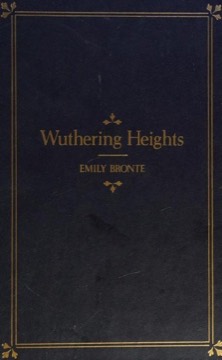
Wuthering Heights
Emily Brontë's only novel, published in 1847 under the name Ellis Bell: two generations on the Yorkshire moors, narrated at two removes, and almost entirely populated by people behaving badly.
- First published
- 1847
- Publisher
- Ediciones Destino
- Pages
- 318
- Shelf
- Love
- Level
- Core
- ISBN-13
- 9781985682313
Record checked against
Catalogue note
- Reads as
- ReflectiveChanges how you see rather than what you do.
- Level
- Core / BuildingAssumes general familiarity with the subject.
- Approach
- Theoretical
- Written for
- Anyone thinking about how people attach, Readers with some grounding
Saved in this browser only — no account, nothing sent anywhere. My library
Read this if
- You want to be kept up late, and made uneasy about who to believe.
- You want to understand why people attach to each other the way they do.
- You want a book that changes how you see things rather than what you do tomorrow.
- You know roughly how the subject works and want the fuller account.
The premise
Mr Lockwood rents Thrushcross Grange and, curious about his landlord Heathcliff, gets the story from Nelly Dean, the housekeeper who has served both houses. Everything the reader learns is Nelly telling Lockwood.
The story covers two generations: Heathcliff's arrival as a foundling, his bond with Catherine Earnshaw, her marriage elsewhere, and the long campaign of revenge he conducts against two families and their children.
Every event reaches you through a housekeeper telling a stranger, and she is not neutral.
Devmark’s reading — not a quotation from the book
How it is built
The double frame is the novel's most underrated feature. Nelly is a participant with her own interests, and Lockwood is obtuse, so the reader is receiving a partial account from an unreliable teller through a foolish listener.
The chronology is exact — Brontë tracks dates and ages with unusual precision — which makes the structural coldness more striking against the emotional extremity.
What it is not
It is not a romance, and reading it as one produces an incoherent book. Heathcliff and Catherine's bond is presented as destructive to everyone including themselves, and the novel's second half is entirely about the damage inflicted on the next generation.
Contemporary reviewers found it brutal and morally shocking, which is a more accurate reading than the popular one.
The novel's second half exists to show what the famous first half did to everyone else's children.
Devmark’s reading — not a quotation from the book
Its standing
Dismissed or bewildered at publication and now among the most studied English novels, partly for the narrative architecture and partly for Heathcliff, whose racial ambiguity and class position the text keeps deliberately unresolved.
Charlotte Brontë's 1850 preface, apologising for her sister's roughness, is itself a document worth reading.
Two unreliable narrators
Everything reaches the reader through Lockwood, an outsider who understands almost nothing, relaying Nelly Dean, a servant with forty years of involvement and her own interests. Nothing in the novel is witnessed directly. The structure is the reason the central relationship can be read as transcendent or as monstrous — the text never speaks for itself.
There is no neutral account anywhere in this book. There is only Nelly, and Nelly was involved.
Devmark’s reading — not a quotation from the book
Two generations
Half the novel takes place after the famous characters are dead, following their children. Readers who expect it to end with the first generation frequently find the second half a disappointment; it is in fact the argument, showing damage repeating and then, unusually for Brontë, being interrupted.
Property
The plot is driven by inheritance law, entailment, marriage settlements and who holds the deeds to two houses. Heathcliff's revenge is conducted almost entirely through acquisition and legal manoeuvre rather than violence, and the novel is far more interested in title deeds than its reputation suggests.
Where he came from
Heathcliff is found on the streets of Liverpool, a slaving port, and is described in terms that mark him as racially other without ever specifying what he is. That deliberate blank has generated substantial scholarship, and it is inseparable from how the household treats him from the first day.
Not a romance
The relationship at the centre involves cruelty to animals, children, servants and each other, and neither principal is presented as admirable. Readers arriving from the novel's cultural reputation as a great love story are routinely shocked, and the shock is the correct response rather than a misreading.
Its first reception
Published under a male pseudonym, it was widely found brutal and coarse, and Charlotte's preface to the posthumous edition partly apologised for her sister. Its elevation to the canon took decades, and the softening in adaptations largely postdates that — the original was never intended to be comfortable.
What to take away
- 01A doubly filtered storyNelly tells Lockwood; both are compromised as narrators.
- 02Two generationsThe second half is the consequence of the first.
- 03Not a romanceThe central bond is destructive and the novel says so repeatedly.
- 04Exact chronologyDates and ages tracked precisely under the emotional extremity.
- 05Heathcliff unresolvedRace, class and origin deliberately never settled.