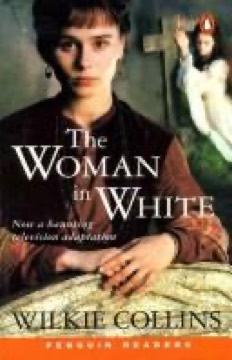
The Woman in White
Wilkie Collins's 1859 sensation novel, which begins with a woman in white stopping a man on a moonlit road outside London and turns into a case about identity, inheritance and asylum committal.
- First published
- 1859
- Publisher
- HarperCollins Publishers
- Pages
- 544
- Shelf
- Mystery
- Level
- Core
- ISBN-13
- 9781346217512
Record checked against
Catalogue note
- Reads as
- ReflectiveChanges how you see rather than what you do.
- Level
- Core / BuildingAssumes general familiarity with the subject.
- Approach
- Theoretical
- Written for
- Readers who want to be kept up late, Readers with some grounding
- Ideas
Saved in this browser only — no account, nothing sent anywhere. My library
Read this if
- You want to be kept up late, and made uneasy about who to believe.
- You want a book that changes how you see things rather than what you do tomorrow.
- You know roughly how the subject works and want the fuller account.
The premise
Walter Hartright, a drawing master, encounters a distressed woman dressed entirely in white who has escaped from an asylum. He then takes a post at Limmeridge House and discovers that one of his pupils, Laura Fairlie, is her near double.
Laura's marriage to Sir Percival Glyde, and the involvement of Count Fosco, proceeds into a conspiracy about property, identity and the ease with which a woman could be confined.
Two women who look alike, one large inheritance, and a legal system with no defence against either fact.
Devmark’s reading — not a quotation from the book
The form
Collins constructs the novel as testimony: multiple narrators each giving evidence about what they personally witnessed, arranged as a legal case would be. He had trained as a barrister and the structure shows.
The effect is that the reader assembles the crime the way a jury would, from partial accounts by people with different levels of understanding and honesty.
It is arranged as a legal case, by a writer who had trained for the bar.
Devmark’s reading — not a quotation from the book
Why it matters
It effectively created the sensation novel, and through it the modern thriller: a crime concealed inside a respectable household, discovered by ordinary people rather than by police.
Count Fosco — enormous, charming, keeps mice in his pockets — is one of the first genuinely modern villains, dangerous because he is likeable rather than despite it.
What it is about
Married women's property, and the legal position of a wife whose husband controls her money and can have her declared insane. Collins is writing about a real and current vulnerability.
It is long and serialised, with the pacing that implies — chapter endings engineered for a weekly wait — and is considerably more readable than its length suggests.
Marian Halcombe
The novel's genuine protagonist is not the drawing master or the heiress but Marian: intelligent, resourceful, plainly described as unattractive by the standards the book itself keeps invoking, and the only person who consistently acts. She was recognised on publication as something new in fiction, and she still reads as the most modern person in the book.
Count Fosco
The villain is enormously fat, impeccably courteous, devoted to small animals and entirely without conscience, and he is the reason the novel is still read. Collins gives him charm, intellect and a genuine admiration for Marian, which makes him far more dangerous than the conventional aristocratic brute he works alongside.
He is polite, affectionate to his pet mice, and the most frightening person in the book.
Devmark’s reading — not a quotation from the book
Testimony
Collins's preface explains that the story will be told by several pens in the way evidence is presented in court, each witness speaking only to what they can attest. The device gives the book its momentum and its unusual credibility, and it was borrowed from his own interest in the law rather than invented for effect.
Fosco's postscript
The novel's most startling moment is the discovery that a private diary has been read by the person it describes, who then adds an appreciative note to it. In a book built on documents, the violation of one is worse than a threat, and it lands harder than any physical menace in the plot.
What it is really about
Underneath the mystery is the legal position of married women: property passing to a husband on marriage, the ease with which a woman could be committed to an asylum, and the near-impossibility of proving an identity once the paperwork said otherwise. The sensation plot is a delivery mechanism for a real grievance.
Serialisation
It ran weekly in Dickens's magazine and the structure shows: chapters end on hooks, information is rationed, and the pace is calibrated to a reader waiting seven days. Read straight through it is long and occasionally repetitive; read a few chapters at a time it works as designed.
What to take away
- 01Testimony as structureMultiple witnesses arranged as legal evidence.
- 02The sensation novelCrime concealed inside a respectable house, found by amateurs.
- 03Count FoscoCharming and enormous; dangerous because he is likeable.
- 04Married women's propertyThe legal vulnerability the plot actually runs on.
- 05Serialised pacingChapter endings built for a weekly wait.