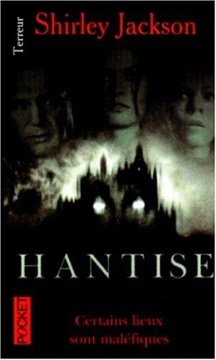
The Haunting of Hill House
Shirley Jackson's 1959 novel about four people who spend a summer in a house with a reputation, and about one of them in particular. The most influential haunted-house novel in English, and the one least interested in showing you a ghost.
- First published
- 1959
- Publisher
- Pages
- 253
- Shelf
- Mystery
- Level
- Core
- ISBN-13
- 9782266097802
Record checked against
Two sources agreed on 1959; a third reported differently (openlibrary 1999, wikidata 1959, wikipedia 1959).
Catalogue note
- Reads as
- ReflectiveChanges how you see rather than what you do.
- Level
- Core / BuildingAssumes general familiarity with the subject.
- Approach
- Theoretical
- Written for
- Readers who want to be kept up late, Readers with some grounding
- Ideas
Saved in this browser only — no account, nothing sent anywhere. My library
Read this if
- You want to be kept up late, and made uneasy about who to believe.
- You want a book that changes how you see things rather than what you do tomorrow.
- You know roughly how the subject works and want the fuller account.
The premise
Dr Montague, an academic looking for evidence of the supernatural, rents Hill House for a season and invites people who have had unexplained experiences. Two accept: Theodora, confident and sociable, and Eleanor Vance, who has spent eleven years caring for her invalid mother and has never had a life of her own. Luke, the heir to the house, joins them.
Things happen in the house. What the novel is actually watching is Eleanor, for whom Hill House is the first place that has ever seemed to want her.
The famous first paragraph is about a house that is not sane. The book is about a person who is not either.
Devmark’s reading — not a quotation from the book
How it is built
Jackson's technique is omission. The frights are almost entirely sound, cold and writing on walls; nothing is ever displayed. The prose stays in close third person on Eleanor, and it slides — sentences begin as narration and end somewhere more interior without marking the transition.
The result is a book with no reliable outside. There is no point at which an authoritative voice confirms what is in the house, and Jackson refuses that confirmation deliberately and to the end.
Nothing is shown. The reader supplies the ghost, which is why it works.
Devmark’s reading — not a quotation from the book
Themes
Loneliness is the engine. Eleanor's hunger to belong is established before anything supernatural occurs, and every later event can be read as the house exploiting it or as her mind doing so. The novel holds both readings open without preferring either.
Under that sits a sharper point about women with no independent life. Eleanor has no money, no home of her own and no practice at being wanted. Jackson wrote repeatedly about women constrained in exactly this way, and the horror here is inseparable from the constraint.
Why it matters
Almost every serious haunted-house story since owes something to this book, and most of them take less care. The decision never to explain, and never to let the reader stand outside the protagonist's perception, is the thing imitators usually lose.
It is also the cleanest demonstration in the genre that atmosphere is structural rather than decorative: the dread comes from what the sentences withhold, not from what the house contains.
The first paragraph
The novel opens with a short passage about what happens to any living thing kept too long in absolute reality, ending on the observation that whatever walked in the house walked alone. It is among the most quoted openings in the language and it states the book's entire argument before a character has appeared: this is a story about isolation, and the house is its instrument.
The thesis is delivered in the first paragraph. Everything after it is demonstration.
Devmark’s reading — not a quotation from the book
Eleanor before she arrives
Jackson spends the opening chapters establishing that Eleanor has spent eleven years nursing a mother who has just died, has no home of her own, and takes a car that is not entirely hers to reach the house. She is already without anywhere to belong before anything supernatural occurs, which is the condition the house exploits.
Theodora
The other guest is Eleanor's opposite — quick, stylish, unbothered, and written with an ambiguity about her domestic life that was as explicit as 1959 permitted. The friendship between them warms, curdles and turns cruel, and a great deal of the book's distress is social rather than spectral.
The geometry
The house's horror is architectural: doors that swing closed, angles fractionally off true, rooms arranged concentrically so that people become lost in a building with no corridors longer than a house requires. Jackson's insight is that a space can be wrong in ways an occupant senses before they can describe, and she withholds the description.
Writing on the wall
The single most effective incident is a message appearing in the house naming Eleanor directly. It does two things at once: it terrifies, and it flatters — the house has singled her out, which is the first time anyone has. Her response to being chosen is the pivot the rest of the novel turns on.
What the adaptations did
The 1963 film is faithful and effective; the later television series shares the title and almost nothing else, inventing a family, a plot and a resolution. Anyone arriving from the screen should expect a considerably quieter book with far fewer events and a great deal more interiority.
What to take away
- 01Dread by omissionJackson never shows the thing, and the refusal is the technique rather than a limitation.
- 02A house that flattersHill House is frightening because it offers Eleanor exactly what nobody else has.
- 03No outside viewThere is no narrator standing clear of Eleanor to tell you what is real.
- 04ConfinementEleanor's supernatural danger is continuous with her ordinary one: she has nowhere to go.
- 05The sliding sentenceNarration drifts into interiority mid-sentence, so you lose the join between world and mind.