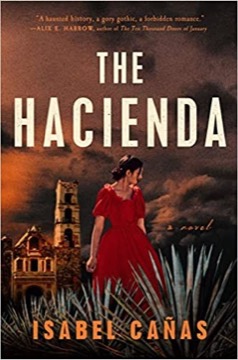
The Hacienda
Isabel Cañas's gothic set in Mexico in the 1820s, just after independence: a woman marries to secure her family's position and arrives at a country estate where the previous wife died.
- First published
- 2022
- Publisher
- Berkley
- Pages
- 315
- Shelf
- Mystery
- Level
- Entry
- ISBN-13
- 9781837860807
Record checked against
Catalogue note
- Reads as
- ReflectiveChanges how you see rather than what you do.
- Level
- Accessible / FoundationalNo prior reading assumed.
- Approach
- Theoretical
- Written for
- Readers who want to be kept up late, Newcomers to the subject
- Ideas
Saved in this browser only — no account, nothing sent anywhere. My library
Read this if
- You want to be kept up late, and made uneasy about who to believe.
- You want a book that changes how you see things rather than what you do tomorrow.
- You are starting from scratch here and want a way in that assumes no prior reading.
The premise
Beatriz's father was executed in the war of independence and her family has lost everything. She marries Rodolfo Solórzano for security and travels to his hacienda in the countryside.
The house is wrong. His sister is hostile, the servants will not stay after dark, and the first wife's death is not discussed. Beatriz finds an ally in Andrés, a young priest with an inheritance of his own.
The standard gothic arrangement, relocated to a country where the coloniser's house is the haunted one.
Devmark’s reading — not a quotation from the book
What it does with the form
Cañas has a background in medieval Islamic history and the research shows. The novel sets Catholic ritual against indigenous practice, and Andrés's position — a priest who is also the grandson of a curandera — is where the book's argument lives.
The haunting is tied directly to the hacienda system: what the estate was built on, and who died building it.
The house is haunted by the labour system it was built to run.
Devmark’s reading — not a quotation from the book
Themes
Casta, the colonial racial hierarchy, governs everyone's options, and the novel is precise about how it operates after independence has formally ended it.
Beatriz's situation is economic before it is supernatural: she cannot leave, and the book spends real time on why, which is what keeps the gothic from being decorative.
For a reader
Alternating narration between Beatriz and Andrés, short chapters, and a faster pace than most gothics. It is closer to Mexican Gothic in ambition than to a traditional ghost story.
The historical setting is specific and unfamiliar to most English-language readers, which is much of the appeal.
After the war of independence
The setting is Mexico in the 1820s, in the immediate aftermath of independence, with the old colonial order collapsing, the casta hierarchies unsettled but not gone, and families either ruined or newly and precariously risen depending on which side they chose. Cañas uses a period of genuine and documented social instability as the ground the haunting grows out of, rather than as decoration behind it.
Two narrators
The novel alternates between Beatriz, who marries into the estate for security, and Andrés, a priest who practises the folk witchcraft his grandmother taught him and has spent his life concealing it from the Church. The double perspective is what lets the book hold two belief systems at once.
One of them was trained by the Church. The other was trained by his grandmother. He is the same man.
Devmark’s reading — not a quotation from the book
The house as a body
San Isidro is written as actively and intelligently hostile rather than merely haunted: doors that will not stay shut, sudden cold, sounds with no source, a red glow under things, and walls that do not remain where they were the night before. The house has appetites and intentions of its own, and the novel commits fully to that rather than leaving the question comfortably ambiguous.
Whose religion counts
The central tension in the book is between sanctioned Catholic exorcism and the Indigenous practice Andrés learned from his grandmother, with the Church classifying the second as heresy punishable by the Inquisition while proving completely unable to address what is actually happening in the house. Making the effective knowledge the suppressed and criminalised one is the novel's clearest and most deliberate argument.
Race and inheritance
Beatriz's mixed ancestry and her father's execution as an insurgent have together cost her family its social standing and its income, and her marriage is presented plainly as a transaction intended to recover both. The horror in the novel is inseparable from the questions running underneath it: who is permitted to own land in this new country, and whose account of events anybody is obliged to believe.
What it borrows
Cañas has described the book as Mexican gothic in the tradition of a great house, a new wife, a dead predecessor and a hostile housekeeper. The familiar architecture is deliberate; the interest is in what changes when it is relocated and the colonial history is made the subject rather than the backdrop.
What to take away
- 01A colonial houseThe haunted estate is the coloniser's, and the haunting knows it.
- 02Two narratorsBeatriz and Andrés alternate, with different access to the problem.
- 03Casta after independenceRacial hierarchy persisting past its formal abolition.
- 04Catholicism and curanderismoThe priest's double inheritance is where the argument sits.
- 05Economic before supernaturalShe cannot leave, and the novel explains why at length.