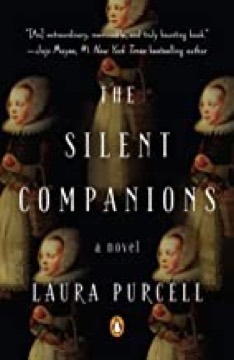
The Silent Companions
Laura Purcell's Victorian gothic about a pregnant widow sent to her late husband's country house, where she finds painted wooden figures that do not stay where they were left.
- First published
- 2017
- Publisher
- DeA Planeta
- Pages
- 343
- Shelf
- Mystery
- Level
- Entry
- ISBN-13
- 9781408888117
Record checked against
Only one source carried a publication date for this work, so the year is uncorroborated.
Catalogue note
- Reads as
- ReflectiveChanges how you see rather than what you do.
- Level
- Accessible / FoundationalNo prior reading assumed.
- Approach
- Theoretical
- Written for
- Readers who want to be kept up late, Newcomers to the subject
- Ideas
Saved in this browser only — no account, nothing sent anywhere. My library
Read this if
- You want to be kept up late, and made uneasy about who to believe.
- You want a book that changes how you see things rather than what you do tomorrow.
- You are starting from scratch here and want a way in that assumes no prior reading.
The premise
Elsie Bainbridge is newly married, newly widowed and pregnant when she arrives at The Bridge, a decaying estate in the Fens. The village will not come near it. The servants are unwilling. Her husband's cousin is the only company.
In a locked garret she finds a silent companion — a life-sized painted wooden figure of the kind actually used as household decoration in the seventeenth century. Then she finds another. Then the number changes.
Silent companions were real Georgian and Stuart household objects, which is what makes them work here.
Devmark’s reading — not a quotation from the book
How it is built
Three timelines run together: Elsie in an asylum afterwards, unable or unwilling to speak; Elsie at the house; and a seventeenth-century diary from an earlier mistress of the same estate.
Purcell keeps the horror visual and static. The figures do nothing while observed. The fear is entirely in position and in count, which is a restrained choice for a genre that usually escalates.
What it is about
The book is concerned with how little power a widow had over her own circumstances, her body or her testimony — the asylum frame makes that literal, since Elsie's account is the thing being assessed.
It is well-researched about Victorian match manufacture and the industrial disease that went with it, and that material is doing thematic work rather than providing period colour.
Nothing ever moves while anyone is looking, which is the whole technique.
Devmark’s reading — not a quotation from the book
The objects
The companions are real historical items: flat painted wooden figures, cut to shape and life-sized, placed in seventeenth-century rooms as decoration or as a deterrent to burglars. Purcell did not invent them, and their genuine existence is a considerable part of why the novel unsettles.
They are real. People genuinely stood painted wooden people in their houses on purpose.
Devmark’s reading — not a quotation from the book
Three timelines
The narrative runs on three levels at once: an asylum in which Elsie cannot or will not speak and is being assessed by a doctor, the recent past at the house leading up to whatever put her there, and a seventeenth-century diary discovered in the building. The structure allows the reader to assemble a family history across two centuries that none of the individual characters ever sees whole.
The Bainbridge house
A newly widowed, pregnant woman arrives at a decaying country house to be received with hostility by the village and the servants. Purcell establishes the isolation practically — the mud, the distance, the reputation of the family — so that staying becomes a real constraint.
The match factory
Elsie's background in her family's match manufacturing business supplies the novel's other horror, and it is entirely historical rather than invented: phosphorus necrosis of the jaw among factory workers, a well-documented industrial disease of the period, described here with clinical accuracy. A good case can be made that the most genuinely disturbing material in the book is industrial rather than supernatural.
The diary
The seventeenth-century sections concern a planned royal visit, a household's social ambitions, and a daughter treated throughout as an asset to be displayed and married off. They supply the origin of the mechanism that the later timeline suffers from, and the period voice is convincingly done. It is also where Purcell's writing is at its most controlled, which some readers find makes the modern sections feel thinner by comparison.
Is she mad
As with a great deal of the tradition it belongs to, the novel keeps open the possibility that the narrator is herself responsible for everything she is describing, and the asylum frame exists specifically to sustain that doubt across the whole book. Unlike its most obvious models, however, it does eventually resolve the question, and it resolves it more definitely than some readers of the genre would prefer.
What kind of read it is
It is a debut, deliberately and knowingly traditional in its construction, considerably more interested in dread and in objects than in psychological interiority, and short enough to read in two sittings. Readers who want the depth and moral complication of the Victorian novels it is modelled on will find it comparatively thin. Readers who want one genuinely frightening image to carry away will find the companions stay with them for years.
What to take away
- 01Real objectsSilent companions were genuine household furniture, which grounds the horror.
- 02Three timelinesAsylum, house and a seventeenth-century diary run in parallel.
- 03Horror by positionThe figures never move on the page; only their placement and number change.
- 04A widow's standingElsie's testimony is the thing on trial, which the asylum frame makes literal.
- 05Researched industryVictorian match manufacture and phossy jaw carry real thematic weight.