The Shining
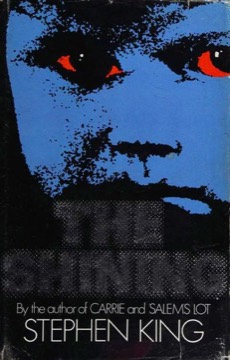
Stephen King's 1977 novel about a recovering alcoholic who takes a winter caretaking job at an isolated Colorado hotel with his wife and son. A haunted-house novel that is mostly about a family already in trouble.
- First published
- 1977
- Publisher
- Knopf Doubleday Publishing Group
- Pages
- 506
- Shelf
- Mystery
- Level
- Core
- ISBN-13
- 9788845295300
Record checked against
Catalogue note
- Reads as
- ReflectiveChanges how you see rather than what you do.
- Level
- Core / BuildingAssumes general familiarity with the subject.
- Approach
- Theoretical
- Written for
- Readers who want to be kept up late, Readers with some grounding
- Ideas
Saved in this browser only — no account, nothing sent anywhere. My library
Read this if
- You want to be kept up late, and made uneasy about who to believe.
- You want a book that changes how you see things rather than what you do tomorrow.
- You know roughly how the subject works and want the fuller account.
The premise
Jack Torrance has lost a teaching job for assaulting a student and has broken his son's arm while drunk. The Overlook Hotel, closed and snowbound for the winter, is his last chance: caretake it, stay sober, finish a play.
His son Danny has an ability the hotel's old cook calls the shining. The Overlook has a history, and it wants the boy.
The hotel does not create Jack's violence. It finds it already there and offers it a justification.
Devmark’s reading — not a quotation from the book
How it is built
King moves between all three Torrances, including the five-year-old, and much of the novel's power comes from Danny understanding more than he can articulate and Wendy understanding less than she needs to.
The isolation is built slowly and practically — the road closing, the radio, the boiler that must be dumped daily. King establishes the hotel as a machine before he establishes it as haunted.
What it is about
Alcoholism and inherited violence are the subject, and King has written openly about how much of Jack came from his own drinking. Jack's self-justifications are rendered from inside, which is the novel's most uncomfortable achievement.
The hotel works as a supernatural entity and as an externalisation at the same time, and the book does not require you to choose.
The novel's most frightening passages are the ones where Jack is only talking himself into something.
Devmark’s reading — not a quotation from the book
The film
Kubrick's 1980 adaptation is more famous and is substantially a different work. King has been consistently critical of it, chiefly because the film presents Jack as unstable from the start, which removes the fall the novel is about.
Read the book for Jack's deterioration; watch the film for its architecture. They are not substitutes for each other.
The hotel has a history
King supplies the Overlook with a documented past — owners, guests, a gangland killing, a previous caretaker — which Jack researches in the basement. The haunting is therefore cumulative and institutional rather than a single restless spirit, and the hotel's interest in the family is presented as appetite.
Jack as a man who is trying
The novel's most important difference from its screen reputation is that Jack begins sympathetic and stays that way for a long time: a recovering alcoholic who broke his son's arm while drunk, who carries real and specific shame about it, and who is genuinely trying to hold a job and a marriage together. The tragedy only works because he had something to lose and was making a serious attempt to keep it.
He is not a man who was always going to do this. That is the whole point of the book.
Devmark’s reading — not a quotation from the book
The shining itself
Danny's ability is defined carefully — a range of telepathy, precognition and the perception of residue — and the cook Hallorann provides the vocabulary and the reassurance that it is not madness. King uses it as a mechanism with rules rather than as an atmosphere.
Wendy
The mother is written as a person with her own history, fear and calculation, and much of the middle section is her assessment of whether her husband is deteriorating and what she can safely do about it. She is far more substantial here than in any adaptation.
Where it came from
King has written about the autobiographical pressure behind it: his own drinking, his fear of what he might do, and a stay in an empty Colorado hotel at the end of a season. He has described it as the book in which he confronted the possibility of being the danger to his own family.
The boiler
The building's defective boiler, which must be relieved of pressure twice a day or it will explode, is both plot mechanism and the novel's controlling image. It is the difference in structure from the film most worth noticing: the book has a device that will detonate if attention lapses.
What to take away
- 01Already in troubleThe family arrives damaged; the hotel supplies permission rather than cause.
- 02A child who knowsDanny perceives more than he can say, and the gap is the dread.
- 03Isolation, built practicallyRoads, radio and boiler establish the trap before the ghosts do.
- 04Written from inside addictionKing has said how much of Jack's reasoning came from his own drinking.
- 05Not the filmKubrick starts Jack unstable, which deletes the descent the novel exists to show.