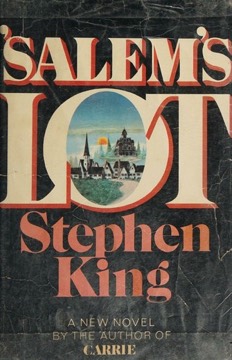
Salem's Lot
Stephen King's 1975 second novel, in which a writer returns to the Maine town of his childhood as a vampire takes possession of it. Dracula relocated to small-town America.
- First published
- 1975
- Publisher
- Random House Proprietary
- Pages
- 503
- Shelf
- Thriller
- Level
- Core
- ISBN-13
- 9788581050454
Record checked against
Sources disagree on the publication year (openlibrary 1959, wikidata 1975). The value shown is the one preferred by the most reliable source for original publication date; the disagreement is recorded rather than resolved.
Catalogue note
- Reads as
- ReflectiveChanges how you see rather than what you do.
- Level
- Core / BuildingAssumes general familiarity with the subject.
- Approach
- Theoretical
- Written for
- Readers who mean to stop at one more chapter, Readers with some grounding
- Ideas
Saved in this browser only — no account, nothing sent anywhere. My library
Read this if
- You want to be kept up late, and made uneasy about who to believe.
- You want a book that changes how you see things rather than what you do tomorrow.
- You know roughly how the subject works and want the fuller account.
The premise
Ben Mears returns to Jerusalem's Lot, a small Maine town, intending to write about the house that frightened him as a child. Two strangers arrive at the same time and open an antiques business.
People begin to disappear, and the town's residents explain the absences to themselves in ordinary ways for considerably longer than they should.
A vampire arrives in a small town, and the town's main defence is its own refusal to notice.
Devmark’s reading — not a quotation from the book
The town as protagonist
King devotes long passages to residents who have no bearing on the plot: a bus driver, a woman conducting an affair, a landlord, a child being abused at home.
The accumulation is the book's method. The town is established as a living organism before it is dismantled, and the horror is the loss of a specific place rather than of individuals.
Dracula updated
The structure follows Stoker closely — an arriving foreign threat, a knowledgeable older man, a group of amateurs, a systematic hunt — and King has been explicit about the debt.
The transposition is the point. The novel asks what the same story looks like in a community that has television, cars and no shared belief in anything.
Secrecy
The town's existing habit of not discussing what it knows — abuse, affairs, alcoholism — is what allows the vampire to spread.
This is the book's strongest idea. The supernatural exploits a social mechanism that was already in place, and King is explicit that the town was rotting before anything arrived.
Barlow and Straker
The vampire himself appears rarely; his human agent handles the practical arrangements and is on the page far more.
The division works well. Straker's competence and courtesy make the threat feel organised rather than merely monstrous, and the delay before Barlow appears is properly managed.
The Marsten House
The house on the hill is established as a source of dread decades before the vampire arrives, associated with a murder-suicide and with Ben's childhood experience inside it.
King uses it as a locus that predates the plot, which makes the town's corruption feel geological rather than recent.
Children
Mark Petrie, a boy who has read enough horror comics to recognise what is happening, is the novel's most effective character.
His practical competence against adults who cannot accept the evidence is both funny and genuinely useful, and the book is unusually good on childhood as a source of clear sight.
Pace
The first third is slow and almost entirely concerned with establishing the town, and readers frequently report finding it a chore before it pays off.
The payoff is real. The middle section, in which the town falls, moves very fast precisely because the groundwork has been done.
Early King
It is his second novel and the prose is looser than his later work, with more adverbs and more explicit signalling of emotion.
The ambition is nevertheless already fully present, and the structural confidence is considerably greater than a second novel usually demonstrates. He has also written about the book's origins in a class discussion about what would happen if Dracula returned in modern America, which is exactly what the novel executes.
Faith
The vampire material requires religious belief to function, and King uses a lapsed Catholic priest to examine what happens when the symbols work but the belief has gone.
The Father Callahan material is the novel's most interesting theological thread and is developed further in King's later Dark Tower books.
Adaptations
A 1979 television version directed by Tobe Hooper is well regarded, particularly for its version of Barlow, and several later adaptations exist.
The television version simplifies the town substantially, which removes the accumulation the novel depends on. A 2004 miniseries and a later film also exist, and none of them has found a way to reproduce the accumulation of minor residents that the novel depends on.
Who it is for
Readers who want traditional vampire horror executed with genuine social observation, and who will tolerate a slow opening.
It is long, and it is the clearest demonstration of King's actual method: build a community in detail, then take it apart. Readers who know King only through his later work will find this both rougher and more ambitious, and it is frequently named by other writers as the book that shaped them.
What to take away
- 01A place built to be destroyedLong passages about residents irrelevant to the plot establish the town as an organism before it is dismantled.
- 02Secrecy as the vectorThe town's existing habit of not discussing what it knows is what lets the infection spread unremarked.
- 03Stoker transposed deliberatelyThe structure follows Dracula closely to ask what the same story looks like in a community with no shared belief.
- 04The agent more present than the monsterStraker's competence and courtesy make the threat feel organised, and Barlow's delayed appearance is properly managed.
- 05A child who recognises itMark Petrie has read enough horror to identify what adults cannot accept, which is both comic and genuinely useful.
- 06Symbols working without beliefThe lapsed priest lets King examine what happens when the apparatus functions and the faith behind it has gone.