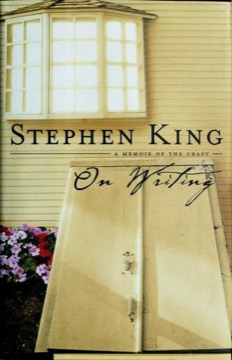
On Writing
Stephen King's part-memoir, part-manual on the writing life — unusually specific about craft, unusually unsentimental about talent, and built on the conviction that writing is a job performed daily rather than a condition you are in.
- First published
- 1999
- Publisher
- Albert Bonniers Förlag
- Pages
- 288
- Shelf
- Design
- Level
- Entry
- ISBN-13
- 9788497597326
Record checked against
Catalogue note
- Reads as
- PracticalWritten to be applied, not only understood.
- Level
- Accessible / FoundationalNo prior reading assumed.
- Approach
- Practical
- Written for
- Designers and makers, Newcomers to the subject
Saved in this browser only — no account, nothing sent anywhere. My library
Read this if
- You want to be understood the first time.
- You make things, and want to understand the work rather than wait for inspiration.
- You want a life told honestly, at full length.
- You want something to apply, not only something to think about.
- You are starting from scratch here and want a way in that assumes no prior reading.
The shape of the book
Three parts. A memoir of King's childhood, early poverty and years of rejection. A toolbox and instruction section on the craft itself. And a final account of being struck by a van in 1999 and using the return to work as recovery.
The memoir is not preamble. It exists to establish that the practices in the middle section came from somewhere specific, and that the person recommending them spent years doing them without any evidence they would work.
The memoir is there so the advice has a cost attached to it.
Devmark’s reading — not a quotation from the book
Read a lot, write a lot
His stated foundation, and he is uncompromising about it. King reports reading seventy to eighty books a year and writing every day including holidays, and his position is that anyone unwilling to do both should not expect the rest of the advice to help.
His argument for reading is technical rather than cultural: bad books teach more than good ones, because in a bad book the mechanism is visible.
The toolbox
His practical instruction is concrete and short. Vocabulary: use the first word that comes to mind if it is the right one, and do not dress it up. Grammar: the passive voice is timid and the adverb is not your friend, especially attached to dialogue attribution.
His rule on attribution is the most usable thing in the book — that "he said" is almost always correct, and that a writer reaching for a more interesting verb is compensating for dialogue that is not doing its work.
Story over plot
King describes himself as a situation-first writer: he begins with a predicament and characters and finds out what happens, rather than constructing a plot in advance.
His argument is that plotting is incompatible with the spontaneity of creation and that a story planned in detail will feel planned. This is genuinely contested among writers — plenty of excellent work is heavily outlined — and he presents a personal method with more universality than it warrants.
The second draft
His most quoted formula: second draft equals first draft minus ten per cent. He reports receiving it as a young writer on a rejection slip and following it since.
The surrounding advice is equally practical: put the completed draft in a drawer for six weeks and work on something else, so that you return to it as a reader rather than as its author. That interval is the mechanism; the ten per cent is a consequence.
Second draft equals first draft minus ten per cent. The six weeks in a drawer is what makes it possible.
Devmark’s reading — not a quotation from the book
On description and dialogue
His guidance on description is to give a few well-chosen details and let the reader build the rest, on the grounds that a reader's own imagination outperforms any inventory a writer can supply.
On dialogue, his test is whether it sounds like speech when read aloud, and his warning is that writers who avoid the way people actually talk — including profanity and incoherence — produce characters who are polite and dead.
The door
His most repeated image: write the first draft with the door closed, and the second with it open. The first is for you; the second is for a reader.
Attached to this is his Ideal Reader — a specific person, in his case his wife, whom he imagines reading. His point is that "the audience" is an abstraction that produces vague decisions, while one actual person produces specific ones.
On talent, and on success
King is bracing about this. His position is that a competent writer can be made good and a good writer can be made great, but a bad writer cannot be made competent — and he does not spend long consoling anyone about it.
He is equally direct that his own commercial success does not make his advice correct, and the book is notably free of the self-mythology the genre invites.
Where it is limited
It is one writer's method, generalised with confidence, and it is specifically a commercial fiction writer's method. Writers of literary fiction, non-fiction, poetry or screenplays will find some of it does not apply, and he does not much acknowledge that.
The anti-outlining position in particular should be read as a personal practice rather than an instruction, and several excellent writers work in exactly the opposite way.
Why it endures
Because it is honest about the work being work. King describes writing as a job with hours, a quota, a place, and an expectation of showing up whether or not anything arrives — which is the opposite of how the activity is usually romanticised.
It is also very well written, which for a book about writing is not a small thing. The prose demonstrates the advice, and that is the strongest argument it makes.
What to take away
- 01Read a lot, write a lotBad books teach more than good ones, because in a bad book the mechanism is still visible.
- 02'He said' is almost always rightA writer reaching for a more interesting attribution verb is compensating for weak dialogue.
- 03Put the draft in a drawerSix weeks away is what lets you return as a reader rather than as its author.
- 04Close the door, then open itThe first draft is for you; the second is for a reader, and confusing them ruins both.
- 05Write for one person'The audience' produces vague decisions. One actual named reader produces specific ones.