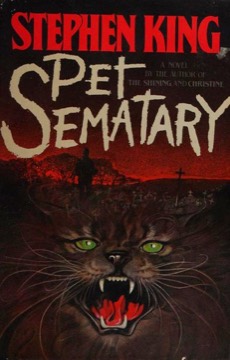
Pet Sematary
Stephen King's 1983 novel about a burial ground beyond a Maine pet cemetery that returns what is buried in it, and a family that moves in next to it.
- First published
- 1983
- Publisher
- Knopf Doubleday Publishing Group
- Pages
- 422
- Shelf
- Thriller
- Level
- Core
- ISBN-13
- 9780743412278
Record checked against
Catalogue note
- Reads as
- ReflectiveChanges how you see rather than what you do.
- Level
- Core / BuildingAssumes general familiarity with the subject.
- Approach
- Theoretical
- Written for
- Readers who mean to stop at one more chapter, Readers with some grounding
Saved in this browser only — no account, nothing sent anywhere. My library
Read this if
- You want to be kept up late, and made uneasy about who to believe.
- You want a life told honestly, at full length.
- You want a book that changes how you see things rather than what you do tomorrow.
- You know roughly how the subject works and want the fuller account.
The premise
Louis Creed, a doctor, moves his family from Chicago to rural Maine, to a house on a fast road used by fuel tankers. Behind the property is a pet cemetery maintained by generations of local children.
Beyond it is older ground. His neighbour Jud Crandall explains that things buried there come back, and that this is known locally and not discussed.
Everyone in the district knows what the ground does. Nobody has ever managed not to use it.
Devmark’s reading — not a quotation from the book
Grief as the engine
The novel's subject is bereavement and the refusal to accept it, and King constructs a situation in which the refusal is available as an action rather than only as a feeling.
The horror is therefore entirely self-inflicted. Every character who uses the ground knows the outcome and proceeds anyway, and the book's argument is about why.
Foreknowledge
King tells the reader what will happen well in advance and repeatedly, and Jud's warnings are explicit about previous cases.
The dread comes from watching a man walk toward something the book has already described. It is the same structural choice as The Day of the Jackal applied to a domestic tragedy.
Children and death
The novel spends its first half on ordinary family material: a daughter's first encounter with mortality, a cat, a conversation about what happens afterwards.
This is the strongest writing in the book and it is doing structural work, establishing exactly what the reader will later watch being destroyed.
The road
The highway carrying tankers past the house is established early and referred to constantly, and its presence is the novel's most effective piece of foreshadowing.
King uses ordinary infrastructure as fate. The danger is not supernatural at all, and the supernatural element is only what the family does afterwards.
Rachel and Zelda
The account of Rachel's sister, who died at home of spinal meningitis while Rachel was left to care for her, is a self-contained horror story inside the novel.
It is among the most frightening material King has written and has almost no supernatural content, which is worth noting about a writer known for the opposite.
Why he held it back
King has said he considered the book too bleak to publish and left it in a drawer for several years, releasing it only to fulfil a contractual obligation.
The account is consistent with the text. It is the least consoling of his novels and offers no recovery of any kind.
The Wendigo
The older mythology invoked to explain the ground is handled lightly and somewhat vaguely, and is the novel's least successful element.
The book is considerably stronger when the ground is simply a fact than when it is explained, and King is more effective describing effects than causes.
Structure
Three parts, with the first establishing the family, the second delivering the central catastrophe, and the third following the consequences.
The third part is the shortest and the fastest, and it moves with an inevitability the first two have carefully constructed. The three-part division is marked in the text itself, and the acceleration between them is one of the more deliberate pieces of construction in King's work.
The ending
It concludes on a single line of dialogue and stops, refusing any resolution.
The abruptness is deliberate and it is among the most effective endings King has written, precisely because it declines to show what the reader already knows is coming. Readers frequently describe finishing it and immediately wishing they had not, which is a response the book is plainly engineered to produce.
The adaptations
Two film versions exist, from 1989 and 2019, and the second alters a major plot element substantially.
Neither captures the domestic material that occupies the novel's first half, which is where the book's power is generated, and both are consequently thinner. The 2019 version in particular changes which child is involved, which alters the moral weight of the central decision considerably and not for the better.
Who it is for
Readers who want horror that is genuinely upsetting rather than merely frightening, and who are not looking for consolation.
Readers with young children frequently find it unbearable, and that reaction is appropriate rather than excessive. It is the bleakest thing in this section. It is also among King's shorter novels, which means the bleakness arrives quickly and does not have several hundred pages of incident to dilute it.
What to take away
- 01Refusal made available as an actionThe ground lets a character act on a feeling everyone has, which converts grief into a decision with consequences.
- 02Outcome disclosed in advanceJud's warnings are explicit and repeated, so the dread comes from watching someone walk toward a described conclusion.
- 03Ordinary infrastructure as fateThe tanker road is established early and constantly referenced, and the actual danger is not supernatural at all.
- 04Domestic material doing the workThe first half's ordinary family life establishes precisely what the reader will later watch destroyed.
- 05Horror without the supernaturalThe account of Rachel's sister is the book's most frightening passage and contains nothing uncanny.
- 06An ending that refuses to showIt stops on a line of dialogue, declining to depict what the reader already knows is about to happen.