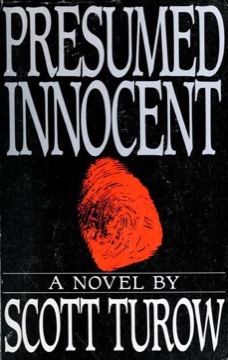
Presumed Innocent
Scott Turow's 1987 novel, in which a chief deputy prosecutor investigating a colleague's murder is charged with it himself. The novel that created the modern legal thriller.
- First published
- 1987
- Publisher
- Éditions J'ai Lu
- Pages
- 432
- Shelf
- Thriller
- Level
- Core
- ISBN-13
- 9784167527075
Record checked against
Catalogue note
- Reads as
- ReflectiveChanges how you see rather than what you do.
- Level
- Core / BuildingAssumes general familiarity with the subject.
- Approach
- Theoretical
- Written for
- Readers who mean to stop at one more chapter, Readers with some grounding
- Ideas
Saved in this browser only — no account, nothing sent anywhere. My library
Read this if
- You want to be kept up late, and made uneasy about who to believe.
- You want a book that changes how you see things rather than what you do tomorrow.
- You know roughly how the subject works and want the fuller account.
The premise
Rusty Sabich, chief deputy prosecuting attorney in a large Midwestern county, is assigned to investigate the rape and murder of Carolyn Polhemus, a colleague.
He had an affair with her that he does not disclose. When the physical evidence begins to point at him, his boss loses an election, and the incoming administration charges him.
The prosecutor investigating the case becomes the defendant in it.
Devmark’s reading — not a quotation from the book
Two halves
The novel divides cleanly: an investigation conducted by a man concealing his own involvement, and then a trial in which he is the accused.
The second half is the more accomplished. Turow's courtroom writing is detailed, tactical and genuinely suspenseful without relying on surprise witnesses or confessions.
Legal accuracy
Turow was a practising assistant US attorney, and the procedural detail — discovery obligations, evidentiary rulings, plea dynamics, the internal politics of a prosecutor's office — is exact throughout.
The book's tension frequently comes from a motion being granted or denied rather than from any revelation, which is unusual in the genre and far more effective than it sounds.
Rusty as narrator
He narrates in a controlled, lawyerly first person, and he is selectively candid: unsparing about his own humiliation and conspicuously evasive about a small number of specific facts.
The reader is therefore never entirely secure in his company. Turow manages this without cheating, and every one of the narration's omissions is defensible in retrospect as something a man in his position would not say.
Office politics
A substantial portion of the novel concerns an election, an administrative transition and the way a prosecutor's office distributes cases according to whose career they will serve.
Turow treats institutional self-interest as the primary driver of the prosecution rather than as background colour, which is the book's most cynical proposition and also its most convincing.
Sexual obsession
Rusty's affair is presented as compulsive rather than romantic, and he recounts it with a mixture of shame and continuing preoccupation.
The novel is unusual in the genre for treating a protagonist's desire as something disreputable that he cannot account for, rather than as a motivation to be sympathised with.
The prose
Dense, formal and considerably more literary than most of the genre, with long paragraphs and a willingness to digress on marriage, ambition and fathers.
It is slower than a Grisham and repays the patience. The writing about Rusty's marriage is among the best in the book.
The judge
Larren Lyttle presides over the trial with a history of his own that becomes material, and the courtroom sections are shaped by his rulings more than by the advocates.
Making a judge a substantive character rather than a referee is one of the novel's better structural choices.
The resolution
The verdict is not the end. The final chapters deliver a private disclosure that reframes the case, and the book closes on a domestic scene rather than a legal one.
It is a genuinely surprising ending that has been criticised as too neat and defended as the only one consistent with what precedes it.
What it established
The lawyer-protagonist whose expertise is turned against him, the trial as the novel's structural centre rather than its climax, and a level of procedural accuracy that made the whole genre credible to serious readers.
Grisham, Connelly's legal novels and a great deal of subsequent television descend from its example, usually with the literary ambition removed.
Sequel
Turow returned to the character in Innocent, published more than twenty years later, which depends on knowledge of this book and is best read after it.
The later novel is quieter and more concerned with age and regret than with the mechanics of a trial.
Who it is for
Readers who want the courtroom taken seriously, and who are content with a protagonist they are not sure they should trust.
It is the most literary novel in this part of the shelf and the one that most rewards attention to what the narrator is choosing not to say.
What to take away
- 01Expertise turned against the expertA prosecutor's knowledge of how cases are built becomes the mechanism of his own prosecution.
- 02Tension from motionsEvidentiary rulings and procedural decisions generate genuine suspense, which almost no other legal novel manages.
- 03A selectively candid narratorRusty is open about his humiliation and evasive about certain facts, without the book ever cheating.
- 04Institutional self-interest as causeAn election and an office transition drive the prosecution more than the evidence does.
- 05Desire as disreputableThe affair is treated as compulsion the protagonist cannot account for, not as a motivation to sympathise with.
- 06The trial as structureMaking the trial the novel's centre, with a judge as a substantive character, set the template the genre still uses.