A Kiss Before Dying
Ira Levin's 1953 debut about a young man who will do anything to marry into money, told in three parts with a structural trick at its centre.
- First published
- 1953
- Publisher
- Goldmann Verlag
- Pages
- 288
- Shelf
- Thriller
- Level
- Core
- ISBN-13
- 9780671683887
Record checked against
Catalogue note
- Reads as
- ReflectiveChanges how you see rather than what you do.
- Level
- Core / BuildingAssumes general familiarity with the subject.
- Approach
- Theoretical
- Written for
- Readers who mean to stop at one more chapter, Readers with some grounding
- Ideas
Saved in this browser only — no account, nothing sent anywhere. My library
Read this if
- You want to be kept up late, and made uneasy about who to believe.
- You want a book that changes how you see things rather than what you do tomorrow.
- You know roughly how the subject works and want the fuller account.
The premise
A young man is involved with the daughter of a wealthy copper magnate. She becomes pregnant, which threatens both the marriage he is planning and the inheritance behind it.
The novel follows what he does about this, and then what happens when her sisters begin to ask questions.
He needs the money more than he needs her, and he is prepared to be practical about it.
Devmark’s reading — not a quotation from the book
The structural trick
The first section is told from the young man's perspective without naming him, and the second introduces a new set of characters among whom he is concealed.
The device requires the reader to work out which man he is, and Levin plays fair while withholding the obvious identifiers. It is among the cleverest constructions in the genre.
Levin's economy
The novel is short, moves very fast, and contains almost nothing that is not load-bearing.
Levin wrote it at twenty-three and the control is remarkable: every detail planted in the first section is used in the second or third, and there is no padding anywhere.
The protagonist
He is charming, intelligent, entirely without conscience, and motivated by a specific and comprehensible desire to escape his mother's circumstances.
Levin gives him an economic motive rather than a pathology, which is more disturbing: he is not deranged, he is ambitious, and the two are treated as adjacent.
Class
The novel is precise about American post-war social mobility, about what a degree and a good manner could buy, and about the gap between appearing respectable and being wealthy.
The murders are career moves, and the book's coldest quality is how rationally they are planned.
The sisters
The three daughters are individually characterised and the investigation is conducted by them rather than by police.
Ellen's amateur enquiry in the second section is the best-plotted material in the book, and Levin's willingness to let a non-professional drive the investigation is unusual for the period.
Suspense technique
Levin generates tension by giving the reader more information than the characters, then placing them in rooms together.
The technique is used repeatedly and does not wear out, largely because the specific danger changes each time. He also withholds names and pronouns at several points, which forces the reader to keep multiple possibilities open in scenes that would otherwise be straightforward.
The ending
The resolution is abrupt, ironic, and delivered in very few pages, and it turns on a physical detail established much earlier.
It is satisfying in a way that feels engineered rather than emotional, which is consistent with the book's whole approach. Levin also resists any final confrontation scene, which a lesser writer would have supplied and which the book is considerably better without.
Levin's career
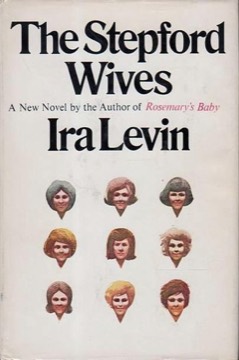
He went on to write Rosemary's Baby, The Stepford Wives, The Boys from Brazil and the play Deathtrap, and the same structural economy runs through all of them.
He is among the most technically efficient popular novelists of the century and is consistently underrated on that basis.
The adaptations
Two film versions exist, from 1956 and 1991, and neither reproduces the structural trick, which is difficult to film without narration.
The device depends on the reader not being able to see the character's face, which is a problem cinema cannot easily solve. The 1991 version in particular restructures the plot to reveal the killer immediately, which removes the single element that makes the book remarkable.
Period attitudes
The treatment of the pregnancy, the available options, and the social consequences for the woman involved are all period-specific and grim.
The novel is clear-eyed about this rather than incidental, and the constraints on the women are what makes the protagonist's leverage possible. The novel does not editorialise about any of this, and the effect is a colder and more accurate picture than commentary would have produced.
Who it is for
Readers who want a short, ingenious thriller with a genuinely surprising construction.
It can be read in an afternoon and rewards a second pass for the plotting. It is among the most purely well-made books in this section. It also won the Edgar for best first novel, and it remains the clearest demonstration of what structural ingenuity alone can achieve in the genre.
What to take away
- 01A trick that requires the reader to workThe killer is concealed among a new cast and the reader must identify him, with Levin playing fair throughout.
- 02Ambition rather than pathologyThe protagonist has an economic motive and no derangement, and the novel treats ambition and ruthlessness as adjacent.
- 03Murders as career movesThe killings are planned rationally to preserve a marriage and an inheritance, which is the book's coldest quality.
- 04Amateurs driving the investigationThe sisters, not the police, pursue the case, which was unusual for 1953 and produces the best-plotted section.
- 05Information asymmetry as methodLevin tells the reader more than the characters and then puts them in rooms together, repeatedly and without diminishing returns.
- 06Nothing that is not load-bearingWritten at twenty-three, every detail planted early is used later and there is no padding anywhere in it.