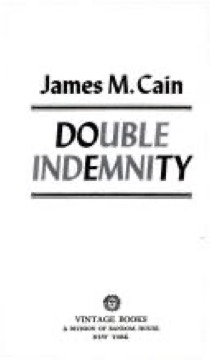
Double Indemnity
James M. Cain's short novel, serialised in 1936 and published in book form in 1943, in which an insurance salesman helps a client's wife kill her husband for the policy. The purest insurance-fraud noir.
- First published
- 1943
- Publisher
- Bruguera
- Pages
- 158
- Shelf
- Thriller
- Level
- Entry
- ISBN-13
- 9780060756680
Record checked against
Two sources agreed on 1943; a third reported differently (openlibrary 1943, wikidata 1943, wikipedia 1936).
Catalogue note
- Reads as
- ReflectiveChanges how you see rather than what you do.
- Level
- Accessible / FoundationalNo prior reading assumed.
- Approach
- Theoretical
- Written for
- Readers who mean to stop at one more chapter, Newcomers to the subject
- Ideas
Saved in this browser only — no account, nothing sent anywhere. My library
Read this if
- You want to be kept up late, and made uneasy about who to believe.
- You want a book that changes how you see things rather than what you do tomorrow.
- You are starting from scratch here and want a way in that assumes no prior reading.
The premise
Walter Huff, an experienced insurance agent, calls at a house in Los Angeles to renew an automobile policy and meets the wife instead of the husband.
Within a few visits they are planning a death that will trigger the double indemnity clause — a policy that pays twice the face value if the insured dies in a rare kind of accident, such as falling from a moving train.
The clause that pays double is also the clause that gets investigated hardest.
Devmark’s reading — not a quotation from the book
Expertise turned against itself
The novel's cleverest move is that the narrator is the expert. Huff knows exactly how claims are assessed, which deaths draw scrutiny, and what a fraudulent case looks like from the company's side.
That knowledge makes the crime possible and makes it doomed. He builds something designed to survive investigation and is then investigated by people using the same handbook.
Keyes
Barton Keyes, the claims manager, is the book's most memorable figure: a fat, dyspeptic, incorruptible man with an instinct for a false claim that he describes as a physical sensation.
He is also fond of Huff, which supplies the novel's only warmth and makes the investigation function as a slow betrayal of an affection rather than as a contest.
Phyllis
Cain writes her as genuinely unreadable. Her motives shift, her account of herself changes, and the novel eventually suggests something considerably darker than money.
She is a large part of the origin of the film-noir femme fatale, though the book's version is stranger and less stylish — less a seductress than something closer to a compulsion.
Structure
Like Cain's debut this is a confession written after the fact, and the first line announces the ending's shape, so the reader watches a known disintegration rather than an uncertain one.
The plotting is tight to the point of mechanical: setup, execution, investigation, collapse, each occupying almost exactly the space it needs.
The procedure
The insurance detail is exact — policy wording, actuarial reasoning, the statistics on how people actually die falling from trains — and Cain uses it the way a later technothriller would.
It is one of the earliest crime novels to make institutional process the source of tension. The antagonist is effectively an underwriting department.
The voice
Huff narrates in the same flat professional register he would use in a report, and his vocabulary is that of a man explaining a policy to a customer.
The horror comes from how little the tone changes as the subject moves from premiums to killing. Nothing in the diction registers that anything unusual is being described.
Cain's economy
The book is very short, and the prose does nothing decorative. Dialogue carries the action, chapters end on reversals, and there is no scene that does not advance the machine.
Cain disliked being grouped with hardboiled writers and said he simply wrote about people who wanted something and went wrong getting it, which is an accurate description of the method.
The Wilder film
The 1944 adaptation, written by Billy Wilder and Raymond Chandler, changed the ending, sharpened the dialogue and is often named among the defining films noir.
Chandler and Cain did not much admire each other's work, and the screenplay is more mannered than the novel. The book's ending is bleaker and considerably less cinematic.
The film gave it wit. The novel is colder and has no jokes in it.
Devmark’s reading — not a quotation from the book
Money as the only motive
There is no ideology and no larger social frame. Two people want a sum of money and are prepared to kill a third to get it, and the novel treats that as sufficient explanation.
The narrowness is the point. Cain's subject is the arithmetic of temptation, and enlarging it would have diluted what he is actually measuring.
Its standing
It is usually placed just behind The Postman Always Rings Twice in Cain's work, chiefly because its shape is more conventional, and ahead of it by readers who prefer the procedural machinery.
Its influence on the insurance-fraud plot is total. Almost every subsequent version of the story is working inside the pattern set here.
Reading it now
Short, fast, and a good entry point to Cain for readers who want structure rather than the rawness of his debut.
Expect no ambiguity about guilt and none about outcome. The pleasure is watching a competent man use his expertise to construct something that his own profession is designed to detect.
What to take away
- 01The expert as criminalHuff's professional knowledge of claims assessment is what makes the fraud possible and what guarantees its discovery.
- 02An underwriting department as antagonistTension comes from actuarial reasoning and policy wording, making this an unusually early procedural.
- 03Affection as the trapKeyes is fond of Huff, so the investigation plays as a slow betrayal rather than as a duel.
- 04Unchanged dictionThe narrator describes killing in exactly the register he uses for premiums, and that flatness is the horror.
- 05Arithmetic of temptationThere is no social frame and no ideology: two people want a sum and the book treats that as sufficient.
- 06A known endingFramed as a confession that announces its own outcome, so the suspense is entirely in the mechanism.