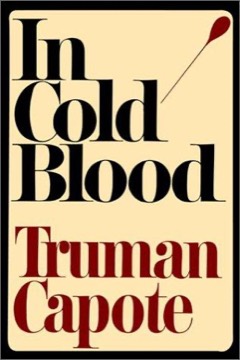
In Cold Blood
Truman Capote's 1966 account of the murder of a Kansas farming family and the two men who killed them. The book that established the non-fiction novel.
- First published
- 1966
- Publisher
- Bertelsmann, Reinhard Mohn OHG
- Pages
- 352
- Shelf
- Thriller
- Level
- Core
- ISBN-13
- 9780722122884
Record checked against
Catalogue note
- Reads as
- ReflectiveChanges how you see rather than what you do.
- Level
- Core / BuildingAssumes general familiarity with the subject.
- Approach
- Theoretical
- Written for
- Readers who mean to stop at one more chapter, Readers with some grounding
Saved in this browser only — no account, nothing sent anywhere. My library
Read this if
- You want to be kept up late, and made uneasy about who to believe.
- You read for the writing as much as for the argument.
- You want a book that changes how you see things rather than what you do tomorrow.
- You know roughly how the subject works and want the fuller account.
What happened
In November 1959 four members of the Clutter family were killed in their farm house near Holcomb, Kansas. Two men, Richard Hickock and Perry Smith, were arrested weeks later, convicted, and executed in 1965.
Capote read a short newspaper item about the killings, travelled to Kansas with Harper Lee, and spent six years on the reporting and writing.
The form
Capote claimed to have invented a new genre — the non-fiction novel — in which a true case is rendered with the techniques of fiction: scene, interiority, structure and withheld information.
The claim was overstated; reported narrative existed before. What was new was the scale of the ambition and the refusal to include the reporter anywhere in the text.
Six years of interviews, and the man who conducted them never appears on the page.
Devmark’s reading — not a quotation from the book
Structure
It is built in four parts, cutting between the family's last day and the killers' approach, so that two ordinary sequences converge on something the reader already knows is coming.
The technique generates enormous dread from entirely undramatic material — a schoolgirl's plans, a farmer's business, a pie left cooling.
Perry Smith
The book's centre of gravity is Smith: damaged, artistic, physically malformed by a motorcycle accident, given to grandiose fantasy and abruptly sentimental.
Capote's attention to him is the source of both the book's power and its central ethical problem. The portrait is sympathetic to a degree the narrative never explicitly defends.
Hickock
Hickock is given far less interiority: presented as shallow, boastful and sexually predatory, and functionally the instigator.
The asymmetry is the most substantial artistic decision in the book and the one most often criticised, since it shapes the reader's moral response to two men who were executed for the same acts.
The town
Holcomb and Garden City are reported with great care — the church affiliations, the social gradations, the effect on neighbours of discovering that the crime was not committed by a local.
Capote is very good on collective fear. The killings damage the community's assumption of safety in ways the book tracks long after the arrests.
Accuracy
Later scrutiny, including examination of Kansas Bureau of Investigation files, established that some scenes were compressed, some dialogue improved, and at least one significant moment — the final graveyard scene — did not happen.
This does not void the book but it does complicate the claim at its centre, since the genre's whole premise was that nothing had been invented.
The relationship with the subjects
Capote corresponded with and visited both men for years, and their trust was essential to the book. He also needed the executions to finish it, a tension he acknowledged privately and never in the text.
It remains one of the sharpest cases of a journalist's interest diverging from a subject's, and it is regularly taught as such.
The book could not be finished until the men who made it possible were dead.
Devmark’s reading — not a quotation from the book
The prose
Controlled, cool and free of editorialising. Capote almost never states a judgement, and the effect of the flat reporting on extreme material is a large part of the book's force.
The descriptive writing about Kansas landscape and weather is exceptional and does most of the emotional work that direct commentary would otherwise do.
The argument about capital punishment
The book does not argue a position, but the long account of the appeals, the conditions on death row and the mechanics of hanging amounts to something close to one.
Capote's method is to describe the process at length and let it make its own case, which is more effective than advocacy would have been and is also deniable.
Its influence
It made literary reportage commercially serious and is the direct ancestor of the modern true-crime book, the long-form magazine piece and, at some remove, the true-crime documentary and podcast.
The ethical questions it raised — about sympathy, access, payment and the writer's stake in an outcome — are still the central questions of the form.
Reading it now
It remains gripping and genuinely upsetting, and the writing is the best Capote produced. The violence is described once, late, and briefly.
Read it alongside its own reception. A reader who takes the reportage entirely at face value is missing the argument the book has been at the centre of for sixty years.
What to take away
- 01The non-fiction novelA true case rendered with fiction's tools — scene, interiority, withheld information — and the reporter kept off the page entirely.
- 02Converging ordinarinessCutting between a family's last day and the killers' drive creates dread from entirely undramatic material.
- 03An asymmetric portraitSmith is given rich interiority and Hickock very little, which shapes the reader's moral response to two men executed for the same acts.
- 04Accuracy under scrutinyLater examination showed compressed scenes and at least one invented moment, which complicates the genre's founding claim.
- 05The author's stakeCapote needed the executions to complete the book, a conflict he acknowledged privately and never in the text.
- 06Argument by descriptionThe long account of death row makes a case against capital punishment without ever stating one.