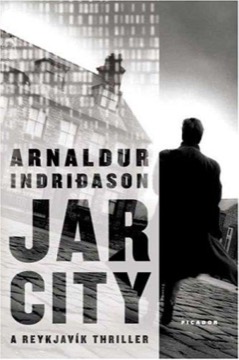
Jar City
Arnaldur Indriðason's 2000 novel, the first of his Detective Erlendur books to reach English, in which the murder of an old man in Reykjavík leads back through decades and into Iceland's genetic records.
- First published
- 2000
- Publisher
- Vaka-Helgafell
- Pages
- 280
- Shelf
- Thriller
- Level
- Core
- ISBN-13
- 9789979214984
Record checked against
Catalogue note
- Reads as
- ReflectiveChanges how you see rather than what you do.
- Level
- Core / BuildingAssumes general familiarity with the subject.
- Approach
- Theoretical
- Written for
- Readers who mean to stop at one more chapter, Readers with some grounding
Saved in this browser only — no account, nothing sent anywhere. My library
Read this if
- You want to be kept up late, and made uneasy about who to believe.
- You read for the writing as much as for the argument.
- You want a book that changes how you see things rather than what you do tomorrow.
- You know roughly how the subject works and want the fuller account.
The premise
An elderly man is found dead in his basement flat in Reykjavík, killed with a heavy ashtray. There is no sign of forced entry, little of value taken, and a photograph of a child's grave left on the body.
Erlendur's investigation turns up a decades-old rape accusation against the dead man that was never prosecuted, and a chain of consequence running forward from it.
A photograph of a grave, left deliberately, on a body nobody was looking for.
Devmark’s reading — not a quotation from the book
Iceland as a closed system
The novel depends on a population small enough that genealogy is public, that families are traceable across centuries, and that a genetic database covering almost everyone actually exists.
Indriðason uses the real controversy over Iceland's national health-sector database, and the plot could not be relocated anywhere else without collapsing.
Erlendur
Divorced, estranged from his adult children, living alone and eating badly, he is recognisably in the Wallander line but with a specific private obsession: a brother lost in a blizzard in childhood and never found.
That loss shapes his professional interest in disappearances and gives the series a coherent psychological centre.
Cold cases as the form
Almost all of Indriðason's plots reach back decades, and the present-day crime is typically a consequence of something unresolved and unpunished long ago.
The books are less about detection than about excavation, and the dominant emotional register is grief rather than suspense. What Erlendur uncovers is usually a life that was quietly ruined while the institutions that might have intervened looked elsewhere.
The genetic material
The disease at the plot's centre and the database that makes it traceable are handled with enough technical care to be plausible, and the ethical questions about consent and ownership are raised rather than resolved.
It is one of the earliest crime novels to make population genetics a plot mechanism rather than a forensic convenience.
Sexual violence and its aftermath
The historical rape is central, and the novel is chiefly interested in the long aftermath: a woman's life afterwards, a case never prosecuted, and institutions that declined to act.
The treatment is restrained. The act itself is described briefly and the consequences at length, which is the reverse of the genre's usual proportion.
Reykjavík
The city is small, wet and dark, and the novel's Iceland is deliberately unromantic: prefabricated housing, bad weather, and a suspicion of outsiders that includes other Icelanders.
Indriðason is writing against a tourist image of the country, and the drab specificity is part of the argument.
Erlendur's daughter
Eva Lind, pregnant and using drugs, appears throughout demanding attention her father cannot give, and their scenes are among the book's most uncomfortable.
The subplot has no connection to the case whatsoever, and it is the series' most consistent source of feeling. Indriðason lets it run unresolved across several books, which is unusual discipline for a crime series and part of why the sequence accumulates weight.
Pace
Short, slow and quiet. There are almost no action sequences, and the investigation proceeds through conversation and record-searching.
The novel is under three hundred pages and can feel considerably longer, which readers either find immersive or inert depending entirely on their tolerance for melancholy. Nothing is withheld to create suspense; the book simply proceeds at the speed of the enquiry.
The prose
Spare and unemphatic in translation, with very little figurative language and a preference for reported speech.
Indriðason's restraint is a genuine stylistic position rather than a limitation of the translation, and the sustained flatness is what makes the occasional direct statement of feeling land as hard as it does. He spends the currency perhaps four times in the book.
The title
The Icelandic title translates as Bog City, a reference to a Reykjavík nickname; Jar City refers to a collection of preserved organs held for research.
The English title foregrounds the medical material, which is a reasonable choice given that the novel's structural idea is a nation that has kept samples of itself.
Series and entry point
It is the third Erlendur novel in Icelandic and the first translated widely, and it works entirely as a standalone.
Readers who want Nordic crime at its quietest and most melancholy should start here; those who want plot machinery will find the Nesbø books more accommodating.
What to take away
- 01A plot that cannot be relocatedPublic genealogy, a tiny population and a real national genetic database make the solution possible only in Iceland.
- 02Excavation rather than detectionThe present crime is a consequence of something decades old, and the register is grief rather than suspense.
- 03Aftermath given the spaceA historical rape is described briefly and its consequences at length, reversing the genre's usual proportion.
- 04Population genetics as mechanismOne of the first crime novels to use a genetic database as plot machinery rather than as forensic convenience.
- 05A private loss driving the workErlendur's brother vanished in a childhood blizzard, which explains his professional fixation on disappearances.
- 06Writing against the tourist imageReykjavík is deliberately drab — prefabs, rain, suspicion — as an argument about the country.