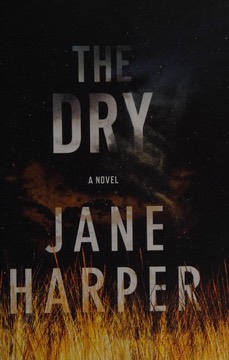
The Dry
Jane Harper's 2016 debut, in which a federal agent returns to the drought-stricken Victorian town he left as a teenager, for the funeral of a friend who apparently killed his family.
- First published
- 2016
- Publisher
- Flatiron Books
- Pages
- 328
- Shelf
- Thriller
- Level
- Entry
- ISBN-13
- 9781250105608
Record checked against
Catalogue note
- Reads as
- ReflectiveChanges how you see rather than what you do.
- Level
- Accessible / FoundationalNo prior reading assumed.
- Approach
- Theoretical
- Written for
- Readers who mean to stop at one more chapter, Newcomers to the subject
Saved in this browser only — no account, nothing sent anywhere. My library
Read this if
- You want to be kept up late, and made uneasy about who to believe.
- You read for the writing as much as for the argument.
- You want a book that changes how you see things rather than what you do tomorrow.
- You are starting from scratch here and want a way in that assumes no prior reading.
The premise
Aaron Falk, a financial investigator with the Australian Federal Police, returns to Kiewarra for the funeral of Luke Hadler, who is believed to have shot his wife and son and then himself.
Luke's father asks him to look into it. Falk left the town twenty years earlier under a cloud, after a girl drowned and he and Luke gave each other an alibi that was not true.
He comes back for a funeral and everyone in town remembers the lie he told at sixteen.
Devmark’s reading — not a quotation from the book
The drought
The region has had no significant rain in two years, farms are failing, livestock is being shot, and the fire risk is constant.
The conditions are the novel's foundation: the economic desperation supplies motive, and the physical discomfort is present in every scene. Harper renders it exceptionally well.
Two timelines
Italic passages recount the events of twenty years earlier, delivered from several perspectives, alongside the present-day investigation.
The device supplies the reader with information Falk does not have and establishes that his own account of the past is incomplete. Harper also keeps the flashbacks short, so they never interrupt the present-day investigation for long enough to lose its momentum.
Small-town memory
The town has not forgotten, does not intend to, and Falk's reception ranges from cold to physically threatening.
Harper is precise about how a rural community holds a grievance across decades, and about the specific impossibility of leaving something behind in a place where everyone was present.
The local policeman
Raco, recently posted and an outsider himself, becomes Falk's partner and supplies both local access and an independent judgement.
The pairing is conventional and well executed, and Raco's scepticism about Falk keeps the reader from settling into the investigator's account. Raco also has a family and a stake in the town's future, which gives him a motive for the investigation independent of Falk's history.
Two investigations
The present-day killings and the twenty-year-old drowning run in parallel, and the novel maintains both without collapsing them into a single explanation.
The refusal to connect them mechanically is a good decision and gives the resolution more weight. Harper also lets the town's assumption that the two must be connected be part of the obstacle, since everyone is certain they already know the answer.
Financial crime
Falk's actual expertise is money, and the eventual break comes from reading accounts rather than from anything physical.
Making the protagonist's specialism unglamorous and then having it matter is a better choice than the genre usually makes. Harper worked as a business journalist before writing fiction, and the confidence with which the accounting material is handled reflects it.
Prose
Clean, restrained and heavily focused on physical sensation: heat, dust, thirst, the sound of dry grass.
Harper worked as a journalist and the writing is economical, with almost no figurative language and a strong preference for concrete detail. The heat in particular is rendered through its practical consequences — what cannot be left in a car, when work can be done — rather than through description.
Pace
It builds slowly through interviews and accumulating hostility, with the tension coming from the town rather than from any immediate threat.
The final act introduces physical jeopardy that the preceding material did not require, which is the most conventional thing about it. The threat is social for most of the book: property damage, a refused service, a note left on a windscreen, none of which requires a confrontation.
The reveal
The solution to the present-day killings is properly clued and the resolution of the historical case is quieter and more affecting.
Both are satisfying, and the decision to give the older case the more emotional resolution is the right one. Harper also plants the essential detail early and in plain sight, which is why the solution satisfies rather than merely surprises.
The adaptation
A 2020 film with Eric Bana is faithful and captures the landscape effectively.
The novel's interiority — Falk's own uncertainty about what he remembers — is the element the film necessarily flattens. The film also relocates several scenes and compresses the flashbacks, which makes the historical case considerably less central than the novel does.
Who it is for
Readers who want rural crime fiction with a genuine sense of place and a well-managed dual timeline.
It won the Gold Dagger and established a substantial Australian crime readership internationally. It is short, well constructed and an easy recommendation. Harper's subsequent novels apply the same method to other Australian landscapes, and readers who like this one generally continue with Force of Nature.
What to take away
- 01Drought as foundationTwo years without rain supplies economic desperation, motive and a physical discomfort present in every scene.
- 02A community that does not forgetHarper is precise about holding a grievance for decades in a place where everyone was present for the original event.
- 03Two cases held apartThe present killings and the old drowning run in parallel without being collapsed into one explanation.
- 04Unglamorous expertise that mattersThe break comes from reading financial accounts, which is a better choice than the genre usually makes.
- 05Information the narrator lacksItalic flashbacks from several perspectives establish that Falk's own account of the past is incomplete.
- 06The quieter resolution given weightThe historical case receives the more emotional answer, which is the correct distribution.