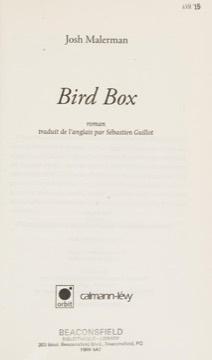
Bird Box
Josh Malerman's 2014 novel set after the appearance of something that causes anyone who sees it to become violently insane, following a woman travelling blindfolded with two children.
- First published
- 2014
- Publisher
- HarperCollins Publishers
- Pages
- 373
- Shelf
- Thriller
- Level
- Entry
- ISBN-13
- 9780008319748
Record checked against
Catalogue note
- Reads as
- ReflectiveChanges how you see rather than what you do.
- Level
- Accessible / FoundationalNo prior reading assumed.
- Approach
- Theoretical
- Written for
- Readers who mean to stop at one more chapter, Newcomers to the subject
Saved in this browser only — no account, nothing sent anywhere. My library
Read this if
- You want to be kept up late, and made uneasy about who to believe.
- You read for the writing as much as for the argument.
- You want a book that changes how you see things rather than what you do tomorrow.
- You are starting from scratch here and want a way in that assumes no prior reading.
The premise
Something appears in the world. Anyone who looks at it becomes violently psychotic, usually killing others and then themselves. Nobody knows what it is, because describing it requires having seen it.
Malorie has survived for five years indoors with two children. The novel alternates between that period and a single day on which she attempts to reach safety by river, blindfolded.
The rule is simple: do not look. Nobody has ever been able to say why.
Devmark’s reading — not a quotation from the book
The rule
The premise's strength is its absolute clarity: one prohibition, no exceptions, immediately fatal consequences.
Everything follows from it. Windows must be covered, journeys must be made blind, and any encounter with another person carries the risk that they will try to make you look. Malerman also never shows the reader anything the characters cannot perceive, so the prohibition constrains the narration as tightly as it constrains the people inside it.
Sound
With sight removed, the novel is conducted almost entirely through hearing: footsteps, breathing, water, an animal moving in undergrowth.
The sustained auditory description is the book's technical achievement, and it produces a specific kind of tension that visual horror cannot. The river sequence in particular is conducted entirely through what Malorie can hear, and the novel makes the reader listen in a way very little prose manages.
Refusing explanation
The creatures are never described, never explained and never given an origin, and the novel is disciplined about this to the end.
The restraint is what makes it work. Any description would reduce the threat to something with properties, and the book understands that completely.
The two timelines
The river journey and the years preceding it alternate, with the earlier thread explaining how Malorie arrived at the situation the later one depicts.
The structure supplies information at a controlled rate and lets the book open on maximum jeopardy, which a chronological telling could not.
The house
The middle section, in a house shared by several survivors, is the strongest material: rationing, disagreement about risk, and the question of whether to admit a stranger.
The social dynamics of enforced confinement are handled well, and the sequence generates more dread than the river does.
The children
Malorie has trained both children to listen with extraordinary precision, and they are named Boy and Girl because she declined to give them anything else.
The decision is presented as a survival measure and as damage simultaneously, and the novel does not resolve which it is.
Prose
Plain, short-sentenced and heavily focused on immediate sensation, with little interiority beyond the practical.
The style suits the material. A more literary approach would have introduced the reflection the situation does not permit. Malerman was a musician before he was a novelist, and the rhythm of the shorter chapters in particular suggests someone thinking in terms of pace rather than of sentence.
Limitations
The characterisation is thin outside Malorie, and several of the house's occupants are functions rather than people.
The novel is a machine for generating tension and does that extremely well, and it does not attempt much else. The prose is also functional rather than distinguished, and readers who want sentences as well as situations should adjust their expectations accordingly.
The ending
The resolution arrives quickly and provides a destination without answering any of the questions the premise raises.
Readers who want explanation will be frustrated. The book's position is that explanation was never available, and the ending is consistent with that. It also arrives rather abruptly relative to the tension preceding it, and several readers have found the final chapters the weakest part of the book.
The adaptation
A 2018 film changed several elements substantially and became widely discussed, largely for its premise rather than its execution.
The novel is considerably tighter and its sound writing is the element the film could not reproduce, since a film cannot remove the audience's sight. The film also supplies more explanation than the novel does, which weakens the premise considerably, since the whole force of it is that nothing can be known.
Who it is for
Readers who want a high-concept survival thriller executed cleanly, and who do not require explanation or depth of character.
It is short, extremely fast, and one of the more effective recent horror premises. Readers who found the film thin should know the book is considerably better.
What to take away
- 01One absolute ruleA single prohibition with immediate fatal consequences generates every constraint the novel operates under.
- 02Conducted through hearingWith sight removed, the sustained auditory description produces tension that visual horror cannot achieve.
- 03Explanation permanently withheldThe creatures are never described or given an origin, because any properties would reduce the threat.
- 04Confinement as the strongest materialRationing, disagreement about risk and whether to admit a stranger generate more dread than the journey does.
- 05Children named as a measureBoy and Girl are unnamed as a survival decision that the novel simultaneously presents as damage.
- 06A structure that opens on jeopardyAlternating timelines let the book begin at maximum tension and supply the backstory at a controlled rate.