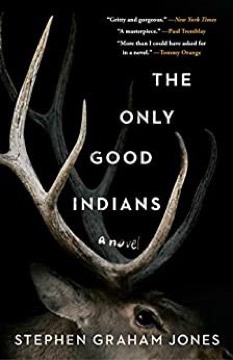
The Only Good Indians
Stephen Graham Jones's 2020 novel about four Blackfeet men pursued, ten years later, by something connected to a hunt they should not have conducted.
- First published
- 2020
- Publisher
- Simon & Schuster
- Pages
- 320
- Shelf
- Thriller
- Level
- Core
- ISBN-13
- 9781663624147
Record checked against
Catalogue note
- Reads as
- ReflectiveChanges how you see rather than what you do.
- Level
- Core / BuildingAssumes general familiarity with the subject.
- Approach
- Theoretical
- Written for
- Readers who mean to stop at one more chapter, Readers with some grounding
Saved in this browser only — no account, nothing sent anywhere. My library
Read this if
- You want to be kept up late, and made uneasy about who to believe.
- You read for the writing as much as for the argument.
- You want a book that changes how you see things rather than what you do tomorrow.
- You know roughly how the subject works and want the fuller account.
The premise
Ten years ago, four young Blackfeet men hunted in a part of the reservation reserved for elders and killed a herd of elk, including a pregnant cow.
They have scattered since. Something has been waiting, and it begins with Ricky in a bar car park in North Dakota.
Four men, one hunt they should not have made, and something that has been waiting ten years.
Devmark’s reading — not a quotation from the book
Structure
The novel is organised in sections following each man in turn, with the perspective moving on as each is reached.
The design means the reader loses the protagonist repeatedly, and the accumulating sense that nobody is safe is produced structurally rather than asserted. Jones also varies the register between sections, so each man's part reads slightly differently and the reader has to readjust each time.
The Elk Head Woman
The entity pursuing them is rendered with genuine strangeness: neither ghost nor monster in any familiar sense, and motivated by something comprehensible.
Jones gives her a perspective, and her sections are among the book's most unsettling because her reasoning is legible and her grievance is real.
Reservation life
The novel is specific about contemporary Blackfeet experience: housing, employment, the basketball court, the relationship with Great Falls, tribal policing, and the differences between those who stayed and those who left.
The texture is the book's foundation and is delivered without explanation. Jones is Blackfeet and the detail is first-hand, and the novel assumes a reader who will keep up rather than pausing to translate anything.
Tradition and its cost
The men's violation was of a rule that is both cultural and practical, and the novel is interested in what obligations survive when the surrounding structure has been damaged.
The question is genuinely open, and Jones does not position tradition as simply correct. Jones also gives the men genuinely mixed relationships with their own community, and none of them is presented as either properly traditional or fully assimilated.
Basketball
The final section is constructed around a game, and the sport carries the book's emotional weight as well as its climax.
The sequence is extraordinary: a full game rendered play by play with something else happening inside it, and it is the novel's best writing.
Horror
The violence is extreme and physically specific, with several sequences involving dogs and one involving a sweat lodge that are genuinely hard to read.
Jones does not moderate and the body horror in particular is relentless. Jones has also written extensively in the genre and is explicit about working within it, so the extremity is a considered position rather than an excess.
Prose
Loose, colloquial, close third person that moves inside each character's speech patterns, with long run-on sentences during the most intense passages.
The style is distinctive and takes adjustment, and the interior monologue is where Jones is strongest. The shifts between characters' voices are also substantial, and the novel reads quite differently depending on whose section it is.
Humour
The novel is frequently funny, particularly in the men's self-deprecation and in the running commentary each keeps on his own situation.
The comedy makes the deaths considerably worse and is deployed deliberately for that purpose. Jones is also funny about horror conventions themselves, and several characters are aware of the shape of the story they are inside.
Guilt
Each man has carried the hunt differently — denial, justification, an attempt at restitution — and the novel is more interested in those responses than in the pursuit.
The variation between them is the book's real substance. Lewis's section in particular, which opens the novel proper, is the most developed and is frequently named as the book's strongest writing.
Its position
It won the Bram Stoker and Shirley Jackson awards and brought Jones a substantial wider readership after a long career.
It is frequently cited as a central work in a recent expansion of Indigenous horror writing. Jones had published more than twenty books before it, and its success drew attention to a substantial back catalogue that had been largely overlooked.
Who it is for
Readers who want horror with a specific cultural setting and can tolerate extreme content.
It is one of the strongest recent American horror novels and the basketball sequence alone justifies it. Readers who cannot read about harm to animals should choose something else. It is also considerably more emotionally substantial than its premise suggests, and the final section is as moving as it is frightening.
What to take away
- 01Protagonists lost repeatedlyFollowing each man in turn means the reader keeps losing the viewpoint, producing the sense of jeopardy structurally.
- 02A grievance that is legibleThe entity is given her own perspective and her reasoning is comprehensible, which is why she unsettles.
- 03Obligations after the structure is damagedThe novel asks what cultural rules still bind when the surrounding framework has been broken, and does not answer simply.
- 04A game carrying the climaxThe final basketball sequence is rendered play by play with something else occurring inside it, and is the book's best writing.
- 05Comedy sharpening the deathsThe men's self-deprecation is genuinely funny and is deployed precisely to make the losses land harder.
- 06Four responses to one actDenial, justification and attempted restitution are more interesting to the novel than the pursuit itself.