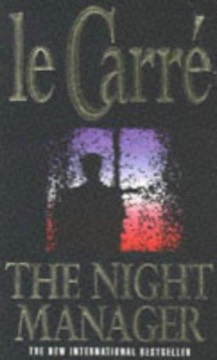
The Night Manager
John le Carré's 1993 novel in which a hotel night manager is recruited to infiltrate the circle of a British arms dealer. His first major book after the Cold War.
- First published
- 1993
- Publisher
- Ullstein Taschenbuchvlg.
- Pages
- 480
- Shelf
- Thriller
- Level
- Core
- ISBN-13
- 9781844569144
Record checked against
Catalogue note
- Reads as
- ReflectiveChanges how you see rather than what you do.
- Level
- Core / BuildingAssumes general familiarity with the subject.
- Approach
- Theoretical
- Written for
- Readers who mean to stop at one more chapter, Readers with some grounding
Saved in this browser only — no account, nothing sent anywhere. My library
Read this if
- You want to be kept up late, and made uneasy about who to believe.
- You read for the writing as much as for the argument.
- You want a book that changes how you see things rather than what you do tomorrow.
- You know roughly how the subject works and want the fuller account.
The premise
Jonathan Pine manages the night shift at a luxury hotel in Zurich. A guest he had known briefly in Cairo is murdered after passing him documents about an arms deal, and he carries the guilt of having handed them on.
A small British agency later offers him the chance to act on it: an elaborate legend, built over months, designed to place him inside the household of the dealer responsible.
Richard Roper
Roper is charming, rich, physically impressive and entirely without scruple — described in the novel's most-quoted phrase as the worst man in the world.
Le Carré resists making him grotesque. He is good company, generous to people he likes, and plausible as someone whose circle would not examine where the money comes from, which is what makes him usable as an argument.
Not a monster. A well-liked man with a business.
Devmark’s reading — not a quotation from the book
What replaced the Cold War
This is the first of the late novels to answer the question the genre faced in 1991. Le Carré's answer is that the interesting conflicts are now commercial, and that the state is a participant rather than a referee.
The arms trade here runs through shell companies, deniable officials and politely worded approvals. The antagonist is a market with sponsors inside government.
The undercover construction
A long central stretch is devoted to building Pine's cover: a criminal record, a plausible violent history, sightings in the right places, and a rescue staged so that Roper feels indebted.
This is the most procedurally satisfying part of the book, and it is unusually explicit about legend-building as a craft with a budget and a schedule.
Pine as a protagonist
He is a former soldier, disciplined, watchful and self-contained, and the novel is interested in how the hotel trade and the army produced the same habits: anticipate the need, remain unmemorable.
Unlike le Carré's institutional heroes he is physically capable, which moves the book closer to conventional thriller territory than the Smiley novels ever go.
The agency that runs him
Pine's handlers are a small, underfunded outfit fighting for jurisdiction against a better-connected Whitehall faction that would prefer the investigation stopped.
That internal conflict supplies as much jeopardy as Roper does. The recurring le Carré proposition — that the dangerous opposition is domestic and procedural — survives the change of subject intact.
Jed
Roper's young mistress is the book's most contested character: written with sympathy, given real interiority, and still substantially defined by the two men's interest in her.
She functions as the point where Pine's operational discipline and his conscience are made to conflict, which is structurally effective and narratively uncomfortable.
Set pieces and geography
The novel moves from Zurich to Cornwall to Quebec to the Caribbean and into Panama, and le Carré writes each with the specificity of somewhere visited rather than researched.
The hotel sections are the strongest. The professional invisibility of good service — a staff that sees everything and is seen by nobody — is the book's best sustained metaphor.
A good hotel and a good intelligence service want the same thing: to be unremembered.
Devmark’s reading — not a quotation from the book
Complicity as the theme
The point is not that Roper is wicked but that a great many respectable people find him useful. Bankers, officials and lawyers each take a small, defensible step.
The novel distributes responsibility deliberately thinly, which is its most uncomfortable argument: no single participant does anything that would look indefensible in isolation.
How it reads as a thriller
It is faster and more plotted than his Cold War work, with genuine action sequences and a conventional escalation. Readers who found the Smiley books static usually get on with this one.
The trade-off is a degree of glamour — yachts, islands, beautiful people — that sits oddly beside the moral case the book is making.
The adaptations
A 2016 television version moved the setting to the Arab Spring, changed a significant character's gender and altered the ending, and it is how most people now encounter the story.
The novel differs in emphasis rather than plot: it is colder, gives more time to the bureaucratic infighting, and is considerably less certain that anything was achieved.
Where it sits
Among the late novels it is the most accessible and the most conventionally entertaining, and a reasonable entry point for a reader who wants le Carré without the Cold War apparatus.
It is not the deepest of them. The Constant Gardener makes a similar argument about corporate power with more anger and less consolation.
What to take away
- 01The post-Cold-War antagonistWith the ideological contest gone, the novel locates the real conflict in arms dealing and the officials who protect it.
- 02Legend-building as craftThe long construction of Pine's false history is the book's most procedurally detailed and satisfying passage.
- 03Charm as the mechanismRoper works because he is good company; making him repellent would have destroyed the argument.
- 04Thinly distributed complicityResponsibility is spread across bankers, lawyers and officials so that no individual step looks indefensible.
- 05Service as invisibilityHotel work and intelligence work are shown to select for the same trait: being present and unremembered.
- 06The domestic obstacleThe most dangerous opposition to the operation comes from a rival faction in Whitehall, not from the target.