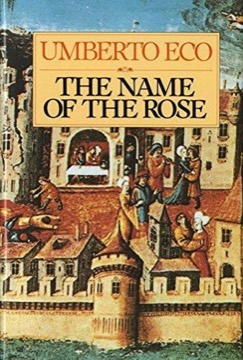
The Name of the Rose
Umberto Eco's 1980 novel, in which a Franciscan friar investigates deaths in a northern Italian abbey in 1327. A medieval murder mystery that is also a treatise on signs.
- First published
- 1980
- Publisher
- dtv
- Pages
- 533
- Shelf
- Thriller
- Level
- Deep
- ISBN-13
- 9781448137749
Record checked against
Catalogue note
- Reads as
- ReflectiveChanges how you see rather than what you do.
- Level
- Advanced / AdvancedAssumes you have read around the subject already.
- Approach
- Theoretical
- Written for
- Readers who mean to stop at one more chapter, Specialists and serious readers
- Ideas
Saved in this browser only — no account, nothing sent anywhere. My library
Read this if
- You want to examine an assumption you have never examined.
- You want a book that changes how you see things rather than what you do tomorrow.
- You have read around this already and want a book that assumes it.
The premise
William of Baskerville, an English Franciscan and former inquisitor, arrives at a wealthy Benedictine abbey with his young novice Adso to prepare for a theological conference between papal and imperial delegations.
A monk has died in suspicious circumstances. Over seven days more follow, and the abbey's great library — the largest in Christendom, and closed to almost everyone — is at the centre of every death.
Seven days, seven deaths, and a library nobody is permitted to enter.
Devmark’s reading — not a quotation from the book
Detection in the fourteenth century
William reasons from physical evidence, footprints, manuscripts and inference, and the novel plays the deductive game seriously while constantly noting that his method has no institutional legitimacy in 1327.
The name signals the intent: a Franciscan Holmes, with Adso as a narrating Watson writing in old age about events he did not understand at the time.
The theological argument
A substantial portion of the book concerns whether Christ owned property, a dispute that was genuinely central to fourteenth-century politics and that distinguished Franciscan poverty movements from papal wealth.
Eco does not simplify it. The debates run for pages and are essential rather than decorative, because the murders are ultimately about what may be read and believed.
Laughter as the subject
The novel's hidden centre is a lost book — the second volume of Aristotle's Poetics, on comedy — and the question of whether laughter is permissible.
The argument is that a faith which cannot tolerate being laughed at is a faith that must control what is read, which is the book's real position and the motive behind every death in it.
Semiotics
Eco was a professor of semiotics, and the novel is an extended demonstration of how signs are read, misread and over-read.
William repeatedly constructs elegant interpretations that turn out to be wrong, and the resolution depends on accepting that a pattern he found was never actually there — an unusually rigorous joke at the detective genre's expense.
The library
The labyrinth is described precisely enough to be mapped, with rooms arranged so that their inscriptions form a coded geography.
It is one of the most famous imaginary buildings in modern fiction, and the physical puzzle of navigating it supplies the novel's most conventional suspense.
Adso as narrator
The account is written decades later by a man who was a naive adolescent at the time, which allows Eco to explain medieval assumptions without condescension.
The device also permits genuine emotion. Adso's one encounter with a village girl is the most direct feeling in a very cerebral book.
Difficulty
There are untranslated Latin passages, long theological digressions, detailed descriptions of manuscript illumination and an extended account of a heresy trial.
Eco said the first hundred pages were a deliberate penance designed to select the readers he wanted, which is either a joke or an accurate description of the effect.
Historical texture
The abbey's economy, scriptorium practice, the politics of the Avignon papacy and the suppression of the Dolcinians are all rendered with real scholarly weight.
The medieval world here is not a costume. Its intellectual assumptions are presented as coherent rather than quaint, which is the book's most valuable achievement.
Its commercial success
An academic semiotician's first novel, dense with Latin and scholastic argument, became an international bestseller, which surprised its author and publisher alike.
Eco later wrote a book-length postscript analysing why it had worked, and concluded that readers will accept a great deal of difficulty provided the narrative frame they are being asked to hold is familiar enough. A murder mystery was the most familiar frame available.
The ending's meaning
The title comes from a Latin hexameter about names surviving the things they named, and the novel closes on the persistence of signs after their referents are lost.
The detective plot resolves; the intellectual one does not, and the closing pages deliberately withhold the consolation the genre normally supplies.
Reading it now
It works as a murder mystery for readers content to skim the theology, and as a novel of ideas for readers who engage with it.
The 1986 film with Sean Connery keeps the mystery and discards the argument, which is a reasonable adaptation choice and leaves most of the book unrepresented.
What to take away
- 01A detective without standingWilliam reasons from evidence in a century that has no institutional place for such a method, and the novel keeps noting it.
- 02Elegant readings that are wrongThe resolution depends on the detective's beautiful pattern having never existed — a rigorous joke at the genre's expense.
- 03Laughter as the real stakeThe murders protect a lost book on comedy, on the argument that a faith which cannot be laughed at must control reading.
- 04Theology that is load-bearingThe dispute over whether Christ owned property is essential rather than decorative, because the killings are about what may be believed.
- 05A naive narrator in retrospectAdso writes decades later about events he did not understand, which lets Eco explain the period without condescension.
- 06Difficulty as selectionEco described the opening hundred pages as a deliberate penance to choose his readers.