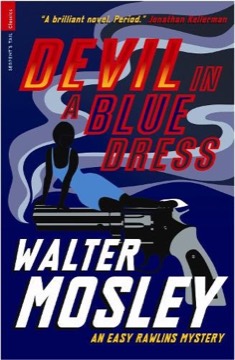
Devil in a Blue Dress
Walter Mosley's 1990 debut, in which a Black veteran in 1948 Los Angeles is paid to find a missing white woman and becomes a detective by accident.
- First published
- 1990
- Publisher
- Serpent's Tail Limited
- Pages
- 219
- Shelf
- Thriller
- Level
- Core
- ISBN-13
- 9781846686832
Record checked against
Two sources agreed on 1990; a third reported differently (openlibrary 2010, wikidata 1990, wikipedia 1990).
Catalogue note
- Reads as
- ReflectiveChanges how you see rather than what you do.
- Level
- Core / BuildingAssumes general familiarity with the subject.
- Approach
- Theoretical
- Written for
- Readers who mean to stop at one more chapter, Readers with some grounding
- Ideas
Saved in this browser only — no account, nothing sent anywhere. My library
Read this if
- You want to be kept up late, and made uneasy about who to believe.
- You want a book that changes how you see things rather than what you do tomorrow.
- You know roughly how the subject works and want the fuller account.
The premise
Ezekiel Rawlins, called Easy, has been laid off from an aircraft plant and is worried about his mortgage when a white man in a bar offers him money to find a woman known to frequent Black clubs in Los Angeles.
He takes the job because he needs the payment, not because he has any relevant skill, and discovers that being able to move through a part of the city white investigators cannot is itself the qualification.
He is hired for the one thing no white detective in the city has: access.
Devmark’s reading — not a quotation from the book
The historical setting
1948 Los Angeles, with wartime migration from Texas and Louisiana having built a large Black population in Watts and along Central Avenue, and restrictive covenants determining where anyone can live.
Mosley's period detail is specific and load-bearing: property, employment and policing all operate by rules the plot depends on.
Property as motive
Easy's central anxiety is his house. He bought it, he is proud of it, and the fear of losing it drives every decision he makes.
This is a genuinely different engine from the genre's usual one. The detective is not pursuing justice or truth but trying to keep an asset, which makes his compromises legible.
Police and danger
Easy's encounters with the police are among the book's most tense passages, and the threat is not that he will be outwitted but that he will be beaten or killed with no recourse.
Mosley rewrites a genre convention here. The hardboiled detective's adversarial banter with police is unavailable to a man for whom the interaction is genuinely dangerous.
Mouse
Easy's friend from Texas is small, charming and entirely without restraint — a man who solves problems by killing people and does not afterwards think about it.
He is the series' most enduring character and its most troubling. The novel is honest that Easy needs him and is frightened of him in equal measure.
Voice
The first-person narration is warm, observant and conversational, closer to storytelling than to the clipped hardboiled register.
Mosley uses dialect and idiom with confidence, and the voice shifts depending on whom Easy is speaking to — a survival skill the book treats as a form of expertise.
The genre inheritance
The structure is classic Chandler: a wealthy client, a missing woman, a widening case, a corrupt establishment. Mosley keeps the shape and changes who is walking through it.
The effect is to expose how much of the original form depended on its hero's freedom to go where he liked and ask what he wanted.
Daphne Monet
The woman Easy is hired to find is the novel's most complicated figure, and the eventual disclosure about her is bound up with the book's argument about racial categorisation.
Mosley handles it without melodrama. The revelation is treated as a fact about how the society sorts people rather than as a twist.
Community
Much of the book is Easy moving among friends, neighbours, bar owners and landlords, and those relationships are rendered with real affection.
The social texture is the difference between this and a transplanted hardboiled novel. The detective has a life that continues when the case is not being worked.
The series
It is the first of a long sequence following Easy across decades of Los Angeles history, and later books take him through Watts in 1965 and beyond.
The novels function as a social history as much as a crime series, with each set at a chosen moment in the city's racial politics.
The film
The 1995 adaptation with Denzel Washington is faithful and well regarded, and Don Cheadle's Mouse is the performance most people remember. It reproduces the period and the plot closely while necessarily externalising a narration that is, in the novel, almost entirely a man talking himself through a risk calculation.
The novel gives considerably more space to Easy's interior calculations about money, property and risk.
Reading it now
It is short, fast and unusually pleasurable for a debut, and it requires no familiarity with the genre it is answering.
Readers who know Chandler will get an extra layer, since much of the book's force comes from the contrast with a form it is deliberately inhabiting.
What to take away
- 01Access as the qualificationEasy is hired not for skill but because he can move through parts of the city no white investigator can reach.
- 02A mortgage as motiveThe fear of losing his house drives every decision, which is a different engine from justice or truth.
- 03Banter is not availableThe genre's adversarial wit with police is replaced by genuine physical danger with no recourse.
- 04Chandler's shape, different occupantKeeping the classic structure and changing who walks through it exposes how much the original relied on its hero's freedom.
- 05A friend who is a weaponMouse solves problems by killing, and the novel is honest that Easy both needs and fears him.
- 06Crime fiction as social historyThe series is positioned at chosen moments in Los Angeles's racial politics, with each book documenting one.