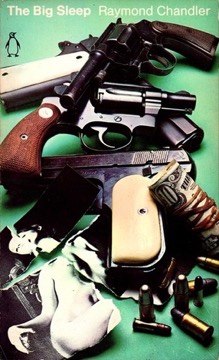
The Big Sleep
Raymond Chandler's 1939 debut, in which a private detective is hired by a dying general to deal with a blackmailer and finds a great deal more. The novel that gave American crime fiction its voice.
- First published
- 1939
- Publisher
- Knopf Doubleday Publishing Group
- Pages
- 229
- Shelf
- Thriller
- Level
- Core
- ISBN-13
- 9781597770521
Record checked against
Catalogue note
- Reads as
- ReflectiveChanges how you see rather than what you do.
- Level
- Core / BuildingAssumes general familiarity with the subject.
- Approach
- Theoretical
- Written for
- Readers who mean to stop at one more chapter, Readers with some grounding
Saved in this browser only — no account, nothing sent anywhere. My library
Read this if
- You want to be kept up late, and made uneasy about who to believe.
- You read for the writing as much as for the argument.
- You want a book that changes how you see things rather than what you do tomorrow.
- You know roughly how the subject works and want the fuller account.
The premise
Philip Marlowe is summoned to the Sternwood mansion, where an elderly, immensely rich general sits in a hothouse among orchids because he can no longer tolerate cold. He has two daughters, both trouble, and a blackmailer to be dealt with.
Marlowe takes the job. Within a day the blackmail has produced a body, and the case begins to open outward into pornography, gambling debts, missing persons and a disappearance the general has not mentioned.
A small job, taken cleanly, that will not stop widening.
Devmark’s reading — not a quotation from the book
The voice
This is the book's real contribution. Marlowe narrates in a first person that is wry, exact, self-aware and capable of sudden lyricism, and the register has been imitated so widely that its originality is easy to miss.
Chandler's method is to let a hard, flat observation run for a sentence and then turn it with an image that is genuinely strange. The similes are famous because they do something specific: they keep a cynical narrator from sounding merely sour.
The plot problem
The novel was assembled by cannibalising two earlier pulp stories, and the joins show. There is a famous unresolved question about one of the deaths which Chandler, asked during the film's production, admitted he could not answer.
This matters less than it should. The book is not built to be solved, and the scenes are arranged for atmosphere and confrontation rather than for a chain of deduction a reader could follow.
Marlowe as a figure
He is a working professional with a small office, a low fee and a code he does not explain. He is rude to the rich, protective of the vulnerable and consistently uninterested in being paid to look away.
The romanticism is real but restrained. Chandler later described the ideal of a man who is neither tarnished nor afraid walking mean streets, and the novel mostly earns it by showing the cost rather than asserting the virtue.
Los Angeles
The city is rendered as geology and weather: canyons, oil sumps, rain, hillside houses and the specific quality of Californian light on something unpleasant.
Chandler writes wealth as a kind of drainage. The Sternwood money came out of oil fields still visible from the house, and the novel keeps returning to the idea that the money and the rot arrived together.
The oil that made the family rich is still leaking at the bottom of the garden.
Devmark’s reading — not a quotation from the book
Structure
It proceeds as a sequence of encounters rather than as an investigation: Marlowe goes somewhere, meets someone, is threatened or lied to, and moves on with slightly more information.
The pattern is closer to picaresque than to detection. What holds it together is the narrator's consistency of judgement, which is why the voice has to carry so much.
The women
The two Sternwood daughters are drawn with real energy and very little generosity — one predatory and unstable, the other calculating — and the book's attitude to both is a mixture of pity and disgust.
This is the element that has aged least well. Chandler's women are usually either threats or victims, and the novel's moral seriousness elsewhere makes the narrowness here more conspicuous rather than less.
Censorship and what is implied
A pornography operation, a drug-induced stupor and a homosexual relationship are all central to the plot and none is stated plainly, because in 1939 they could not be.
The obliquity became a technique. Readers are required to infer, and the sense that the city contains more than the narrator will name is partly an artefact of what the period forbade him to.
The prose at sentence level
Chandler was a late starter who had been an oil-company executive, and he worked on sentences with the deliberateness of someone who came to the craft as an adult.
The paragraphs are short, the verbs are strong, and description is used sparingly and then all at once. The famous openings of scenes are doing structural work: they establish mood so that the dialogue can be entirely functional.
Its relation to Hammett
Chandler credited Hammett with taking murder out of the drawing room, and the debt is plain in the milieu, the dialogue and the refusal of the puzzle plot.
The difference is interiority. Hammett's prose reports behaviour from outside; Chandler's is a narrator thinking, which is why Marlowe became the more imitable model.
The Hawks film
The 1946 adaptation, with a screenplay worked on by William Faulkner, is famously incomprehensible as plot and superb as atmosphere, which is a fair description of the novel's priorities too.
Many readers meet Marlowe through Bogart. The book's Marlowe is younger, more openly angry, and given considerably more interior life.
Reading it now
It is short, fast and consistently entertaining, and it requires no knowledge of the genre it founded. The pleasure is line by line rather than in the resolution.
Approach it as a mood, a city and a voice rather than as a mystery. Readers who need the plot to close will be frustrated; readers who want to hear someone describe Los Angeles will not.
What to take away
- 01The voice is the inventionMarlowe's wry, exact first person is the book's real contribution, and it has been imitated so widely it now sounds like a default.
- 02Atmosphere over solutionScenes are arranged for confrontation and mood; one death is famously never explained and the book barely notices.
- 03Wealth and rot arrive togetherThe Sternwood fortune came from oil fields still visible from the house, which is the novel's controlling image.
- 04A code that is never statedMarlowe's ethics are shown through what he refuses rather than through anything he says about himself.
- 05Censorship became techniqueWhat the period forbade him to name directly produced an obliquity that makes the city feel larger than the narration.
- 06The debt to Hammett, and the departureChandler took the milieu and added interiority, which is why Marlowe rather than the Continental Op became the template.