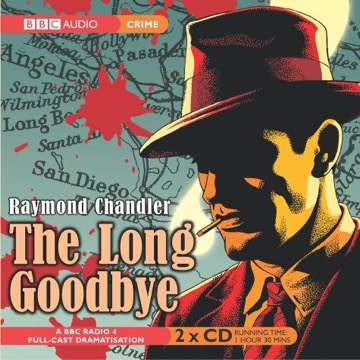
The Long Goodbye
Raymond Chandler's 1953 novel, in which Marlowe's friendship with a charming drunk leads to a murder accusation and a case he is warned off. His longest and most personal book.
- First published
- 1953
- Publisher
- Vintage books
- Pages
- 320
- Shelf
- Thriller
- Level
- Core
- ISBN-13
- 9780394757681
Record checked against
Catalogue note
- Reads as
- ReflectiveChanges how you see rather than what you do.
- Level
- Core / BuildingAssumes general familiarity with the subject.
- Approach
- Theoretical
- Written for
- Readers who mean to stop at one more chapter, Readers with some grounding
Saved in this browser only — no account, nothing sent anywhere. My library
Read this if
- You want to be kept up late, and made uneasy about who to believe.
- You read for the writing as much as for the argument.
- You want a book that changes how you see things rather than what you do tomorrow.
- You know roughly how the subject works and want the fuller account.
The premise
Marlowe helps a courteous, badly drunk stranger named Terry Lennox out of a parking lot, and the acquaintance becomes something close to friendship conducted over gimlets at a bar.
When Lennox's rich wife is found dead and Lennox asks for a lift to the border, Marlowe gives it without asking questions, is arrested for it, and refuses to say anything — which is where the novel's real subject begins.
He is jailed for a silence he chose, and the book is about why he chose it.
Devmark’s reading — not a quotation from the book
Friendship as the subject
Chandler wrote this after his wife's long illness and death, and the book is preoccupied with loyalty, drinking, and what is owed to someone who has not earned it.
Marlowe's attachment to Lennox is never fully explained, which is the point. The novel treats affection as something that happens to people rather than as a judgement they make.
Two plots and a mirror
Alongside the Lennox case runs a second commission: minding Roger Wade, a successful and self-loathing novelist whose drinking is destroying his work.
Wade is a partial self-portrait, and an unsparing one. The two storylines comment on each other — both concern a man whose charm has outlived whatever was underneath it.
Length and pace
It is substantially longer than the earlier novels and much slower. Conversations run for pages, and several chapters advance nothing except the reader's understanding of a character.
Chandler defended this directly: he was interested in the scene rather than the mystery, and thought a reader who wanted only the solution was reading the wrong kind of book.
Marlowe, older
He is wearier here, more solitary, and more explicitly moral. He turns down money more often, and the code that was implied in the earlier books is stated closer to the surface.
Some readers find him sanctimonious in this novel. The charge has some force — he lectures more than he used to — but it is inseparable from the book's greater emotional seriousness.
Money and class
The Potter and Wade households give Chandler his fullest view of Californian wealth: newspapers owned, police influenced, and a settled confidence that scandal can be purchased away.
The critique is sharper than in the earlier books because it is directed at respectability rather than at gangsters. The people who do the most damage here are entirely lawful.
The police
The interrogation sequence after Marlowe's arrest is the most sustained treatment of official brutality in his work: a man held without charge, worked on, and released when it becomes inconvenient to keep him.
Chandler is explicit that this is routine rather than exceptional, and the passage has a cold anger that the earlier novels' wisecracking usually deflects.
Not a scandal. A procedure.
Devmark’s reading — not a quotation from the book
Alcohol
Drinking is described with the specificity of someone who knew the subject from inside: the ritual of the gimlet, the particular clarity of the early drink, the wreckage of the later ones.
The novel neither condemns nor romanticises it. It is treated as a medium people live in, and as the thing that makes both Lennox and Wade unreachable.
The prose
The similes are fewer and the paragraphs longer. Chandler is writing more plainly here, and the effect is a book that sounds less like a performance and more like a man talking.
The famous set pieces — the description of a blonde, the meditation on the city at night — are still present, but they are spaced out and carry more weight for it.
Its reputation
It won the Edgar for best novel and is generally treated as Chandler's most ambitious work, and often as his best, though readers who want a tight case prefer Farewell, My Lovely.
Its influence on later crime fiction is largely emotional. The idea that a detective novel could be about grief and friendship rather than about a puzzle descends substantially from here.
The Altman film
The 1973 adaptation relocates the story to the seventies and plays Marlowe as a shambling anachronism, and changes the ending decisively.
It is a serious work in its own right and an almost complete inversion of the book's values. Readers who know it should expect a novel far more invested in Marlowe's integrity.
Who it is for
Readers who already like Chandler and want the fullest version of him. Readers who came for pace will find this the slowest of the Marlowe books by a considerable margin.
It is also the one that repays rereading most, because its pleasures are in character and cadence rather than in information the reader does not yet have.
What to take away
- 01Loyalty without justificationMarlowe goes to jail rather than explain a friendship the novel never fully accounts for.
- 02A self-portrait, unsparingRoger Wade is a successful novelist drinking himself out of his talent, written by an author who knew the condition.
- 03Respectability does the damageThe harm here comes from lawful, wealthy people managing their reputations, not from criminals.
- 04Scene over mysteryChandler deliberately slowed the book down, arguing that a reader who wants only the solution wants a different book.
- 05Drink as a mediumAlcohol is neither condemned nor glamorised; it is simply what makes the two central men unreachable.
- 06Grief reshaped the genreWritten after his wife's death, it established that a detective novel could be about loss rather than deduction.