The Third Man
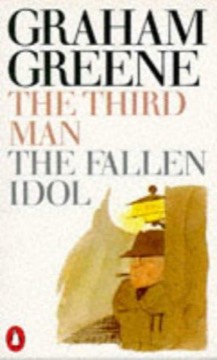
Graham Greene's novella, written as a treatment for the 1949 film and published afterwards, about a writer who arrives in occupied Vienna to find his friend has died.
- First published
- 1950
- Publisher
- Ungar
- Pages
- 134
- Shelf
- Thriller
- Level
- Entry
- ISBN-13
- 9780434305674
Record checked against
Two sources agreed on 1950; a third reported differently (openlibrary 1935, wikidata 1950, wikipedia 1950).
Catalogue note
- Reads as
- ReflectiveChanges how you see rather than what you do.
- Level
- Accessible / FoundationalNo prior reading assumed.
- Approach
- Theoretical
- Written for
- Readers who mean to stop at one more chapter, Newcomers to the subject
Saved in this browser only — no account, nothing sent anywhere. My library
Read this if
- You want to be kept up late, and made uneasy about who to believe.
- You read for the writing as much as for the argument.
- You want a book that changes how you see things rather than what you do tomorrow.
- You are starting from scratch here and want a way in that assumes no prior reading.
The premise
Rollo Martins, a writer of cheap westerns, arrives in Vienna at the invitation of his old friend Harry Lime and learns that Lime was killed by a car days earlier.
The accounts of the accident do not agree. A British military policeman tells Martins that Lime was a racketeer, and Martins sets out to prove otherwise.
He came to Vienna for a job and arrives in time for the funeral.
Devmark’s reading — not a quotation from the book
Occupied Vienna
The city is divided into four zones administered by the Allied powers, with the centre under joint control, and the practical consequences — different police, different laws, a zone where nobody has jurisdiction — drive the plot.
Greene visited and the geography is accurate, and the ruins, the sewers and the ferris wheel are all real locations put to specific narrative use.
Harry Lime
He is absent for most of the story and dominates it entirely, constructed through other people's accounts before he appears.
The technique is the same one le Carré would later use, and Lime's eventual appearance is among the most effective entrances in twentieth-century fiction. Greene also gives him one speech that has outlasted the rest of the book entirely, and the film's version of it was reportedly improvised by Orson Welles.
The racket
Lime's business is stolen penicillin, diluted and sold, which has killed and disabled children in a hospital.
Greene's choice of crime is deliberate and effective: it is unglamorous, specific, and the consequences are visible in a way that a more abstract offence would not be.
Friendship and evidence
Martins's loyalty survives the first several disclosures and is broken only when he is shown the consequences directly.
The novella's central question is how much evidence it takes to abandon someone, and Greene is unsentimental about the answer. Greene is also precise that Martins resists partly because abandoning Lime would mean revising his own past, which is a cost independent of the evidence.
Its origin
Greene wrote it as prose first, as preparation for a screenplay, and did not intend it for publication.
The origin shows in the structure — scenes are visual and economical — and Greene himself described it as inferior to the film, which is unusually modest and roughly correct.
Narration
It is told by Calloway, the military policeman, reconstructing events he partly witnessed and partly learned later.
The device provides a useful distance and a degree of institutional scepticism, and it means the reader receives Martins's romanticism through someone unimpressed by it. It also lets Greene supply police procedure and occupation politics without interrupting Martins's pursuit, since Calloway simply knows these things.
Differences from the film
The novella's ending is substantially different and more conventional, and the film's final shot, which Greene opposed, is not in the prose at all.
Carol Reed's judgement was better. The film's ending is the superior one and Greene later acknowledged it. The novella also names the protagonist Rollo rather than Holly, and several of the supporting characters have different nationalities and functions.
Anna
Lime's former lover, an actress with forged papers and a precarious legal position, is the story's only character with anything genuinely at stake.
Her refusal to condemn Lime, and her contempt for Martins's expectation that she should, is the most morally interesting material in the book.
Length
It is short, closer to a long short story than to a novel, and can be read in a sitting.
The compression is entirely appropriate. There is no subplot and no digression, and the whole is organised around a single disclosure. Most editions pair it with The Fallen Idol, another film treatment, which makes the volume a useful demonstration of Greene working in a deliberately cinematic mode.
Greene's categories
He divided his own work into novels and entertainments, and placed this among the latter, though the distinction is one most critics now regard as unhelpful.
The moral seriousness here is not noticeably lower than in the books he considered serious. He applied the label inconsistently and later regretted it, and most modern editions have quietly dropped the distinction entirely.
Who it is for
Readers who want a short, perfectly constructed story about loyalty, and readers curious about how the film came to exist.
It is worth reading alongside the film rather than instead of it, and the comparison is instructive about what each medium does with the same material.
What to take away
- 01A character built from accountsLime is absent for most of the story and constructed entirely from what others say, which makes his entrance extraordinary.
- 02An unglamorous crime with visible consequencesDiluted penicillin that disabled children is specific and undeniable in a way a more abstract offence would not be.
- 03How much evidence loyalty requiresMartins's friendship survives several disclosures and breaks only when he is shown the results directly.
- 04Jurisdiction as plotFour-power occupied Vienna with a jointly administered centre creates practical gaps the story runs through.
- 05A sceptical narratorCalloway's institutional detachment means the reader receives Martins's romanticism through someone unimpressed by it.
- 06The film's ending is betterGreene wrote a more conventional conclusion and later acknowledged that Reed's judgement was correct.