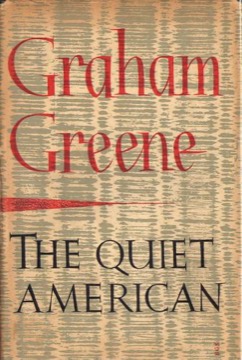
The Quiet American
Graham Greene's 1955 novel about a British journalist in Saigon, an idealistic young American, and the woman they both want. A prediction of the Vietnam War.
- First published
- 1955
- Publisher
- Xuân Thu
- Pages
- 232
- Shelf
- Thriller
- Level
- Core
- ISBN-13
- 9780679600145
Record checked against
Sources disagree on the publication year (openlibrary 1940, wikidata 1955). The value shown is the one preferred by the most reliable source for original publication date; the disagreement is recorded rather than resolved.
Catalogue note
- Reads as
- ReflectiveChanges how you see rather than what you do.
- Level
- Core / BuildingAssumes general familiarity with the subject.
- Approach
- Theoretical
- Written for
- Readers who mean to stop at one more chapter, Readers with some grounding
Saved in this browser only — no account, nothing sent anywhere. My library
Read this if
- You read for the writing as much as for the argument.
- You want to understand how power is taken, kept and lost.
- You want a book that changes how you see things rather than what you do tomorrow.
- You know roughly how the subject works and want the fuller account.
The premise
Thomas Fowler, a middle-aged British correspondent in Saigon during the French war in Indochina, tells himself he is uninvolved and takes no position.
Alden Pyle, a young American attached to the economic aid mission, arrives with a head full of political theory and takes Fowler's Vietnamese partner Phuong. The novel opens with Pyle already dead.
It opens with the American's body. Everything else is the narrator explaining how he got there.
Devmark’s reading — not a quotation from the book
Structure
The book begins after Pyle's death and moves between the investigation and Fowler's account of the preceding months.
The device means the reader watches a friendship develop knowing its outcome, and Fowler's narration is shaped throughout by what he is not yet admitting. Greene also opens with Fowler already knowing everything and withholding it, so the narration is an act of evasion from the first page.
Fowler's neutrality
He insists repeatedly that he is a reporter and not involved, and the novel is entirely about the impossibility of that position.
His eventual action is presented neither as principle nor as jealousy but as a mixture he cannot separate, which is the book's most honest achievement.
Pyle
He is decent, brave, personally kind and responsible for a considerable number of deaths, on the basis of a political theory he read in a book.
Greene's target is not American malice but American innocence: the conviction that good intentions and abstract analysis are sufficient qualification.
Prophecy
Published in 1955, the novel anticipates American involvement in Vietnam, the sponsorship of a third force, and the pattern of civilian casualties that followed.
Its accuracy has become the book's most cited feature, and it was correspondingly badly received in the United States on publication.
Phuong
She is given very little interiority and is discussed by both men as a question of who will provide for her.
Whether this is a failure of the novel or an accurate depiction of how both men see her is genuinely contested, and Greene supplies evidence for both.
Colonialism
The French war is depicted in detail — the watchtowers, the bombing, the conscripted troops — and Greene is unsentimental about the colonial project Fowler is reporting on.
The novel's argument is not that the French were better but that the Americans did not understand what they were replacing.
The bombing
A set piece in a Saigon square, in which a device kills civilians and Pyle is chiefly concerned about the publicity, is the novel's turning point.
Greene based it on a real incident, and the scene's specific horror is Pyle's inability to register the bodies as an objection to his theory.
Prose
Spare, ironic and heavily dependent on dialogue, with Fowler's narration controlling exactly how much the reader learns and when.
Greene is writing at the height of his ability, and the novel is considerably shorter and tighter than its reputation as a political statement suggests. The dialogue in particular carries the political argument, with both men stating positions that the events around them then test.
Opium
Fowler's habit is described without moralising and functions as his method of maintaining the detachment the novel is dismantling.
It is one of the book's quieter devices and is entirely consistent with its central argument about the impossibility of standing aside. It also gives Greene a way to mark the passage of time and the deterioration of Fowler's judgement without ever commenting on either directly.
The adaptations
A 1958 film reversed the politics entirely, making Pyle innocent and Fowler a dupe, which Greene detested; a 2002 version is faithful.
The 1958 alteration is among the more notorious cases of a film inverting its source's argument. Greene reportedly regarded the 1958 film as a propaganda exercise, and the reversal it performs is among the clearest examples of an adaptation arguing against its source.
Who it is for
Readers who want a political novel that works completely as a thriller, and who can accept a narrator who is lying to himself.
It is short, extremely well made, and has become more rather than less relevant. It is the strongest argument in this section for the thriller as a vehicle for serious political writing.
What to take away
- 01Neutrality shown as impossibleFowler insists he is uninvolved, and the entire novel is constructed to dismantle that position.
- 02Innocence as the targetPyle is brave, decent and responsible for many deaths, on the basis of a theory he read; the objection is to the innocence, not to malice.
- 03Motive that cannot be separatedFowler's final action mixes principle and jealousy inextricably, and the book declines to disentangle them.
- 04An outcome known from page oneOpening after Pyle's death means the reader watches the friendship develop already knowing where it ends.
- 05A theory that survives the bodiesPyle's inability to treat civilian casualties as a refutation is the novel's specific and most damning observation.
- 06Accuracy that became notoriousWritten in 1955, it anticipated American involvement closely enough that its reception in the United States was hostile.