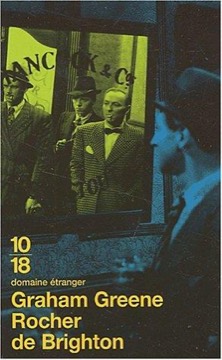
Brighton Rock
(Brighton rock) : roman
Graham Greene's 1938 novel about a seventeen-year-old gang leader in Brighton, the murder he commits, and the woman who decides to see him caught.
- First published
- 1938
- Publisher
- Éditions 10/18
- Pages
- 456
- Shelf
- Thriller
- Level
- Core
- ISBN-13
- 9782264033925
Record checked against
Two sources agreed on 1938; a third reported differently (openlibrary 1966, wikidata 1938, wikipedia 1938).
Catalogue note
- Reads as
- ReflectiveChanges how you see rather than what you do.
- Level
- Core / BuildingAssumes general familiarity with the subject.
- Approach
- Theoretical
- Written for
- Readers who mean to stop at one more chapter, Readers with some grounding
Saved in this browser only — no account, nothing sent anywhere. My library
Read this if
- You want to be kept up late, and made uneasy about who to believe.
- You read for the writing as much as for the argument.
- You want a book that changes how you see things rather than what you do tomorrow.
- You know roughly how the subject works and want the fuller account.
The premise
Pinkie Brown, seventeen and running a small protection racket after his predecessor's death, arranges the killing of a journalist who had exposed the previous gang leader.
A waitress named Rose can place one of his men at the scene. A woman called Ida Arnold, who met the victim shortly before he died, decides that somebody ought to do something about it.
A seventeen-year-old murderer, a witness he has to marry, and a stranger who will not let it go.
Devmark’s reading — not a quotation from the book
Pinkie
He is violent, ambitious, sexually repulsed by everything, and a lapsed Catholic who believes entirely in damnation and not at all in the possibility of grace.
He is among the most frightening characters in English fiction precisely because his theology is coherent. He is not amoral; he has a morality and has concluded he is beyond it.
The theology
The novel's central opposition is not good against evil but the religious against the secular: Pinkie and Rose share a Catholic framework, and Ida operates on ordinary decency.
Greene's sympathies are genuinely unclear. Ida is right and is presented as shallow; Pinkie is monstrous and is taken seriously in a way she is not.
Rose
She is sixteen, poor, plain, Catholic and entirely devoted to Pinkie from the moment he pays her any attention.
Her willingness to be damned alongside him is the novel's most disturbing element, and Greene refuses to present it as stupidity, which would have made it easier to read.
Ida Arnold
Cheerful, promiscuous, fond of a drink, and possessed of an uncomplicated conviction that right and wrong exist and that she can tell the difference.
She is the closest thing to a detective and is treated by the novel with a condescension that many readers find its most objectionable feature.
Brighton
The seaside town is rendered as two places at once: the pier, the pleasure gardens and the day trippers, and behind them the boarding houses, the razor gangs and the racecourse rackets.
The contrast is used continuously, and the geography is specific enough that the locations can be followed.
Violence
The razor attacks and the intimidation are described briefly and with considerable force, and the violence is squalid rather than dramatic.
Greene's restraint makes the few extended sequences considerably worse, and the novel is more physically frightening than its literary reputation suggests. The vitriol attack in particular is handled in a few lines and is more disturbing for it, and Greene never returns to describe the injury afterwards.
Prose
Dense, image-heavy and frequently beautiful, with a persistent religious vocabulary applied to ordinary objects.
It is the most stylistically ambitious book in this section, and the writing is doing theological work rather than decorating the thriller underneath. Greene also uses Brighton's cheerfulness against itself continuously, placing the worst events beside bandstands and ice cream and day-trip crowds.
Genre
Greene classified it as an entertainment in some editions and as a novel in others, and the uncertainty is instructive.
It functions completely as a crime novel and is also a serious work about salvation, and the two do not interfere with each other at any point.
The ending
The final scene is among the cruellest in English fiction and turns on a gramophone record, and Greene stops immediately afterwards.
The famous last line has been read as a small mercy and as the opposite, and both readings are supported. Greene also refuses to show what follows, stopping at the moment before the consequence rather than depicting it, which is the same choice King later made in Pet Sematary.
The adaptations
A 1948 film with Richard Attenborough is excellent and softens the ending substantially; a 2010 version relocates the story to the 1960s.
The 1948 film's alteration removes precisely the cruelty the novel is constructed to deliver. Greene co-wrote the 1948 screenplay himself, which makes the softened ending his own decision rather than an imposition, and he defended it afterwards.
Who it is for
Readers who want crime fiction that is also serious literature, and who are not put off by an explicitly Catholic framework.
It is the best-written book in this section and among the bleakest. Readers with no interest in the theology will still find a first-rate thriller underneath it.
What to take away
- 01A coherent theology of damnationPinkie is not amoral; he has a framework and has concluded he is outside its mercy, which is why he frightens.
- 02Religious against secular, not good against evilPinkie and Rose share a Catholic vocabulary and Ida operates on ordinary decency, and Greene's sympathies are genuinely unclear.
- 03Devotion refused the excuse of stupidityRose's willingness to be damned alongside him is never presented as foolishness, which would have made it easier to read.
- 04Two towns at onceThe pier and the day trippers sit against the boarding houses and the razor gangs, and the contrast runs continuously.
- 05Religious vocabulary on ordinary objectsThe prose does theological work rather than decorating the crime plot beneath it.
- 06An ending that stops immediatelyThe final scene turns on a gramophone record and Greene ends there, with the last line readable as mercy or its opposite.