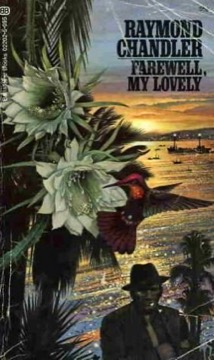
Farewell, My Lovely
Raymond Chandler's 1940 novel, in which a chance encounter with a huge ex-convict looking for a lost girlfriend draws Marlowe into a second, unrelated case. Generally held to be his best-plotted book.
- First published
- 1940
- Publisher
- Bruguera
- Pages
- 266
- Shelf
- Thriller
- Level
- Core
- ISBN-13
- 9798507574407
Record checked against
Catalogue note
- Reads as
- ReflectiveChanges how you see rather than what you do.
- Level
- Core / BuildingAssumes general familiarity with the subject.
- Approach
- Theoretical
- Written for
- Readers who mean to stop at one more chapter, Readers with some grounding
Saved in this browser only — no account, nothing sent anywhere. My library
Read this if
- You want to be kept up late, and made uneasy about who to believe.
- You read for the writing as much as for the argument.
- You want a book that changes how you see things rather than what you do tomorrow.
- You know roughly how the subject works and want the fuller account.
The premise
Marlowe is on an errand in a black neighbourhood on Central Avenue when he is picked up, almost absent-mindedly, by Moose Malloy — an enormous man just out of prison after eight years, looking for a woman named Velma who used to sing in a club that has changed hands.
The encounter ends in a killing that the police have no great interest in solving, and Marlowe, with no client and no fee, keeps looking.
He is not hired. He simply cannot leave it, which is the whole of his character.
Devmark’s reading — not a quotation from the book
Two plots, one solution
The novel runs a second case alongside the first: a jewel robbery, a handover that goes wrong, and a wealthy household with a young wife and an older husband.
Chandler braids them with much more control than in his debut. The satisfaction of the ending is that the two lines turn out to be one, and unlike The Big Sleep the machinery genuinely holds.
Moose Malloy
Malloy is the book's great creation: immense, sentimental, dangerous without temper, and entirely fixed on a woman he has not seen in eight years.
He is written with real tenderness. The novel's emotional weight sits almost entirely on his patience, and the contrast between his simplicity and the sophistication around him is the engine of the whole thing.
The middle section
Marlowe is drugged and confined in a private clinic, and the recovery sequence — disordered, furious, slowly clearing — is among the strongest writing Chandler did.
It also serves the plot. He emerges with nothing but anger and a name, and the second half is driven by a grievance rather than by a commission.
Corruption as the system
Bay City, the fictionalised Santa Monica, is run as a business: the police take money, the gambling ships sit outside the jurisdiction, and the respectable and the criminal are the same people at different hours.
Chandler's political vision is at its clearest here. The detective's usefulness is not that he can outfight the machine but that he is the only person present who has not been bought.
Everyone in the city is on a payroll. That, and nothing else, is what makes him unusual.
Devmark’s reading — not a quotation from the book
Race in the opening chapters
The Central Avenue scenes contain racial language and attitudes that are ugly and that the novel does not examine. Marlowe's narration is casually contemptuous in ways that are not framed as characterisation.
It is worth stating without softening. The same pages are also alert to the fact that the police regard a killing in that neighbourhood as not worth investigating, which is the observation the plot is built on.
The supporting cast
Anne Riordan, a policeman's daughter who does real investigative work, is the most capable and least punished woman in Chandler's fiction, and the book is better whenever she is present.
Against her sits a gallery of grotesques — a psychic, a hotel clerk, a drunken widow — written with a relish that occasionally overwhelms the scene.
Comedy
It is much funnier than its reputation. The set piece with Jessie Florian and a bottle of bourbon, and Marlowe's interview with the psychic, are sustained comic writing.
The humour is not relief from the bleakness; it is the same faculty. What makes a line funny is the same precision that makes an observation uncomfortable.
Rewriting the pulps
Like its predecessor, the novel was built by combining earlier short stories, a process Chandler called cannibalising. Three magazine pieces supply most of its incidents.
He was better at it the second time. The seams are largely invisible, and material originally written for a different detective was rethought rather than transplanted.
The ending
The resolution is melancholy rather than triumphant, and the final revelation lands as loss instead of as cleverness.
This is the shape Chandler preferred and the one his imitators most often miss. Solving the case does not repair anything, and the book is honest about how little has been achieved.
Its standing
It is frequently named the strongest of the Marlowe novels, on the grounds that it combines the voice of the first with a plot that actually works.
Readers who prefer The Long Goodbye usually do so for its greater emotional range. Those who prefer this one do so because it is the most purely enjoyable.
Where to start
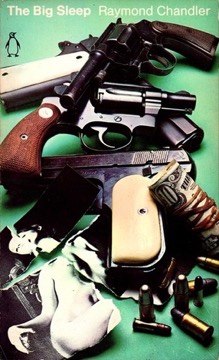
It reads perfectly well before The Big Sleep, and some readers are better served by beginning here, since the plotting is tighter and the pleasures are the same.
Nothing in it depends on the earlier book. The only cost is meeting Marlowe already formed, without the introduction the debut provides.
What to take away
- 01Two cases that are oneThe braiding of an unpaid missing-person search and a jewel robbery is Chandler's most controlled piece of construction.
- 02A client is not requiredMarlowe pursues the case with no fee and no authority, which is the clearest statement of what he is.
- 03Sentiment in a bruteMoose Malloy's eight-year patience carries the novel's emotional weight and offsets the surrounding cynicism.
- 04Corruption as the defaultBay City is run as a business, so the detective's only real advantage is that nobody has bought him.
- 05Comedy and precision are the same facultyThe funniest passages come from exactly the observational exactness that makes the bleak ones land.
- 06Solving nothingThe resolution is written as loss rather than triumph, which is the note most imitators fail to reproduce.