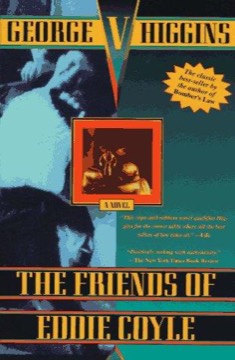
The Friends of Eddie Coyle
George V. Higgins's 1970 debut about a low-level Boston gun dealer facing a prison sentence and deciding what to trade for it. A crime novel told almost entirely in dialogue.
- First published
- 1970
- Publisher
- מ. מזרחי
- Pages
- 192
- Shelf
- Thriller
- Level
- Core
- ISBN-13
- 9780312429690
Record checked against
Two sources agreed on 1970; a third reported differently (openlibrary 1972, wikidata 1970, wikipedia 1970).
Catalogue note
- Reads as
- ReflectiveChanges how you see rather than what you do.
- Level
- Core / BuildingAssumes general familiarity with the subject.
- Approach
- Theoretical
- Written for
- Readers who mean to stop at one more chapter, Readers with some grounding
Saved in this browser only — no account, nothing sent anywhere. My library
Read this if
- You want to be kept up late, and made uneasy about who to believe.
- You read for the writing as much as for the argument.
- You want a book that changes how you see things rather than what you do tomorrow.
- You know roughly how the subject works and want the fuller account.
The premise
Eddie Coyle is a middle-aged, unimportant man in the Boston criminal economy who supplies handguns to people who rob banks. He is awaiting sentencing in New Hampshire for driving a truckload of stolen liquor.
He does not want to go to prison, so he begins talking to a federal agent about what he might be able to give in exchange for a word to the judge.
Not a criminal mastermind. A man with a sentencing date trying to buy a favour.
Devmark’s reading — not a quotation from the book
The dialogue method
Higgins was an assistant US attorney who had listened to years of wiretaps, and the novel is built almost entirely from conversation, with minimal description and almost no interiority.
Characters talk at length, digress, repeat themselves and tell anecdotes that go nowhere. Plot arrives sideways, inside talk that appears to be about something else.
What is deliberately missing
There are no action set pieces of the usual kind. Robberies happen and are described afterwards by people who were not there, and the most violent events reach the reader as reports.
The refusal to dramatise is the book's governing decision. It puts the reader in the position of an investigator hearing about things rather than a spectator watching them.
The economy it describes
The novel maps a small ecosystem: bank robbers, a bartender who fences and informs, a gun supplier, a machine-gun source, and the federal agents who run all of them against each other.
Nobody is powerful. Everyone is managing a small margin and a set of obligations, and the book is very exact about the prices — of a handgun, of a favour, of a name.
Informing as the subject
Almost every character is trading information with someone. The question is never whether a person will inform but on whom, for what, and whether the buyer will honour it.
Higgins treats this as the actual structure of organised crime rather than as a betrayal of it, which was a genuinely new emphasis in 1970.
Eddie himself
He is tired, worried about his family, physically unimpressive and nicknamed for an injury inflicted as a punishment years earlier.
The novel's sympathy for him is real but unsentimental. He is not a good man and not an interesting one, and the book's achievement is making an unremarkable person's predicament absorbing.
Boston
The geography is precise — specific bars, roads, suburbs and courthouses — and the speech is closely observed local idiom rather than generic tough talk.
Higgins effectively invented the Boston crime novel as a form, and the line from this book to Lehane, to Mystic River and to a generation of films is direct.
Structure
Chapters alternate between conversations, often without immediately establishing who is speaking or why the scene matters. Connections become clear several chapters later.
It demands attention. A reader who skims will lose the thread, because the information that turns the plot is usually delivered in a subordinate clause by someone who is complaining about something else.
The morality
There is no judgement offered. Police manipulate, criminals inform, and the institutional players behave with the same instrumentality as the professional ones.
The book is cold in a way that reads as honesty rather than posture. Nobody gets a speech, and nobody is given a moment of self-understanding.
Its reputation among writers
Elmore Leonard called it the best crime novel ever written and reshaped his own dialogue after reading it, which is the clearest single line of influence in the modern genre.
Its standing among practitioners has always exceeded its general fame, and it is frequently the book crime writers name when asked what taught them.
The novel that other crime writers cite when asked what changed their method.
Devmark’s reading — not a quotation from the book
The film
Peter Yates's 1973 adaptation with Robert Mitchum is faithful in tone and frequently in exact dialogue, and is one of the better American crime films of its decade.
The novel is still harder. Its refusal to show events is not reproducible on screen, and the film necessarily dramatises what the book only reports.
Reading it now
It is short and reads quickly once the method clicks, which for most readers is somewhere in the second chapter.
Expect to be disoriented at first, to have to work out who is talking, and to find that the plot has advanced considerably while you were listening to two men complain about a car.
What to take away
- 01Dialogue as the entire methodBuilt from talk, with minimal description and no interiority, drawn from years of listening to real wiretaps.
- 02Events reported, not shownRobberies and killings reach the reader secondhand, putting them in an investigator's position rather than a spectator's.
- 03Informing is the structureEveryone trades information; the question is only on whom and for what, which was a new emphasis for crime fiction.
- 04A small economy, precisely pricedThe book is exact about what a handgun, a favour and a name actually cost in this ecosystem.
- 05An unremarkable protagonistEddie is neither clever nor interesting, and making his predicament absorbing is the novel's real achievement.
- 06Influence through practitionersElmore Leonard reshaped his dialogue after reading it, and the Boston crime novel descends from here.