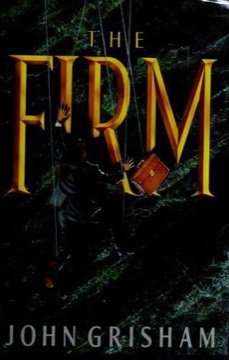
The Firm
John Grisham's 1991 novel about a young lawyer recruited by a Memphis tax firm that pays extraordinarily well and does not let people leave. The book that made the legal thriller a mass genre.
- First published
- 1991
- Publisher
- BCA
- Pages
- 496
- Shelf
- Thriller
- Level
- Entry
- ISBN-13
- 9780099537090
Record checked against
Catalogue note
- Reads as
- ReflectiveChanges how you see rather than what you do.
- Level
- Accessible / FoundationalNo prior reading assumed.
- Approach
- Theoretical
- Written for
- Readers who mean to stop at one more chapter, Newcomers to the subject
Saved in this browser only — no account, nothing sent anywhere. My library
Read this if
- You want to be kept up late, and made uneasy about who to believe.
- You read for the writing as much as for the argument.
- You want a book that changes how you see things rather than what you do tomorrow.
- You are starting from scratch here and want a way in that assumes no prior reading.
The premise
Mitch McDeere graduates near the top of his Harvard Law class, poor and ambitious, and accepts an offer from a small Memphis firm that outbids everyone: high salary, low-interest mortgage, a car, and his student debt cleared.
The terms are too good, the partners are unusually interested in his marriage, and no associate has ever left the firm alive.
The offer is better than anyone else's, which is the first thing wrong with it.
Devmark’s reading — not a quotation from the book
The hook
The premise works because it inverts an aspiration. A dream job, offered to someone who has earned it and needs it, becomes the trap.
Grisham's insight was that professional ambition is a strong enough motive to carry a thriller, and that readers would recognise the pressure without needing it explained.
The procedural texture
Grisham practised law for nearly a decade, and the detail about billable hours, partnership tracks, associate culture and tax structures is accurate and used for plot.
The money-laundering mechanism at the centre is explained clearly enough to be followed and technically enough to be plausible.
Mitch
He is intelligent, competitive and not especially scrupulous, and a good deal of the novel's tension comes from his willingness to consider staying.
Grisham keeps him self-interested to the end. The escape plan is driven by calculation rather than by conscience, which is the book's most honest decision.
Structure and pace
Short chapters, multiple viewpoints including the FBI and the firm's own security staff, and a steady tightening as surveillance closes around a protagonist who cannot let anyone see that he knows.
The middle third — Mitch aware that he is watched and having to perform ordinary contentment for people trained to notice — is the most effective sustained sequence in the book.
Surveillance
The firm bugs homes, tracks travel and reads mail, and the novel is genuinely good on the psychology of being observed: the exhaustion of performing ordinary behaviour.
This material has aged better than anything else in the book, since the technology has become cheaper rather than obsolete.
Abby
Mitch's wife is given a real role in the escape and some of the plan's better ideas, though the marriage subplot is resolved more conveniently than it is set up.
She is more capable than most spouses in the genre at this date and still substantially defined by the protagonist's situation.
The prose
Functional and transparent, with dialogue carrying most of the work, short paragraphs, and almost no figurative language anywhere in the book.
Grisham writes to be read quickly on a plane and does not attempt anything else. The style is a delivery mechanism rather than an object of interest, and it is entirely successful on the terms it sets itself.
What it did to publishing
Its success established the legal thriller as a reliable commercial category, and Grisham's subsequent output defined the template: an ordinary professional, an institutional threat, a technical mechanism, a fast escape.
The genre's centre of gravity moved from courtroom drama to institutional conspiracy largely because of this book.
Turow, and the difference
Presumed Innocent preceded it by four years and is the better novel by most literary measures, but Grisham reached a far wider audience.
The distinction is instructive: Turow wrote a legal novel with a crime in it, and Grisham wrote a thriller that happened to be set in a law firm.
One writer used the law to complicate a story. The other used it to accelerate one.
Devmark’s reading — not a quotation from the book
The film
The 1993 adaptation changes the ending substantially, giving Mitch a solution based on legal ethics rather than on money.
The novel's ending is more cynical and more satisfying on its own terms, and readers who know the film will find the book's conclusion notably colder.
Reading it now
It remains an extremely efficient thriller and an easy entry to the genre. No legal knowledge is required.
Expect thin characterisation and a plot that depends on a few conveniences. Expect also to keep turning pages, which is the only thing it is trying to achieve.
What to take away
- 01Ambition as the trapThe premise inverts an aspiration: the dream offer, made to someone who needs it, is the mechanism of capture.
- 02Practitioner detailBillable hours, partnership tracks and tax structures are accurate and used to drive plot rather than to decorate it.
- 03A self-interested protagonistMitch seriously considers staying, and his escape is calculated rather than principled.
- 04The exhaustion of being watchedThe novel is genuinely good on the effort of performing normality under surveillance — the part that has aged best.
- 05Thriller first, legal secondUnlike Turow, Grisham uses the law to accelerate a story rather than to complicate one.
- 06A genre establishedIts success moved the legal novel's centre of gravity from courtroom drama to institutional conspiracy.