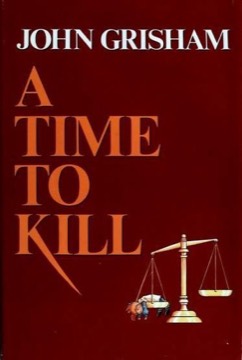
A Time to Kill
John Grisham's 1989 first novel, in which a Black father in Mississippi kills the two men who raped his daughter, and a young white lawyer defends him.
- First published
- 1989
- Publisher
- VKT
- Pages
- 515
- Shelf
- Thriller
- Level
- Entry
- ISBN-13
- 9780553745191
Record checked against
Catalogue note
- Reads as
- ReflectiveChanges how you see rather than what you do.
- Level
- Accessible / FoundationalNo prior reading assumed.
- Approach
- Theoretical
- Written for
- Readers who mean to stop at one more chapter, Newcomers to the subject
Saved in this browser only — no account, nothing sent anywhere. My library
Read this if
- You want to be kept up late, and made uneasy about who to believe.
- You want to think harder about what is actually right.
- You want a book that changes how you see things rather than what you do tomorrow.
- You are starting from scratch here and want a way in that assumes no prior reading.
The premise
In a small Mississippi town, a ten-year-old Black girl is raped and left for dead by two white men. They are arrested, and her father shoots them both in the courthouse.
Carl Lee Hailey is charged with capital murder. Jake Brigance, a young local attorney, takes the defence and attempts an insanity plea in a county where the jury will be almost entirely white.
Its origin
Grisham, then a practising lawyer and state legislator, watched the testimony of a young rape victim in a Mississippi courtroom and began imagining what would have happened if her father had taken revenge.
He wrote the book over three years in early mornings before work. It sold poorly on publication and was reissued successfully after The Firm.
The legal question
The novel is organised around whether a jury will apply the law or their sympathies, and whether those can be separated when the defendant's act is widely felt to be justified.
Grisham is more interested in jury selection, venue and the mechanics of an insanity defence than in courtroom rhetoric, which gives the book real procedural substance.
Race
The treatment is direct: the Klan reorganises, the National Guard is deployed, and the novel is explicit that the verdict depends on the racial composition of a jury.
Its perspective nonetheless remains that of a sympathetic white attorney, and the most substantial criticism of the book is that Carl Lee is largely a figure to be defended rather than a consciousness the reader occupies.
Jake Brigance
Ambitious, underfunded and personally endangered by the case, Jake is the most fully realised character Grisham had written at that point.
His motives are mixed — genuine conviction, and a clear awareness that the case will make his career — and the novel does not tidy that up.
The supporting cast
A disbarred alcoholic mentor, a young female law student, a local sheriff and a judge under political pressure fill out a town whose institutions are all personally entangled.
The small-town legal ecosystem is the book's strongest material and the thing that distinguishes it from Grisham's later, more mechanical work.
Length and pace
It is considerably longer and slower than his subsequent novels, with extended passages on procedure, county politics, church attendance and domestic life that no later Grisham would tolerate.
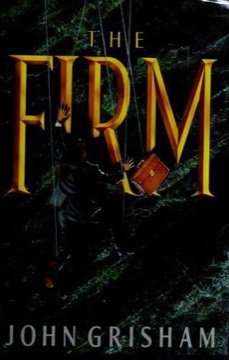
Readers coming from The Firm should expect a different rhythm entirely. The digressions are what give the town its weight, and they are the point rather than an inefficiency.
The moral position
The novel is broadly sympathetic to Carl Lee's act, and critics have argued that it endorses vigilante violence when the provocation is sufficient.
Grisham complicates this less than he might. The book's emotional current runs clearly in one direction even as the legal argument tries to remain neutral.
The argument in the courtroom is balanced. The book is not.
Devmark’s reading — not a quotation from the book
Violence against a child
The assault is described early, briefly and with enough detail to establish the stakes, and its aftermath recurs throughout.
It is the hardest material in the novel and readers should be prepared for it. It is not dwelt on, but it is not softened either.
Its place in his work
Grisham has said it remains his favourite of his own novels, and he returned to Jake Brigance in two later books, Sycamore Row and A Time for Mercy.
It is the least formulaic thing he has written, largely because it was written before he had a formula and before he had any reason to expect an audience.
The film
The 1996 adaptation is faithful in outline and closes on the closing argument, giving the story a cleaner and more uplifting emotional shape than the novel's more procedural ending.
The book spends far more time on jury selection, on the Klan subplot and on the town's ordinary business, which is where its real interest lies.
Reading it now
It is the strongest Grisham for readers who want character and place rather than mechanism, and it works entirely as a standalone.
Its politics are of its moment and its perspective is limited in ways worth noticing, but the courtroom and community writing remain genuinely good.
What to take away
- 01Law against sympathyThe novel is organised around whether a jury can separate what the law requires from what they feel is deserved.
- 02Procedure over rhetoricJury selection, venue and the mechanics of an insanity plea carry more weight than courtroom speeches.
- 03A limited perspective, honestly notedThe story is told from a sympathetic white attorney's position, and Carl Lee is defended more than inhabited.
- 04Mixed motives left mixedJake's conviction and his career ambition are both real, and the book declines to resolve them.
- 05The town as ecosystemA disbarred mentor, a pressured judge and an entangled sheriff make the small-town legal world the book's best material.
- 06Written before the formulaLonger, slower and more digressive than his later work, because the template did not yet exist.