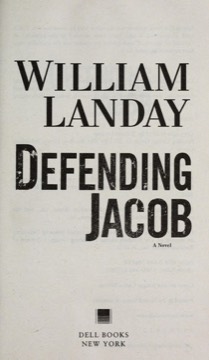
Defending Jacob
William Landay's 2012 novel about an assistant district attorney whose fourteen-year-old son is charged with murdering a classmate.
- First published
- 2012
- Publisher
- Dell Books
- Pages
- 419
- Shelf
- Thriller
- Level
- Entry
- ISBN-13
- 9781409121060
Record checked against
Catalogue note
- Reads as
- ReflectiveChanges how you see rather than what you do.
- Level
- Accessible / FoundationalNo prior reading assumed.
- Approach
- Theoretical
- Written for
- Readers who mean to stop at one more chapter, Newcomers to the subject
Saved in this browser only — no account, nothing sent anywhere. My library
Read this if
- You want to be kept up late, and made uneasy about who to believe.
- You want a life told honestly, at full length.
- You want to think harder about what is actually right.
- You want a book that changes how you see things rather than what you do tomorrow.
- You are starting from scratch here and want a way in that assumes no prior reading.
The premise
Andy Barber is first assistant district attorney in a Massachusetts county when a boy is found stabbed in a park. He takes the case, and then his own son Jacob becomes the suspect.
He is removed from the prosecution, the family closes around itself, and the novel follows the year between charge and trial.
He was prosecuting the case until the fingerprint came back as his son's.
Devmark’s reading — not a quotation from the book
The frame
The narrative is presented as Andy's testimony to a grand jury some time after the trial, with the transcript interleaved throughout.
The device establishes early that something further has happened, and it means every chapter is being recounted by a man under examination. Landay also withholds the subject of the grand jury investigation, so the transcript operates as a slow disclosure alongside the main narrative.
Parental certainty
Andy's conviction of his son's innocence is established as absolute and is progressively shown to be a position rather than a conclusion.
The novel's real subject is what a parent will decline to see, and Andy's narration is unreliable in a way he does not recognise and the reader gradually does.
Laurie
Jacob's mother moves in the opposite direction, and the marriage's disintegration under the pressure of two incompatible beliefs about the same child is the book's strongest material.
Landay gives her a coherent position and does not treat her doubt as disloyalty, which is what makes the conflict work.
The murder gene
A defence expert proposes a genetic predisposition to violence, and Andy's own concealed family history — a father and grandfather convicted of violent crimes — becomes evidence.
The science is presented sceptically by several characters and the novel does not endorse it, using it instead as a pressure on Andy's self-understanding.
Legal accuracy
Landay was an assistant district attorney in Boston, and the procedure is exact: grand jury mechanics, discovery, plea dynamics, and the specific awkwardness of a prosecutor's family inside a prosecution.
The insider material is the book's most reliable pleasure. The material on how a prosecutor's office handles a conflict of interest is particularly good, and it drives several of the book's early complications.
Jacob
The son is withdrawn, difficult to read, and the novel deliberately withholds access to his interiority.
Every assessment of him comes from adults with an interest, which means the reader cannot form an independent judgement, and the ambiguity is structural. He is also permitted to be genuinely unpleasant in several scenes, which the novel neither excuses nor treats as proof of anything.
The internet material
Jacob's online activity, including a story he wrote and a private group he belonged to, supplies the prosecution's most damaging evidence.
The treatment is dated in its specifics and accurate in its general point about how a teenager's digital record reads to people who did not produce it.
Pace
The middle section is slow, occupying months of waiting, and the book is frank that this is what the period between charge and trial actually involves.
Readers who want incident will find the domestic stretches long, and they are where the marriage material does its work.
The ending
The final movement delivers two reversals in quick succession, and the last is genuinely shocking and has divided readers sharply.
It is prepared, and it is also the point at which the novel commits to an answer after three hundred pages of refusing one, which some readers regard as a betrayal of its method.
The adaptation
A 2020 television series expands the material considerably and alters the ending's emphasis.
The novel is tighter and its first-person limitation is the element the adaptation necessarily loses, since a camera shows the reader things Andy does not narrate. The series also relocates several scenes and gives Laurie considerably more screen time, which alters the balance between the two parents.
Who it is for
Readers who want a legal thriller that is actually about a marriage, and who can accept an ending that resolves what the book had kept open.
It is well constructed and genuinely upsetting. Readers who dislike late reversals should know the last one is substantial.
What to take away
- 01A position mistaken for a conclusionAndy's certainty about his son is shown to be a stance he adopted rather than an inference he reached.
- 02Two beliefs about one childThe marriage disintegrates because the parents move in opposite directions, and the novel gives the doubting parent a coherent case.
- 03Interiority withheldEvery assessment of Jacob comes from an adult with an interest, so the reader cannot judge him independently.
- 04Testimony as the frameThe whole narration is delivered to a grand jury after the fact, establishing early that something further occurred.
- 05Science used as pressure, not proofThe genetic predisposition argument is treated sceptically and functions as a strain on Andy's self-understanding.
- 06Waiting rendered accuratelyThe long middle occupies the months between charge and trial, which is what that period actually contains.