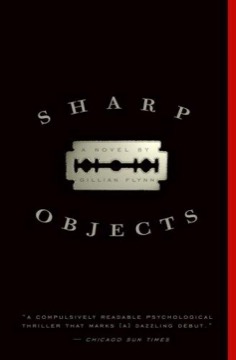
Sharp Objects
Gillian Flynn's first novel: a reporter returns to the town she grew up in to cover the killings of two girls, and finds that she cannot report on it from any distance at all.
- First published
- 2006
- Publisher
- Random House Audio
- Pages
- 312
- Shelf
- Mystery
- Level
- Core
- ISBN-13
- 9781597224581
Record checked against
Catalogue note
- Reads as
- ReflectiveChanges how you see rather than what you do.
- Level
- Core / BuildingAssumes general familiarity with the subject.
- Approach
- Theoretical
- Written for
- Readers who want to be kept up late, Readers with some grounding
Saved in this browser only — no account, nothing sent anywhere. My library
Read this if
- You want to be kept up late, and made uneasy about who to believe.
- You want a life told honestly, at full length.
- You want a book that changes how you see things rather than what you do tomorrow.
- You know roughly how the subject works and want the fuller account.
The premise
Camille Preaker is a journalist at a second-rate Chicago paper, recently discharged from a psychiatric hospital, sent back to Wind Gap, Missouri to write about two dead children. Going back means living in her mother's house, which is the thing she has spent her adult life not doing.
The murders are the occasion rather than the subject. What the book is actually about is a household — a mother, two daughters, a great deal of money and a particular kind of Southern-gothic control that expresses itself as care.
The crime story is a way into a house that the narrator has been avoiding her whole life.
Devmark’s reading — not a quotation from the book
How it is built
Camille narrates, and she self-harms by cutting words into her skin, so the novel's central metaphor is also its literal plot: a body used as a page. Flynn keeps the device from becoming decorative by making it practical — which words are visible, what she can wear, what she cannot let anyone see.
It is short, close and claustrophobic. The town is small, the cast is small, and the book rarely lets Camille get more than a room away from the people she came to escape.
Themes
The novel's real subject is femininity as something inflicted: taught, enforced and passed down between women who have no other tools. Three generations of one family do this to each other, and the book declines to let any of them be simply a victim.
It is also about the limits of professional distance. Camille's job requires objectivity about material she is standing inside, and the book treats that demand as slightly absurd.
Flynn writes women who are damaging, not only damaged — which at publication was still unusual.
Devmark’s reading — not a quotation from the book
Words on skin
The narrator has carved words into her own body over years, and the novel's prose keeps surfacing them — a word she is sitting on, a word that itches. It is the most unusual formal device in the book: the self-harm is not a backstory detail but a running feature of the sentences, so the reader is never allowed to set it aside.
The narration keeps naming the words on her skin, so the damage is never merely past.
Devmark’s reading — not a quotation from the book
The town
Wind Gap is drawn with real economic specificity — the hog-processing plant the family owns, the hierarchy it enforces, the girls whose futures are already allocated. The claustrophobia is social and financial before it is psychological, and the crimes are legible only inside that structure.
Mothers and daughters
The novel's actual subject is inheritance between women: what is taught, withheld, performed and passed down as care. Flynn writes several varieties of maternal attention that are indistinguishable from control, and the book is far more interested in that than in the identity of a killer.
Returning as a reporter
Sending a damaged journalist home to report on her own town lets Flynn use the interview as a structural form: Camille is professionally obliged to ask neighbours, old schoolfriends and her own family direct questions she would never otherwise be able to raise, and to write down the answers. The assignment becomes the excuse for an excavation she would not have chosen and cannot now stop.
Girls and violence
The book is deliberately about violence enacted by and upon girls, a combination crime fiction usually splits along tidy lines. Flynn has said the absence of genuinely violent women in fiction was part of what she set out to correct, and this was the first attempt.
Three generations
The household contains a mother, an adult daughter returning, and a half-sister on the edge of adolescence, and the novel sets them against each other continuously. What is being transmitted down that line — attention, illness, performance, control — is the question the crime plot exists to force into the open.
The investigation is the pretext. The subject is what gets handed from one woman to the next.
Devmark’s reading — not a quotation from the book
What kind of book it is
It is short, extremely dark, and contains sustained depictions of self-harm, child death and disordered eating. It is a first novel and occasionally shows it in the plotting, but the voice is already fully formed, and readers who came from the later books will recognise everything that makes them work.
What to take away
- 01The body as textCamille's scars are literal writing, and the book refuses to treat that as only symbolic.
- 02Inherited harmFemininity passes down this family as a discipline, enforced by the people who suffered it first.
- 03Care as controlThe most frightening figure in the novel is attentive, warm and always looking after someone.
- 04No safe distanceReporting on your own childhood is the job the novel sets its narrator, and it does not go well.
- 05Small and airlessThe compression is the point: there is nowhere in Wind Gap to stand and be objective.