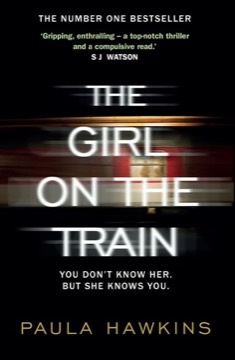
The Girl on the Train
Paula Hawkins's novel about a woman who watches the same house from the same commuter train every morning, invents a life for the couple who live there, and then sees something that does not fit. A study of what an unreliable witness is actually unreliable about.
- First published
- 2015
- Publisher
- Anchor Canada
- Pages
- 360
- Shelf
- Mystery
- Level
- Entry
- ISBN-13
- 9781784161750
Record checked against
Catalogue note
- Reads as
- ReflectiveChanges how you see rather than what you do.
- Level
- Accessible / FoundationalNo prior reading assumed.
- Approach
- Theoretical
- Written for
- Readers who want to be kept up late, Newcomers to the subject
- Ideas
Saved in this browser only — no account, nothing sent anywhere. My library
Read this if
- You want to be kept up late, and made uneasy about who to believe.
- You want a book that changes how you see things rather than what you do tomorrow.
- You are starting from scratch here and want a way in that assumes no prior reading.
The premise
Rachel takes the 8:04 into London and back again every day, past the street where she used to live. She drinks, heavily and secretly, and her days have lost most of their structure. To fill them she has constructed a story about a couple she can see from the window, whom she has never met and has named herself.
Then the woman disappears, and Rachel — who was in the area that night and cannot remember it — becomes convinced she knows something. The difficulty is that she is the least credible person imaginable, to the police, to everyone around her, and to herself.
She is not an unreliable narrator because she is lying. She is unreliable because she genuinely cannot remember.
Devmark’s reading — not a quotation from the book
How it is built
Three women narrate in rotation, on offset timelines, which lets the book withhold without ever obviously cheating. Rachel's blackouts are the structural device: gaps in her account are gaps in the evidence, and the reader is put in the position of trying to reconstruct a night from a witness who is doing the same thing.
It is a domestic thriller rather than a detective novel. Nobody is investigating in any professional sense; the pressure comes from proximity and from the fact that everyone involved has reason to prefer a particular version of events.
Themes
The sharpest thread is how quickly a woman who is drinking is written off, and how useful that is to everyone around her. The novel is interested in the social machinery that decides whose account counts, and in what it does to a person to be inside that machinery.
It is also about the stories we build around strangers. Rachel's invented version of the perfect couple is an escape from her own life, and the book is quietly unkind about how thin those projections are — including the ones readers are making about Rachel.
Being disbelieved often enough is its own kind of erasure.
Devmark’s reading — not a quotation from the book
What the commute is for
The daily train journey past the backs of houses is the book's organising image and its method: a woman constructing an imagined life for strangers glimpsed for seconds, then becoming convinced that she has seen something real. It establishes unreliable observation as a physical fact of the setting rather than a narrative trick.
She sees the same houses twice a day for seconds, and builds entire lives out of it.
Devmark’s reading — not a quotation from the book
The alcohol
Rachel's blackouts are the plot's engine and the book's most serious material. Hawkins writes the specific texture of not knowing what you did — the fragments, the dread, the reconstruction from other people's accounts — and makes the reader share the condition, because the narrator cannot supply what she does not have.
Three women, one man
The rotating narrators are all connected through the same person, and the structure quietly demonstrates how thoroughly each of their self-accounts has been shaped by him. The offset timelines let information arrive in an order that keeps the reader ahead of one narrator and behind another.
Being disbelieved
The sharpest thread is not the mystery but the mechanics of dismissal: how quickly a woman who drinks is written off by police, by her ex-husband, by herself, and how efficiently that dismissal can be used by someone who benefits from it. The book is better on this than on its plot.
Where it is weaker
The characters are not especially likeable and are not meant to be, but two of the three narrators are thinly drawn next to Rachel, and the resolution depends on a coincidence of geography the earlier chapters work hard to make plausible. It is a book carried by its central voice rather than its construction.
The suburb
The setting is specific and underrated: a commuter belt of near-identical houses backing onto the line, where everyone is visible from the train and nobody knows their neighbours. Hawkins uses it to make surveillance feel ordinary — half the characters watch each other routinely, and none of them thinks of it as watching.
Everyone on that street is observed daily by hundreds of strangers, and none of them notice.
Devmark’s reading — not a quotation from the book
What it belongs to
It arrived in the wave that followed Gone Girl and was marketed into it, but its interests are different: less about performance and media, more about memory, addiction and credibility. Read it for the portrait of a blackout from inside, which is the thing it does better than its shelf-mates.
What to take away
- 01Memory as evidenceThe book takes seriously what it means to be the only witness to something you cannot recall.
- 02Whose account countsCredibility here is social, not factual: it tracks respectability far more than accuracy.
- 03Three narrators, offsetThe rotating timeline withholds information structurally rather than by authorial trick.
- 04ProjectionRachel's fantasy about the couple in the window is a critique of the reader's own habit of inventing strangers.
- 05Domestic, not proceduralThere is no detective. The danger is close, ordinary and already known to everyone involved.