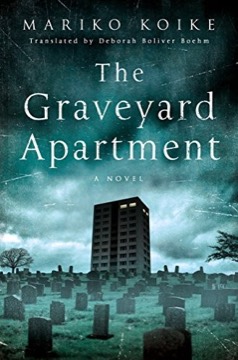
The Graveyard Apartment
Mariko Koike's 1986 Japanese horror novel about a young family who move into a new apartment block beside a graveyard, and the neighbours who leave one by one.
- First published
- 1986
- Publisher
- Thomas Dunne Books
- Pages
- 324
- Shelf
- Mystery
- Level
- Entry
- ISBN-13
- 9781250060549
Record checked against
Catalogue note
- Reads as
- ReflectiveChanges how you see rather than what you do.
- Level
- Accessible / FoundationalNo prior reading assumed.
- Approach
- Theoretical
- Written for
- Readers who want to be kept up late, Newcomers to the subject
- Ideas
Saved in this browser only — no account, nothing sent anywhere. My library
Read this if
- You want to be kept up late, and made uneasy about who to believe.
- You want a book that changes how you see things rather than what you do tomorrow.
- You are starting from scratch here and want a way in that assumes no prior reading.
The premise
Teppei, Misao and their small daughter move into a modern building in suburban Tokyo, bought cheaply because of what it overlooks: a graveyard, a crematorium and a temple.
Things begin in the basement. Over months the other residents move out, until the family is alone in a building that is behaving badly, with a marriage that already has something in it they do not discuss.
The building empties gradually, and the horror is that leaving keeps not happening.
Devmark’s reading — not a quotation from the book
How it works
Koike's method is domestic realism with the pressure slowly raised. Most of the novel is ordinary apartment life — deliveries, neighbours, the lift, the family's pet bird — with the wrongness introduced in small increments.
The most effective device is the basement lift, which turns an everyday machine into the thing you cannot stop thinking about. The scares are architectural rather than visual.
The most frightening object in the book is a lift, because it is the one you must keep using.
Devmark’s reading — not a quotation from the book
Themes
The couple's past is the second engine. Their marriage began in a way that harmed someone else, and the novel is interested in guilt that has been agreed not to discuss.
It is also a book about Japanese property in the bubble years: the rationalisations of people who bought something cheap for an obvious reason and cannot afford to admit the reason mattered.
For a reader
It is slow, domestic and cumulative rather than shocking, and its ending is abrupt in a way that divides readers sharply — some find it the most frightening thing in the book, others find it withheld.
Published in Japan in 1986 and not translated into English until 2016, which is why a novel this influential at home arrived thirty years late elsewhere, after the genre it helped shape had already reached English-language readers through film.
The block of flats
A young family buys a bargain apartment in a new building that backs onto a cemetery, a crematorium and a temple. Koike spends the first third on ordinary domestic life — schools, neighbours, the residents' association — so that the building's slow emptying registers as a housing problem before it registers as a haunting.
The basement
The threat is located almost entirely in the basement and the lift that reaches it, and the novel's method is restriction: something is down there, nobody goes, and the tension is built out of a space characters can avoid until the plot requires them not to.
Nothing chases anybody. There is simply a floor of the building nobody will go down to.
Devmark’s reading — not a quotation from the book
Everyone leaves
The most effective structural idea in the book is depopulation. Families move out one by one, each for an entirely reasonable and separately stated reason — a job, a school, a relative — and the Kanos remain because they cannot afford to leave and cannot sell. The horror is inseparable from a mortgage, which is an unusual foundation for a ghost story and an extremely effective one.
The family's history
The marriage has a past — a previous relationship that ended badly — and the novel keeps it in view as a possible explanation for what is happening. Whether the building is haunted or the family has brought something with them is deliberately left open for most of the book.
Bubble-era Japan
Written in 1986, it is a novel about property: the cost of an apartment, the compromise of buying cheap, the shame of an address, and the impossibility of selling. The period's housing market is the pressure that keeps the characters in place, and it dates the book usefully rather than badly.
The pace
It is slow by the standards of contemporary horror, with long domestic stretches and a final section that accelerates sharply. Readers who want incident throughout will find the middle patient; readers who like dread accumulating in an ordinary setting will find it the best thing about the book.
What to take away
- 01Domestic realism, slowly wrongOrdinary apartment life with increments of wrongness.
- 02The liftAn everyday machine turned into the object of dread.
- 03Guilt agreed not to mentionThe marriage's origin is the second engine.
- 04Bubble-era propertyPeople who bought cheaply and cannot admit why.
- 05Late in EnglishPublished 1986, translated 2016.