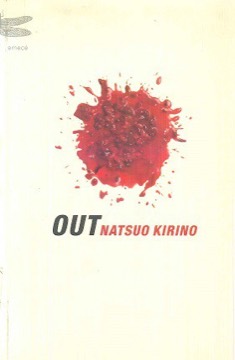
Out
Natsuo Kirino's 1997 novel about four women working the night shift at a Tokyo boxed-lunch factory, one of whom kills her husband, and what the other three agree to do about it.
- First published
- 1997
- Publisher
- Planeta
- Pages
- 616
- Shelf
- Mystery
- Level
- Core
- ISBN-13
- 9788467225822
Record checked against
Catalogue note
- Reads as
- ReflectiveChanges how you see rather than what you do.
- Level
- Core / BuildingAssumes general familiarity with the subject.
- Approach
- Theoretical
- Written for
- Readers who want to be kept up late, Readers with some grounding
- Ideas
Saved in this browser only — no account, nothing sent anywhere. My library
Read this if
- You want to be kept up late, and made uneasy about who to believe.
- You want a book that changes how you see things rather than what you do tomorrow.
- You know roughly how the subject works and want the fuller account.
The premise
Masako, Yoshie, Kuniko and Yayoi work nights assembling bento boxes in a suburb of Tokyo. Each is trapped in a different way: debt, a dependent mother-in-law, consumer credit, a violent husband.
Yayoi strangles her husband. She calls Masako. What follows is a practical problem, and the novel treats it as one.
The killing is the beginning. The book is about the logistics, and about what the logistics do to four people.
Devmark’s reading — not a quotation from the book
What it actually is
This is a crime novel that functions as social realism about women's work in 1990s Japan: the shift, the pay, the childcare, the husbands, the economics that make a factory job at midnight the only available option.
Kirino is unsentimental about solidarity. The alliance forms from necessity and degrades under pressure exactly as you would expect.
The solidarity is transactional from the first page, and Kirino never pretends otherwise.
Devmark’s reading — not a quotation from the book
Content
It is genuinely brutal, with extended sequences of body disposal and, later, sexual violence. It is not a cosy or procedural read and the violence is not stylised.
The final act moves somewhere many readers find a step too far, and that divergence is the most common criticism of the book.
Its standing
It won the Grand Prix for Crime Fiction in Japan, was the first Japanese novel shortlisted for an Edgar, and is the book that established Kirino internationally.
It is regularly cited as the foundational work of Japanese feminist noir, and its influence on later women-centred crime writing is substantial.
The factory
The novel opens on a night shift making boxed lunches on a production line — the cold, the speed, the hairnets, the hierarchy among the women, the bathroom breaks that must be requested. Kirino establishes the physical exhaustion and the economics of the work before any crime occurs, and everything afterwards follows from it.
The horror is established on the assembly line, before anybody has done anything.
Devmark’s reading — not a quotation from the book
Four women, four debts
The central group is defined by money: a woman supporting a useless husband, a woman with crushing consumer debt, an older woman caring for a mother-in-law, and one with a gambling problem. Their willingness to participate is calculated, and Kirino makes the arithmetic explicit rather than appealing to loyalty.
What it is honest about
This is crime fiction that treats the disposal of a body as physical labour: difficult, protracted, nauseating and skilled. The extended sequence is the most discussed in the book and is genuinely hard to read, and the point is that it is work — performed by women who are already very good at unpleasant repetitive tasks.
Masako
The organiser is middle-aged, ignored by her family, and was pushed out of a financial career after taking action over her treatment. Her competence has had no outlet for years, and the novel's uncomfortable suggestion is that the crime is the first thing in a long time that has used her fully.
The men
Almost every man in the book is violent, useless or predatory, and Kirino has been criticised for it. The counter-argument is structural: the novel is written from inside the experience of women for whom men have been an economic and physical threat, and the flatness is the view from that position.
What to expect
It contains graphic violence, sexual violence and dismemberment, and the ending is bleak in a way that surprised even readers prepared for the rest. It won Japan's major crime award and was the first Japanese novel nominated for the Edgar; it is a serious book and a genuinely distressing one.
What to take away
- 01Four women, one night shiftEconomic constraint is established before any crime occurs.
- 02Logistics as plotThe novel's engine is the practical problem of disposal.
- 03Transactional solidarityThe alliance is necessity, and it degrades under pressure.
- 04Unstylised violenceBrutal and deliberately not aestheticised.
- 05Feminist noirThe foundational Japanese work in that line.