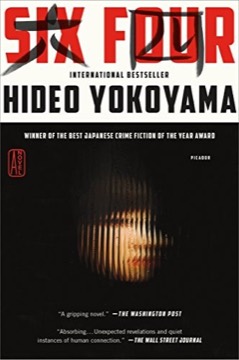
Six Four
Hideo Yokoyama's 2012 novel about a police press officer, once a detective, handling a media crisis during the fourteenth anniversary of an unsolved child abduction.
- First published
- 2012
- Publisher
- Bungei Shunjū
- Pages
- 647
- Shelf
- Thriller
- Level
- Deep
- ISBN-13
- 9784163818405
Record checked against
Catalogue note
- Reads as
- ReflectiveChanges how you see rather than what you do.
- Level
- Advanced / AdvancedAssumes you have read around the subject already.
- Approach
- Theoretical
- Written for
- Readers who mean to stop at one more chapter, Specialists and serious readers
- Ideas
Saved in this browser only — no account, nothing sent anywhere. My library
Read this if
- You want to be kept up late, and made uneasy about who to believe.
- You want a book that changes how you see things rather than what you do tomorrow.
- You have read around this already and want a book that assumes it.
The premise
Yoshinobu Mikami was a detective and is now head of media relations for a prefectural police force, a posting he regards as a demotion and a humiliation.
The commissioner general plans to visit for the anniversary of Six Four, an abduction and murder that was never solved. Mikami must manage the press, his own former colleagues, and the fact that his own daughter has run away.
A press officer who used to be a detective, managing an anniversary nobody wants marked.
Devmark’s reading — not a quotation from the book
Bureaucracy as the subject
The novel's actual material is institutional: the rivalry between administrative and criminal investigation divisions, the relationship between a prefectural force and Tokyo, and the politics of who is told what.
Very little detection occurs. The book is a workplace novel in which the workplace happens to be a police force, and the stakes are entirely about position and disclosure.
The press club
A substantial portion concerns the kisha club system, in which accredited journalists receive information on terms set by the police, and a dispute about anonymising a driver's name in a traffic fatality.
The dispute occupies hundreds of pages and is genuinely gripping, which is the clearest demonstration of what Yokoyama can do with apparently unpromising material.
Mikami
He is stubborn, professionally frustrated, poor at explaining himself, and caught between two institutional loyalties that cannot both be served.
His domestic situation — a missing daughter, a wife waiting by a telephone — runs alongside and is never resolved into a subplot the main narrative can absorb.
Length and pace
It runs to around six hundred pages and is very slow, with extended meetings, telephone calls and negotiations occupying the bulk of the book.
Readers expecting a crime novel frequently abandon it. The accumulation is the method, and the final hundred pages depend entirely on the reader having absorbed the institutional detail.
Japanese policing
The novel is specific about a system unfamiliar to most English readers: prefectural autonomy, the career paths that separate elite administrators from working detectives, and the informal obligations between them.
Yokoyama was a journalist covering police and the material is drawn from direct observation. The distinction between career officers posted from Tokyo and locally recruited detectives is the source of most of the novel's conflict and has no exact English equivalent.
The ending
The final section delivers a resolution to the original case that is genuinely surprising and arrives extremely late.
It also recontextualises the entire bureaucratic narrative, revealing that the institutional manoeuvring the reader has been following was the investigation. Yokoyama also withholds one participant's identity until the final pages, and the disclosure recasts a relationship the reader has watched throughout.
The title
Six Four refers to the case's designation by the year of the Shōwa era in which it occurred, a year that lasted only seven days before the emperor's death.
The detail is characteristic: an administrative convention that turns out to carry meaning, which is the novel's method in miniature.
Prose
Plain and heavily functional in translation, with a great deal of dialogue and very little description.
The translation by Jonathan Lloyd-Davies is generally well regarded, and the flatness suits a book about procedure and position. The dialogue in particular is extensive, and a substantial share of the novel consists of two people in a room negotiating what can be said.
Its reception
It sold over a million copies in Japan and was widely praised on English publication, though several reviewers noted that it is not the book its marketing suggested.
It was presented as a crime thriller and is a novel about organisational life. Its English publication also arrived during a period of increased interest in translated crime fiction, which helped it find readers who would not otherwise have looked.
Difficulty
The cast is large, the institutional structure is unfamiliar, and the names and ranks are demanding for a reader without background.
Most editions include a character list, and using it is not a sign of inattention. Readers unfamiliar with Japanese naming conventions may also find the surname-first ordering and the frequent use of rank rather than name an additional obstacle.
Who it is for
Readers who want a genuinely unusual crime novel and are willing to invest in six hundred pages of institutional detail before the payoff.
It is among the most rewarding books in this section for readers who commit, and among the most likely to be abandoned by those who do not.
What to take away
- 01A workplace novel with a police force in itDivisional rivalry and the politics of disclosure are the material; almost no detection occurs until the final section.
- 02A press dispute sustained for hundreds of pagesAn argument about anonymising a name in a traffic fatality is genuinely gripping, which demonstrates the author's method.
- 03Institutional manoeuvring as the investigationThe ending reveals that the bureaucratic narrative the reader has followed was the case all along.
- 04A system unfamiliar to English readersPrefectural autonomy and the career separation between administrators and detectives are specified from direct observation.
- 05A convention that carries meaningThe case's designation refers to an era-year that lasted seven days, which is the book's method in miniature.
- 06Sold as something it is notMarketed as a crime thriller and actually a novel about organisational life, which accounts for much of its divided reception.