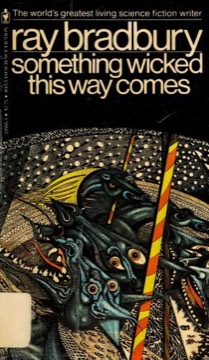
Something Wicked This Way Comes
Ray Bradbury's 1962 novel about a carnival that arrives in an Illinois town in October and offers each resident what they most want.
- First published
- 1962
- Publisher
- Easton Press
- Pages
- 278
- Shelf
- Thriller
- Level
- Core
- ISBN-13
- 9780553136951
Record checked against
Catalogue note
- Reads as
- ReflectiveChanges how you see rather than what you do.
- Level
- Core / BuildingAssumes general familiarity with the subject.
- Approach
- Theoretical
- Written for
- Readers who mean to stop at one more chapter, Readers with some grounding
Saved in this browser only — no account, nothing sent anywhere. My library
Read this if
- You want to be kept up late, and made uneasy about who to believe.
- You read for the writing as much as for the argument.
- You want a book that changes how you see things rather than what you do tomorrow.
- You know roughly how the subject works and want the fuller account.
The premise
Will Halloway and Jim Nightshade, both thirteen, are woken by a train arriving at three in the morning in late October. Cooger and Dark's Pandemonium Shadow Show sets up outside town.
The carnival's central attraction is a carousel that changes the rider's age, and the proprietor collects people by giving them what they have been wishing for.
A carousel that makes you older or younger, offered to everyone in town who is unhappy with their age.
Devmark’s reading — not a quotation from the book
Desire as the trap
Nobody is forced. Each victim is offered exactly what they want — youth, maturity, restored sight — and accepts.
The novel's argument is that unhappiness with one's own life is the vulnerability, and that the carnival is a harvesting mechanism rather than an attacking one.
Charles Halloway
Will's father is fifty-four, works as a school janitor, and is preoccupied with having become a father too late to keep up with his son.
He is the novel's real protagonist. The book is substantially about middle age looking at childhood and being unable to reach it, and his eventual counter to the carnival comes from accepting that.
Two boys
Will and Jim are born minutes apart on either side of Halloween, and the contrast — one cautious, one hungry for what comes next — organises the plot.
Jim's desire to be older is the specific vulnerability the carnival works on, and the friendship's survival is the book's genuine stake.
Prose
Bradbury writes in a heightened, incantatory register with long sentences, extensive metaphor and a strong rhythmic pulse.
It is the most stylistically extreme book in this section and is either intoxicating or exhausting. There is very little middle ground in readers' responses to it. Bradbury was writing from a screenplay he had developed and could not sell, and the prose's theatricality may owe something to that origin.
October
The season is the novel's organising atmosphere: dry leaves, early dark, the particular quality of small-town autumn before winter.
Bradbury's October is a construction rather than a description, and it has influenced an enormous amount of subsequent American horror and fantasy. It also gave its name to a collection and to a whole strand of American seasonal writing, and Bradbury returned to the material repeatedly across his career.
Laughter as the weapon
The carnival is eventually opposed not with force but with cheerfulness, on the argument that it feeds on fear and cannot process joy.
The solution is thematically consistent and dramatically thin, and it is the most common criticism of the book. It works better as an idea than as a sequence.
Mr Dark
The Illustrated Man, whose tattoos depict the people he has collected, is among the more durable antagonists in American fantasy.
He is given very little backstory and is more effective for it, operating as a principle rather than as a person with history. The tattoos are his one concrete attribute, and the image of a man wearing the people he has taken is among the most durable in the genre.
Boyhood
The novel is centrally concerned with the specific texture of being thirteen: the library at night, the ravine, the sense that adulthood is both desirable and a loss.
Bradbury is very good on this and the nostalgia is earned rather than asserted, largely because he pairs it with the father's parallel regret.
Its influence
King has named it repeatedly as formative, and its shape — a small American town, a supernatural arrival, children who see clearly — underlies a great deal of subsequent work.
The seasonal small-town horror mode is substantially this book's invention. King's Needful Things in particular is a direct response, and the pattern of an arrival that offers each resident their private wish recurs across a great deal of later fiction.
Length
It is short and reads quickly despite the prose density, with short chapters and a great deal of white space.
Readers who find the style difficult should know it does not let up, and that the book is not long enough for the difficulty to become an endurance.
Who it is for
Readers who want fantasy that is genuinely about ageing and regret, and who respond to heightened prose.
It is the most literary thing in this part of the section and the least plot-driven. Readers who want incident should look elsewhere; readers who want language will find a great deal.
What to take away
- 01Nobody is forcedEach victim accepts exactly what they wanted, which makes dissatisfaction with one's own life the actual vulnerability.
- 02Middle age as the centreThe fifty-four-year-old father is the real protagonist, and the book is about looking at childhood from outside it.
- 03A season constructedBradbury's October is an invention rather than a description, and it has shaped an enormous amount of American horror since.
- 04An antagonist without historyMr Dark is given almost no backstory and is more effective as a principle than he would be as a person.
- 05A solution better as idea than sceneDefeating the carnival with cheerfulness is thematically right and dramatically thin, which is the standard criticism.
- 06Nostalgia paired with regretThe boyhood material is earned because it sits against the father's parallel sense of having arrived too late.