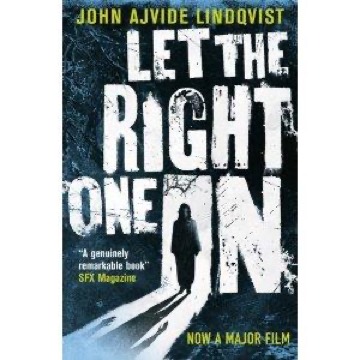
Let the Right One In
John Ajvide Lindqvist's 2004 novel about a bullied twelve-year-old in a Stockholm suburb and the child who moves in next door and only appears at night.
- First published
- 2004
- Publisher
- Ordfront
- Pages
- 472
- Shelf
- Thriller
- Level
- Core
- ISBN-13
- 9782811205454
Record checked against
Catalogue note
- Reads as
- ReflectiveChanges how you see rather than what you do.
- Level
- Core / BuildingAssumes general familiarity with the subject.
- Approach
- Theoretical
- Written for
- Readers who mean to stop at one more chapter, Readers with some grounding
Saved in this browser only — no account, nothing sent anywhere. My library
Read this if
- You want to be kept up late, and made uneasy about who to believe.
- You read for the writing as much as for the argument.
- You want a book that changes how you see things rather than what you do tomorrow.
- You know roughly how the subject works and want the fuller account.
The premise
Oskar is twelve, bullied severely at school, living with his mother in Blackeberg, a planned suburb of Stockholm built in the 1950s.
Eli moves into the next flat with an older man who kills people and drains their blood. Eli is a vampire, has been twelve for a very long time, and becomes Oskar's only friend.
He is being bullied at school. The child next door has been twelve for two hundred years.
Devmark’s reading — not a quotation from the book
The suburb
Blackeberg is a real place and the novel is specific about it: the concrete, the underground station, the swimming pool, the off-licence, the particular bleakness of Swedish social housing in the early 1980s.
The setting is the book's foundation. This is a vampire novel about a specific failing suburb, and the social observation is as detailed as the horror.
Bullying
Oskar's treatment is described at length and with specificity — the humiliations, the routines, the teachers who see and do nothing.
Lindqvist has spoken about drawing on his own experience, and the material is considerably more distressing than the supernatural content. Lindqvist is also specific about the mechanics: which routes Oskar takes, which times he leaves, and the constant low-level calculation that governs his day.
Håkan
The man who lives with Eli and kills to provide blood is a paedophile, and the novel places the reader inside his perspective for extended passages.
The material is genuinely difficult and is not gratuitous: it establishes what Eli's survival costs and who is prepared to pay it, and the book does not soften any of it.
Eli
The child's gender is addressed directly in the novel in a way the films handle obliquely, and the history behind it is disclosed.
Eli is written as neither innocent nor monstrous but as something that has been surviving for a very long time by whatever means are available.
The friendship
The relationship between the two children is genuinely tender and is simultaneously an arrangement in which one of them is acquiring what Håkan used to provide.
The novel holds both readings without resolving them, which is what makes the ending land as it does. Lindqvist also gives Eli genuine affection for Oskar, which is what makes the arrangement disturbing rather than simply transactional.
The ensemble
Substantial space is given to the suburb's adults: alcoholics in the local bar, a divorced father, a woman who is bitten and whose deterioration is tracked in detail.
The subplots are among the book's strongest material and are almost entirely absent from the adaptations. The bar regulars in particular are given substantial space, and their small failures and loyalties supply the novel with a social texture the horror alone would not have.
Horror
The novel is genuinely frightening, with the swimming pool sequence and the hospital material among the most effective in modern horror.
The violence is sudden, physically specific and unglamorous, and the vampirism is treated as a disease with mechanics rather than as a condition with rules.
Prose
Plain and cold in Ebba Segerberg's translation, with short paragraphs and a great deal of shifting perspective across a large cast.
The flatness suits the material, and the novel moves between viewpoints frequently enough that the reader is never allowed to settle with any one character.
The films
A 2008 Swedish adaptation by Tomas Alfredson, with Lindqvist's screenplay, is widely admired, and an American version followed in 2010.
Both remove the paedophilia, the ensemble subplots and most of the ambiguity about Eli, which produces a considerably gentler story. The Swedish version also removes almost all of the ensemble, which produces a considerably more focused film and a much thinner world.
Content
The novel contains child sexual abuse, extreme violence, animal cruelty and substantial material about children being harmed.
It is the most difficult book in this section by a clear margin, and readers should establish that before beginning rather than during. Lindqvist does not present any of it approvingly, and the difficulty is in the sustained proximity to perspectives the reader would rather not occupy.
Who it is for
Readers who want horror with a serious social setting and who can tolerate genuinely disturbing content.
It is considerably better than its reputation as the source of a good film suggests, and considerably harsher. Readers who know only the adaptations should approach it carefully. It is also genuinely well written rather than merely effective, and the Blackeberg material would justify the novel even without the vampire in it.
What to take away
- 01A specific failing suburbBlackeberg is real and rendered precisely, and the social observation is as detailed as the horror.
- 02Bullying worse than the vampireOskar's treatment at school is the book's most distressing material, drawn from the author's own experience.
- 03What survival costs, and who paysHåkan's perspective establishes the arrangement Eli depends on, and the novel refuses to soften any part of it.
- 04Two readings of one friendshipThe relationship is genuinely tender and is also a replacement of a provider, and the book holds both.
- 05An ensemble the films removedThe suburb's adults, particularly the woman who is bitten, supply some of the strongest material and appear in no adaptation.
- 06Disease rather than mythologyVampirism is treated as an infection with physical mechanics rather than as a condition governed by folklore rules.