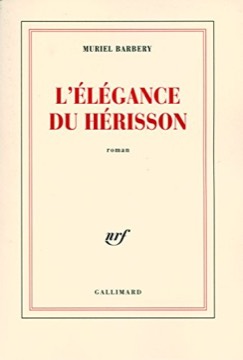
The Elegance of the Hedgehog
Muriel Barbery's 2006 novel about a concierge who conceals her erudition and a twelve-year-old resident who is planning to kill herself, in the same Paris apartment building.
- First published
- 2006
- Publisher
- Gallimard
- Pages
- 359
- Shelf
- Thriller
- Level
- Core
- ISBN-13
- 9783423138147
Record checked against
Catalogue note
- Reads as
- ReflectiveChanges how you see rather than what you do.
- Level
- Core / BuildingAssumes general familiarity with the subject.
- Approach
- Theoretical
- Written for
- Readers who mean to stop at one more chapter, Readers with some grounding
Saved in this browser only — no account, nothing sent anywhere. My library
Read this if
- You read for the writing as much as for the argument.
- You want to examine an assumption you have never examined.
- You want a book that changes how you see things rather than what you do tomorrow.
- You know roughly how the subject works and want the fuller account.
The premise
Renée Michel is the concierge of a wealthy building on the rue de Grenelle. She is fifty-four, widowed, and hides an extensive self-education behind a performance of exactly what her employers expect.
Paloma Josse is twelve, lives on the fifth floor, has concluded that adult life is futile, and intends to kill herself on her thirteenth birthday.
A concierge hiding her reading, and a twelve-year-old with a date set for her own death.
Devmark’s reading — not a quotation from the book
Two voices
The novel alternates between Renée's first-person narration and Paloma's journals, with distinct registers and typographic treatment.
The alternation is strictly maintained and the two voices are genuinely different, which is the book's principal technical achievement. Paloma's journals are also formally divided into profound thoughts and a journal of the movement of the world, which is a device that characterises her precisely.
Class
Renée's concealment is a strategy: she has concluded that a visibly educated concierge would be intolerable to the building's residents and would lose her position.
The observation is sharp and the novel is precise about how thoroughly a class role is enforced by expectation rather than by rule.
Philosophy
Both narrators discuss Husserl, Kant, Tolstoy, Japanese cinema and Dutch still life at length, and the digressions occupy a substantial portion of the book.
Barbery taught philosophy, and the material is genuine rather than decorative. It is also the element that most divides readers. The phenomenology material in particular occupies several chapters, and readers with no patience for it will find those sections genuinely difficult to get through.
Kakuro Ozu
A wealthy Japanese resident moves into the building, recognises Renée's concealment, and treats her as an equal.
His arrival is the plot's engine and his characterisation is the novel's weakest element: he is almost entirely benign and functions as a solution. His name is also a direct reference to the film director, which is characteristic of the novel's habit of signalling its own allusions.
Why it is on this shelf
It is not a crime novel, and it sits here because its central situation is one of sustained concealment with a genuine cost, and because the tension is about whether Renée will be exposed.
The classification is arguable. It is included as suspense in the older sense of the word rather than as a thriller.
Sentiment
The novel is unembarrassedly emotional and its final movement is engineered for maximum effect.
Readers divide sharply on the ending, with a substantial number finding it manipulative and others finding it earned by everything preceding. The final development is also abrupt in a way that several readers have found tonally inconsistent with the two hundred preceding pages of interior reflection.
Japanese aesthetics
Both narrators admire Japanese art, film and manners, and the novel's ideal of restraint and precision is explicitly borrowed.
The treatment has been criticised as idealising, and the objection is reasonable: the Japanese characters are almost uniformly wise. The novel's use of Japan as a repository of refinement is also unexamined, and the country functions largely as an idea rather than as a place.
Its reception
It sold enormously in France and internationally and won several prizes, while attracting criticism from some French critics for what they regarded as middlebrow philosophising.
The divide between its commercial and critical reception is unusually wide. It sold over a million copies in France alone and has been translated into more than forty languages, which is remarkable for a novel this discursive.
Prose
Ornate, aphoristic and heavily punctuated with quotation, in Alison Anderson's translation.
The style is deliberate and is a substantial part of what readers either enjoy or find insufferable, and there is very little middle ground. The aphorisms in particular divide readers, since the book contains a great many sentences plainly written to be quoted separately from it.
The film
A 2009 French adaptation, released as The Hedgehog, simplifies the philosophy considerably and foregrounds the relationship between the two protagonists.
It is gentler than the book and removes most of the intellectual material, which is either a mercy or a gutting depending on the reader.
Who it is for
Readers who want a novel of ideas with a strong emotional situation, and who do not object to extended philosophical digression.
It is the least generically conventional book in this section. Readers looking for a thriller should be clear that it is not one, and readers looking for a novel about hiding will find it substantial.
What to take away
- 01Concealment as strategyRenée hides her education because a visibly cultivated concierge would be intolerable to her employers and would lose her the post.
- 02A class role enforced by expectationNo rule requires her performance; the building's assumptions do, and the novel is precise about the mechanism.
- 03Two registers held apartThe alternation between a fifty-four-year-old's narration and a twelve-year-old's journal is the book's technical achievement.
- 04Philosophy that is not decorativeBarbery taught the subject and the digressions are genuine, which is also the element most likely to lose a reader.
- 05A solution rather than a characterKakuro is almost entirely benign and exists to resolve the situation, which is the novel's weakest construction.
- 06An idealised borrowingThe Japanese aesthetic ideal the book admires produces characters who are uniformly wise, which is a fair criticism.