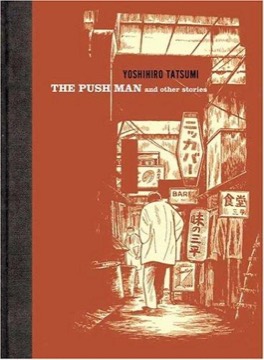
The Push Man and Other Stories
A collection of Yoshihiro Tatsumi's short stories from 1969, published in English in 2005. The gekiga short story at its bleakest.
- First published
- 2005
- Publisher
- Drawn and Quarterly
- Pages
- 224
- Shelf
- Anime
- Level
- Core
- ISBN-13
- 9781896597850
Record checked against
Only one source carried a publication date for this work, so the year is uncorroborated.
Catalogue note
- Reads as
- ReflectiveChanges how you see rather than what you do.
- Level
- Core / BuildingAssumes general familiarity with the subject.
- Approach
- Theoretical
- Written for
- Readers of comics, and anyone curious how the form works, Readers with some grounding
Saved in this browser only — no account, nothing sent anywhere. My library
Read this if
- You read for the writing as much as for the argument.
- You want a book that changes how you see things rather than what you do tomorrow.
- You know roughly how the subject works and want the fuller account.
What it is
Sixteen short stories, most running eight pages, about men at the bottom of Japan's economic expansion: a man paid to push commuters onto trains, a sewer worker, a projectionist in a pornographic cinema, a man who collects discarded objects.
Each is a self-contained situation ending in resignation, violence or nothing.
Sixteen eight-page stories about men with jobs nobody thinks about, in the middle of an economic miracle.
Devmark’s reading — not a quotation from the book
Gekiga
Tatsumi coined the term — dramatic pictures — in 1957 to distinguish adult comics from the children's material the word manga then implied.
These stories are the form at its most characteristic: short, bleak, concerned with ordinary working people, and drawn in a plain style that refuses any decorative appeal.
The economic frame
They are set during Japan's high-growth period, and the prosperity is present in every story as something happening to other people.
The men here service the boom without participating in it, and the collection is a systematic account of who the expansion was built on.
Compression
Eight pages is extremely short for a narrative, and Tatsumi's economy is the technical achievement: a situation, a complication and a conclusion, with almost no dialogue.
Several stories turn entirely on a final image, and the endings are frequently abrupt to the point of seeming unfinished.
Bleakness
There is essentially no consolation. Characters are humiliated, trapped or destroyed, and the stories decline to provide meaning for any of it.
The relentlessness is deliberate and is also the collection's main limitation, since sixteen variations on futility produces diminishing returns. Tatsumi has said he was writing against the optimism of the period, and the uniformity is therefore deliberate rather than a failure of range.
Sex
A large proportion of the stories concern sexual frustration, transactional sex, or violence against women, and the depiction is frequently uncomfortable.
The stories are not endorsing what they show, and they are also not examining it with much curiosity. Readers should expect material that is grim without being interrogated.
The drawing
Plain, slightly crude, with simplified figures and detailed backgrounds — the reverse of the usual emphasis, and deliberate.
The characters are anonymous by design and the environments are specific, which puts the weight on the circumstances rather than on the individuals inside them. Backgrounds are frequently traced from photographs, which was common practice and which contributes to the documentary quality the stories aim for.
Adrian Tomine's editions
Drawn and Quarterly published three collections edited and designed by Adrian Tomine, arranged by year, which is how Tatsumi reached English readers.
The presentation is excellent and the introductions are useful, and the project did a great deal to establish gekiga's reputation outside Japan. Tomine also designed them to read right-to-left at a time when most English manga was flipped, which was a deliberate statement about how the work should be treated.
Historical importance
Tatsumi is a central figure in the medium's development toward adult subject matter, and these stories demonstrate what that shift actually produced.
Their influence runs through alternative comics internationally, and the connection to American underground work of the same period is frequently noted. Tatsumi also worked in the rental library system that supported gekiga commercially, and the stories were produced for that market rather than for a mainstream magazine.
Reading strategy
The collection is better sampled than read straight through, since the stories are tonally uniform and the effect flattens.
Three or four at a time preserves the impact that reading all sixteen consecutively dissipates. The collection is also arranged chronologically rather than thematically, so reading out of order costs nothing and may help sustain the effect across a longer period.
Tatsumi's other work
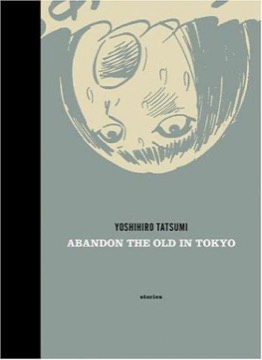
A Drifting Life is his six-hundred-page autobiography about the development of gekiga, and Abandon the Old in Tokyo collects stories from the following year.
The autobiography is the more historically valuable and the short stories are the better artistic achievement. Good-Bye, the third Drawn and Quarterly collection, covers 1971 to 1972 and is the darkest of the three, which is a meaningful claim given the competition.
Who it is for
Readers interested in the medium's history, in the short story as a form, or in post-war Japanese social conditions.
It is short and available, and it is not enjoyable in any ordinary sense. Readers should approach it as documentation of a particular moment and a particular class position.
What to take away
- 01A term coined to separate adult workTatsumi's gekiga distinguished dramatic comics from children's material, and these stories are the form at its most characteristic.
- 02The boom's undersideSet during high growth, the prosperity is present in every story as something happening to other people.
- 03Eight pages, no dialogueExtreme compression with situations turning on a final image is the collection's technical achievement.
- 04Anonymous figures, specific placesSimplified characters against detailed backgrounds put the weight on circumstance rather than individual.
- 05Grim without interrogationThe sexual material is uncomfortable and is neither endorsed nor examined with much curiosity.
- 06Better sampled than finishedSixteen tonally uniform stories flatten in sequence, and a few at a time preserves the impact.