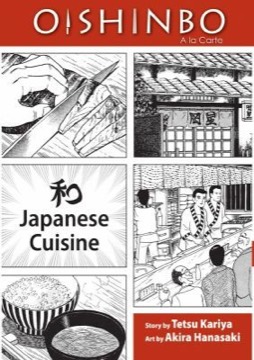
Oishinbo
A La Carte, Vol. 1: Japanese Cuisine
Tetsu Kariya and Akira Hanasaki's series, begun in 1983, in which a newspaper journalist is assigned to compile the ultimate menu. The founding work of food manga.
- First published
- 1983
- Publisher
- Shōgakkan
- Pages
- 311
- Shelf
- Anime
- Level
- Core
- ISBN-13
- 9784091925305
Record checked against
Catalogue note
- Reads as
- PracticalWritten to be applied, not only understood.
- Level
- Core / BuildingAssumes general familiarity with the subject.
- Approach
- Practical
- Written for
- Readers of comics, and anyone curious how the form works, Readers with some grounding
Saved in this browser only — no account, nothing sent anywhere. My library
Read this if
- You read for the writing as much as for the argument.
- You make things, and want to understand the work rather than wait for inspiration.
- You want something to apply, not only something to think about.
- You know roughly how the subject works and want the fuller account.
What it is
Shirō Yamaoka, an idle journalist at a Tokyo newspaper, is assigned to a project creating the Ultimate Menu for the paper's anniversary. His estranged father, a celebrated gourmet and ceramicist, is developing a rival Supreme Menu.
Each chapter presents a culinary problem — an ingredient, a technique, a disputed preparation — and resolves it through demonstration and argument.
A newspaper project to define the ultimate menu, and a father competing to do it better.
Devmark’s reading — not a quotation from the book
The format
Chapters are self-contained and follow a reliable pattern: a dispute arises, someone is wrong about food, and Yamaoka corrects them by producing something that settles the matter.
The repetition is the point. The series ran for over a hundred volumes on this structure and the reader's pleasure is in the information rather than in any development.
Food as information
The series is genuinely didactic: water quality, rice varieties, dashi technique, knife work, regional differences and the seasonality of ingredients are all explained at length.
It functions as a culinary education, and a substantial number of Japanese readers report learning to cook from it. It also covers the economics of ingredients: what a good fish costs, why a particular producer charges what they do, and who along the chain is being underpaid.
The father
Yūzan Kaibara is imperious, contemptuous and frequently correct, and the relationship with his son is the series' only sustained emotional thread.
The antagonism has a genuine cause in the mother's treatment, and the series returns to it periodically without ever fully resolving it. Kaibara is also consistently rude to everyone, which the series presents as the privilege of being right, and the joke wears thinner across a hundred volumes.
Culinary nationalism
The series is strongly committed to Japanese ingredients and traditional technique, and is frequently dismissive of foreign food and of industrialisation.
The position is stated rather than argued, and readers should expect a consistent line that is closer to advocacy than to enquiry. Several storylines are actively hostile to imported ingredients and to convenience food, and readers coming to it for information should expect that position throughout.
The English edition
Viz published seven themed volumes — sake, ramen, vegetables, fish, izakaya food, rice, and pub food — selected from across the run rather than translating it sequentially.
The arrangement works well, since the series is episodic and the themed selection produces coherent volumes. The volumes also include brief explanatory notes on ingredients and terms that have no English equivalent, which are genuinely necessary for several of the chapters.
The art
Hanasaki's drawing is functional and food-focused: characters are unremarkable and the dishes are rendered with considerable care.
The priority is clear. The series is not visually ambitious and does not need to be, since the information is what readers come for. Hanasaki also draws the preparation rather than only the result, which is what makes the series usable as instruction rather than merely as description.
Its influence
Nearly every subsequent food manga descends from it, and the genre it established is substantial in Japan and increasingly visible internationally.
The structure — a problem, an expert, a demonstration — has been reproduced across cooking, wine, coffee and a great many other subjects. Its commercial effect was also substantial: restaurants featured in it reported large increases in custom, and the series was credited with shifting consumption of particular ingredients.
The Fukushima controversy
In 2014 a storyline depicting nosebleeds attributed to radiation exposure near Fukushima caused substantial public controversy, and the series went on indefinite hiatus afterwards.
The episode is worth knowing about, since it ended the run and involved claims that were widely disputed by medical authorities.
Length
More than a hundred volumes in Japanese, of which a small fraction exists in English.
The English reader encounters a curated sample rather than the work, and should treat the themed volumes as an introduction to a format rather than to a narrative. The Japanese run also continued for three decades, so the English volumes span a considerable period of the series' own development without indicating where each chapter falls.
Tone
It is earnest, opinionated and frequently very funny about the seriousness with which its characters treat food.
The comedy is largely unintentional from inside the story and entirely deliberate from outside it, which is a difficult balance the series manages consistently. Characters routinely declare that a badly made dish is an insult to the ingredient, and the series means this entirely, which is what makes it funny and also what makes it work.
Who it is for
Readers interested in Japanese food, in cooking generally, or in how a didactic comic works.
The themed English volumes are short, cheap and immediately useful, and they are among the few manga in this section that a reader might genuinely consult rather than read. It is also unusually cheap for what it contains, and the individual themed volumes can be bought singly according to interest.
What to take away
- 01A reliable repeated structureA dispute, an expert and a demonstration, repeated across more than a hundred volumes, with information as the reward.
- 02Genuinely didacticWater quality, rice varieties and dashi technique are taught at length, and readers report learning to cook from it.
- 03Advocacy rather than enquiryThe commitment to Japanese ingredients and traditional technique is stated rather than argued, and dismissiveness about foreign food is consistent.
- 04A founding genre textAlmost all subsequent food manga descends from it, and the format has spread to wine, coffee and many other subjects.
- 05A curated English sampleSeven themed volumes selected from across the run, which suits the episodic structure and is not the whole work.
- 06Ended by controversyA 2014 storyline about radiation effects near Fukushima caused disputes with medical authorities and the series went on hiatus.